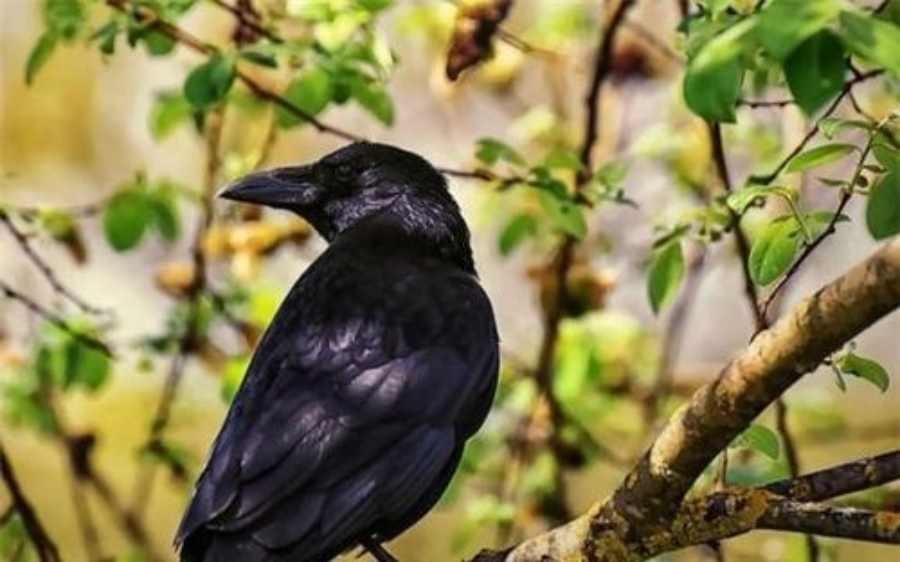
Seeing a raven is commonly associated with transformation, wisdom, intuition, mystery, endings, and new beginnings in spiritual symbolism. Rather than carrying one fixed message, a raven’s meaning depends on the circumstances of the encounter, including what the bird is doing, how many ravens appear, whether the sighting repeats, and what is happening in your life at the time.
Ravens have complex symbolism because they are connected with both darkness and insight. Their black plumage and association with death have led some traditions to connect them with endings, loss, and the unknown. At the same time, their intelligence, observational behavior, and prominent roles in mythology have made them symbols of knowledge, awareness, transformation, and spiritual insight. Seeing a raven therefore does not automatically mean that something bad will happen.
The spiritual meaning can also change when a raven crosses your path, visits your home, stares at you, follows you, or repeatedly appears around you. Seeing one raven may carry a different interpretation from seeing two or several ravens. Cultural context matters as well because Norse, Celtic, Christian, and other spiritual traditions do not interpret ravens in exactly the same way. Understanding these differences provides a clearer way to interpret what seeing a raven may symbolize for you.
What Does Seeing a Raven Mean Spiritually?
Seeing a raven spiritually represents transformation, wisdom, intuition, mystery, endings, new beginnings, and self-reflection. These meanings come from the raven’s long-standing association with intelligence, darkness, death, hidden knowledge, and transition. The exact interpretation depends on what happens during the encounter and what is occurring in your life when the raven appears.
Transformation is one of the strongest spiritual meanings associated with seeing a raven. Ravens are frequently connected with death and darkness, but spiritual interpretations do not have to treat death literally. Death can symbolize the end of a relationship, belief, habit, identity, career stage, or other period of life. In this context, seeing a raven can represent the transition between an ending and whatever develops afterward. A person leaving an unfulfilling career, for example, might interpret a raven encounter as a symbol of releasing an old identity before entering a new phase.
Wisdom and intelligence form another major layer of raven symbolism. Ravens are highly intelligent birds capable of problem-solving, remembering information, and responding flexibly to their surroundings. These observable characteristics have helped make the raven a symbol of knowledge and careful observation. Spiritually, seeing one can therefore serve as a reminder to examine a situation before reacting to it. When important information is unclear, the symbolism points toward observation and discernment rather than impulsive action.
Intuition and mystery are closely connected to this meaning. The raven’s dark appearance and historical associations with the unknown have made it a natural symbol for things that are hidden or not yet understood. A raven encounter can consequently be interpreted as an invitation to pay closer attention to instincts, recurring thoughts, overlooked details, or emotions that have not been fully acknowledged. This interpretation does not mean that the bird reveals supernatural knowledge about the future. Instead, the raven functions symbolically as a prompt to notice information that may already be present but has not received enough attention.
Seeing a raven can also symbolize self-reflection. Difficult transitions often require a person to examine what needs to be retained and what needs to be released. Raven symbolism fits this process because it combines endings with intelligence and awareness. For example, encountering a raven during a major relationship change may be interpreted as an opportunity to examine repeated patterns, personal boundaries, or lessons from the relationship rather than as a prediction about what will happen next.
The spiritual meaning of a raven is therefore contextual rather than fixed. A raven appearing once while feeding near your home does not necessarily carry the same personal significance as repeated encounters during a major period of change. Its behavior, the number of ravens present, the frequency of the sightings, your emotional response, and the spiritual tradition through which you interpret the bird all influence the meaning you may assign to the experience.
Is Seeing a Raven a Good or Bad Omen?
Seeing a raven is not inherently a good or bad omen. Raven symbolism contains both positive and darker associations, including wisdom, protection, transformation, death, uncertainty, and warning. Whether an encounter feels positive or negative depends largely on its context and the symbolic framework used to interpret it.
A raven can be viewed as a positive sign when its appearance is connected with growth, insight, resilience, or a necessary transition. An ending is not always a negative event. Leaving an unhealthy situation, abandoning an outdated belief, or completing a difficult stage of life can create the conditions for a new beginning. Under this interpretation, the raven represents the transition itself rather than a promise that a specific positive event will occur.
Ravens can also carry warning symbolism. In this context, a warning does not necessarily predict danger. It can instead represent a need for greater awareness. Seeing a raven during a confusing situation might encourage reflection on information that has been ignored, a decision that has been rushed, or a pattern that continues to create problems. The practical value of this interpretation comes from using the encounter as a prompt for observation rather than treating it as proof that misfortune is approaching.
The idea that ravens are always bad omens largely comes from their historical connections with death, battlefields, carrion, darkness, and the unknown. These associations have given ravens an ominous reputation in parts of folklore and popular culture. However, the same bird has also represented knowledge, memory, intelligence, and powerful spiritual figures in other traditions. A single universal interpretation therefore cannot accurately represent every spiritual or cultural context.
Does Seeing a Raven Mean Death?
Seeing a raven does not mean that someone is going to die. The connection between ravens and death is primarily symbolic, cultural, and historical rather than a reliable prediction of literal death.
Ravens are scavengers and can feed on carrion, which historically brought them into environments associated with dead animals and human conflict. Their black feathers further strengthened associations with darkness, mourning, and mortality. Over time, these characteristics contributed to the raven becoming a recognizable symbol of death in folklore, mythology, literature, and spiritual imagery.
In spiritual interpretation, however, death frequently represents an ending rather than physical death. The end of a relationship, a change in identity, the completion of a life stage, or the release of an old belief can all be described symbolically as forms of death because something established is ending. The next stage of this symbolic sequence is transformation or renewal.
For this reason, seeing a raven during a major transition can be interpreted as ending → release → transformation → new beginning. Someone moving to a new country, ending a long-term relationship, changing careers, or abandoning an old way of living may find this symbolism personally relevant. The raven does not establish what will happen next; it provides a symbolic framework through which the transition can be reflected upon.
Treating every raven sighting as a prediction of death also removes the broader meanings attached to the bird. Wisdom, observation, mystery, transformation, resilience, and awareness are equally important parts of raven symbolism. The context of the encounter should therefore guide interpretation instead of the assumption that a raven automatically represents death.
What Do Different Raven Encounters Mean Spiritually?
Different raven encounters can symbolize awareness, transition, self-reflection, intuition, or the need to examine a situation more carefully. The interpretation changes according to the raven’s behavior because a bird crossing your path creates a different symbolic context from one repeatedly visiting your home, staring at you, following you, or flying overhead. The encounter itself provides the micro-context for interpreting the broader spiritual symbolism of the raven.
A raven visiting you can symbolize attention and awareness, particularly when the encounter feels unusual or occurs repeatedly. A raven that regularly appears near your home, garden, balcony, or another familiar location may feel more personally significant than a raven briefly seen in the distance. Spiritually, this type of encounter can be interpreted as a prompt to observe what is currently demanding your attention. For example, repeated visits during a period of uncertainty may encourage you to examine a decision, unresolved issue, or approaching transition more carefully. The interpretation should remain separate from the raven’s natural behavior, however, because food sources, nesting areas, curiosity, and learned routines can also explain repeated visits.
A raven crossing your path is commonly interpreted through the symbolism of direction and transition. A path represents movement from one state or place to another, while the raven represents themes such as transformation, intelligence, mystery, and awareness. Together, these symbols can represent a moment when your current direction deserves closer examination. If you encounter a raven while considering a career change, ending a relationship, moving somewhere new, or making another consequential decision, the experience can serve as a symbolic reminder to evaluate where your present choices are leading.
A raven staring at you carries a different symbolic emphasis because eye contact naturally directs attention toward observation. A raven staring at you can symbolize self-awareness, careful observation, and the need to notice something you have overlooked. This interpretation aligns with the raven’s broader association with intelligence and attentiveness. Rather than assuming that the bird is transmitting a supernatural message, consider what was occupying your thoughts immediately before the encounter. A persistent concern, ignored emotion, or unresolved decision may provide more useful context for interpreting why the experience felt meaningful.
Being followed by a raven can symbolize an issue, thought, or transition that continues to demand attention. Repetition is the central attribute in this type of encounter. If the same experience appears to occur several times, it may feel as though the symbolism is following you just as the bird appears to be doing. Spiritually, this can represent a subject that has not yet been resolved or understood. From a practical perspective, ravens are intelligent animals whose behavior can also be influenced by food, territory, curiosity, or previous interactions with people. Both contexts should be considered before assigning a spiritual explanation.
A raven flying over you can symbolize perspective and transition. Flight naturally creates an association with seeing from above, while movement across the sky represents passage from one place to another. Within spiritual symbolism, this encounter can therefore be interpreted as a reminder to step outside an immediate problem and consider its wider context. A person caught in a disagreement, for example, might use the encounter as a prompt to examine the situation beyond the emotions of the moment and consider its longer-term consequences.
The most useful interpretation comes from combining the raven’s behavior with your circumstances. A single behavior does not create a universal message. Location, timing, repetition, number of ravens, emotional response, and current life events provide the context needed to interpret a raven encounter. This approach preserves the symbolic value of the experience without treating ordinary animal behavior as definite evidence of supernatural intervention.
Why Do I Keep Seeing Ravens?
Repeatedly seeing ravens can be interpreted spiritually as a recurring prompt to pay attention to transformation, intuition, unresolved issues, or changes taking place in your life. Repetition can make an encounter feel more significant because the same symbol continues to appear within your awareness. However, repeated raven sightings can also have straightforward environmental or behavioral explanations, so frequency alone does not prove that a spiritual message is being sent.
There are several details that make repeated sightings more meaningful within a spiritual interpretation. Frequency is the first: seeing ravens several times within a short period may attract more attention than an isolated encounter. Location is another factor because repeatedly encountering ravens in the same place creates a different context from seeing different birds while traveling through areas where ravens naturally live. Behavior also matters. A raven repeatedly approaching, calling nearby, or appearing at a particular moment may feel more personally relevant than birds simply flying in the distance.
Timing provides another important layer of context. Repeated raven encounters during a major transition can become associated with the emotional or psychological meaning of that period. For example, someone repeatedly noticing ravens while preparing to leave a long-term job may connect the sightings with endings and transformation. Someone processing an unresolved decision may instead associate them with observation and intuition. In both examples, the same central entity—the raven—acquires a different interpretation because the person’s circumstances change the context.
Your emotional response can also explain why particular sightings stand out. Feeling curious, calm, unsettled, or unusually attentive during an encounter affects the meaning you assign to it. An encounter that immediately brings an unresolved concern to mind can function as a prompt for reflection. This does not establish that the raven caused the thought or intentionally delivered a message. It means the encounter has become a symbol through which an existing concern can be examined.
Natural explanations should remain part of the interpretation. Ravens may repeatedly appear because an area provides food, water, shelter, nesting opportunities, or suitable habitat. Their intelligence also allows them to learn routines and respond to their surroundings. If ravens appear around your home at approximately the same time each day, for example, a consistent food source may provide a simpler explanation than a spiritual cause.
The spiritual and practical interpretations do not have to cancel each other out. An encounter can have an ordinary biological cause and still hold personal symbolic meaning. The key distinction is between interpreting an experience and claiming that it objectively predicts an event. If repeated raven sightings encourage you to recognize a transition, examine an unresolved problem, or become more observant of your choices, their spiritual value comes from the reflection they inspire rather than from certainty about why the birds appeared.
What Does the Number of Ravens You See Mean Spiritually?
The number of ravens you see can change the spiritual interpretation of the encounter, with one raven emphasizing individual awareness, two emphasizing duality or partnership, and three or more emphasizing collective energy, communication, or a larger transition. These meanings are symbolic rather than universal rules. The raven’s behavior, the circumstances of the sighting, and the spiritual tradition used for interpretation remain important when deciding whether the number feels significant.
Number-based interpretations add another layer to raven symbolism because quantity changes the context of an encounter. One raven naturally places attention on a single figure, while two introduce a relationship between two figures. A larger group shifts attention toward collective behavior. This means the symbolism does not need to come from the number alone; it can also develop from what the number changes about the experience.
What Does Seeing One Raven Mean?
Seeing one raven can symbolize independence, introspection, personal transformation, and heightened awareness. A solitary raven places the symbolic focus on the individual, making the encounter particularly relevant to situations involving personal decisions, identity, or inner reflection.
For example, seeing one raven while reconsidering your direction in life may be interpreted as a reminder to rely less on outside opinions and examine what you already know about the situation. The raven’s associations with intelligence and observation strengthen this interpretation. Instead of predicting which decision you should make, the encounter can symbolize the need to gather information, recognize your own motives, and determine what needs to change.
A solitary raven can also represent an ending that must be processed individually. Leaving a familiar environment, changing a personal belief, or releasing an old habit can create a period in which the previous identity no longer fits but the new one is not yet fully established. Raven symbolism connects naturally with this transitional state because endings, mystery, and transformation are closely related themes.
Seeing one raven should not automatically be interpreted as loneliness, death, or misfortune. The meaning depends on the context surrounding the encounter. A solitary raven appearing during a period of personal growth may carry a substantially different symbolic meaning from the same bird appearing during grief or uncertainty.
What Does Seeing Two Ravens Mean?
Seeing two ravens can symbolize partnership, balance, duality, cooperation, or a relationship that requires attention. The presence of two birds shifts the interpretation from individual awareness toward the relationship between two sides, people, ideas, or possible directions.
This symbolism can be relevant when relationships are already central to your circumstances. For example, seeing two ravens while working through a disagreement with a partner may prompt reflection on communication, mutual understanding, or balance within the relationship. During a decision between two alternatives, the same encounter may instead symbolize competing directions that need to be evaluated.
Two ravens can also represent the relationship between opposing but complementary ideas. Endings exist alongside beginnings, intuition alongside reason, and uncertainty alongside discovery. Because raven symbolism already contains contrasting themes such as darkness and wisdom, seeing a pair can reinforce the idea that two apparently opposing elements may need to be considered together.
The meaning should not be reduced to a fixed prediction about romance, marriage, or future relationships. Two ravens observed together may simply be behaving naturally. Spiritually, their value comes from the symbolic association that the encounter creates within the observer’s existing circumstances.
What Does Seeing Three or More Ravens Mean?
Seeing three or more ravens can symbolize community, communication, collective change, or a situation involving influences beyond one individual. A group changes the focus from personal or paired symbolism toward relationships within a wider social environment.
Ravens are social and communicative birds, making a group encounter naturally compatible with themes of cooperation, social awareness, and collective behavior. Spiritually, seeing several ravens may prompt reflection on your role within a family, friendship group, workplace, community, or another network. For example, encountering a group of ravens during a period of workplace change might symbolize the need to consider how a transition affects the entire group rather than focusing only on your individual position.
Some spiritual and folkloric systems assign specific meanings to individual numbers. Those interpretations should be understood within the tradition that produced them rather than treated as universal rules for every raven encounter. Seeing three ravens does not objectively guarantee one outcome, just as seeing a larger group does not establish that a specific event is approaching.
The most useful number-based interpretation therefore considers quantity together with behavior and context. One quiet raven, two interacting ravens, and a large group calling loudly create three different encounters. The number contributes to the symbolism, but it does not determine the meaning by itself.
What Does Seeing a Raven Mean During Major Life Changes?
Seeing a raven during a major life change can symbolize an ending, transition, release, self-reflection, or the beginning of a new phase. This interpretation follows one of the central themes of raven symbolism: transformation. Major changes create a natural boundary between what existed before and what comes afterward, making the raven particularly relevant as a symbol of transition.
Seeing a raven after a loss can carry symbolism related to grief, remembrance, acceptance, and the process of moving through an ending. Loss may involve the death of someone important, but it can also involve a relationship, friendship, home, job, opportunity, or version of life that no longer exists. The raven’s association with death makes it understandable that the bird can feel especially significant during these periods. However, seeing one should not be presented as evidence that a deceased person is communicating through the bird. The encounter can hold personal spiritual meaning without establishing a supernatural cause.
The symbolism of transformation becomes especially relevant when starting a new chapter. A career change, relocation, graduation, new relationship, separation, or major change in personal identity requires leaving at least part of an earlier stage behind. In this context, a raven can symbolize the threshold between the old and the new. For example, noticing a raven while preparing to move to another city may become personally associated with leaving familiar circumstances and entering an uncertain environment.
Seeing a raven during a difficult decision can emphasize observation and discernment rather than transformation alone. Important decisions frequently contain incomplete information, competing priorities, and uncertainty about consequences. Because ravens are strongly associated with intelligence and attentiveness, the encounter can function symbolically as a reminder to examine details before committing to a direction. This interpretation favors careful judgment over treating the raven as an instruction to choose a particular option.
A raven encounter can also feel significant when an internal change is occurring without an obvious external event. Changing beliefs, recognizing an unhealthy pattern, establishing stronger boundaries, or reconsidering personal priorities can alter a person’s identity even when circumstances appear unchanged from the outside. The raven’s association with mystery and hidden knowledge fits these quieter forms of transformation because the most important change may initially be internal.
The emotional response to the encounter helps identify which interpretation is most relevant. Feeling peaceful may connect the raven with acceptance or readiness for change. Feeling unsettled may point toward uncertainty, unresolved concerns, or resistance to an ending. Feeling curious may align more closely with discovery and self-reflection. The emotion does not prove that the raven carries a specific message, but it reveals which part of the encounter has become personally meaningful.
Ultimately, seeing a raven during a major life transition is best interpreted as a symbol for reflection rather than a prediction of the outcome. The raven can represent what is ending, what needs attention, or the uncertainty that exists before a new phase becomes clear. Its spiritual significance lies in helping frame the transition, while the decisions that follow still depend on your circumstances, information, and actions.
What Does a Raven Symbolize in Different Spiritual Traditions?
Ravens symbolize different concepts across spiritual and religious traditions, including knowledge, memory, prophecy, death, divine provision, and transformation. There is no single ancient or universal spiritual meaning of a raven. Each tradition developed its symbolism within a different religious, mythological, and cultural context, so these interpretations should remain distinct rather than being combined into one meaning.
This distinction is important when interpreting a raven encounter. Modern spiritual interpretations frequently associate ravens with transformation, intuition, and hidden knowledge, but those meanings do not automatically represent what every historical tradition believed. Looking at individual traditions provides a more accurate picture of why raven symbolism contains both positive and ominous associations.
What Do Ravens Symbolize in Norse Mythology?
In Norse mythology, ravens are strongly associated with Odin and symbolize knowledge, thought, memory, and the gathering of information. Odin is accompanied by two ravens, Huginn and Muninn, who fly across the world and return with information. Their relationship with Odin helped establish the raven as an important symbol of observation and knowledge within a Norse context.
Huginn and Muninn are commonly connected with thought and memory or mind, reinforcing the raven’s association with mental awareness rather than simply darkness or death. Their role involves traveling, observing, and returning to Odin, creating a symbolic relationship between the raven and the acquisition of knowledge. This context helps explain why modern interpretations often connect seeing ravens with paying closer attention to information and observing circumstances carefully.
Ravens also appear within a broader Norse context involving Odin, warfare, death, and the battlefield. These associations add a darker dimension without making the raven exclusively a symbol of misfortune. Knowledge and death can exist within the same symbolic system, which illustrates why reducing raven symbolism to either a “good sign” or a “bad sign” removes much of its original complexity.
For someone using Norse mythology as a spiritual framework, seeing a raven may therefore evoke themes of knowledge, observation, memory, or Odin. This is a tradition-specific interpretation, however, rather than evidence that every raven encounter is a message from Odin.
What Do Ravens Symbolize in Celtic Traditions?
Ravens in Celtic traditions are associated with themes such as warfare, death, prophecy, sovereignty, and supernatural knowledge, although the precise symbolism depends on the specific story and cultural context. Celtic material covers different peoples, periods, and bodies of mythology, so “Celtic raven meaning” should not be treated as one fixed belief shared everywhere.
One important association comes from Irish mythology, where raven and crow imagery can appear alongside figures connected with warfare, fate, sovereignty, and death. The Morrígan is particularly relevant to this symbolic context and is associated with battle and ominous events in Irish narrative tradition. This connection contributed to the broader modern association between dark corvids, conflict, prophecy, and major transitions.
The symbolism of death in this context does not require every modern raven sighting to be interpreted as a prediction of physical death. Historical mythological imagery and contemporary personal spirituality serve different functions. Someone drawing inspiration from Celtic or Irish mythology might view a raven encounter as a symbol of confrontation, transformation, power, or an approaching turning point without assuming that the bird predicts a literal event.
Specific sources and traditions should therefore guide interpretation. Using “Celtic” as a general label for every raven belief risks combining separate traditions into a single spiritual system that historically did not exist.
What Do Ravens Symbolize in the Bible and Christianity?
In the Bible, ravens are associated with both desolation and divine provision, making their symbolism more complex than a simple representation of evil or death. Biblical references should be interpreted within their scriptural context rather than through modern raven symbolism.
One of the best-known raven appearances occurs in the story of Noah. After the flood, Noah sends out a raven from the ark. The episode places the bird within a narrative involving destruction, survival, and the changing conditions of the world after the flood. The raven’s presence therefore belongs to a specific biblical narrative rather than establishing a universal rule about what seeing a raven means.
Another important biblical theme is divine provision. Ravens are used in narratives and teachings to demonstrate that creatures can receive sustenance through God’s provision. This creates a markedly different association from the popular image of the raven as purely ominous. Within a Christian reading, the bird can therefore appear in contexts involving dependence, provision, and trust as well as wilderness and desolation.
These biblical references do not establish that encountering a raven today carries a specific prophetic message. A Christian interpretation may use the encounter as a reminder of scriptural themes, but that is different from claiming that the bird predicts an event or communicates a guaranteed divine instruction.
The contrast between Norse, Celtic, and Christian contexts demonstrates why raven symbolism should always be qualified. A raven can be associated with knowledge in one framework, warfare or fate in another, and divine provision in another. The tradition used to interpret the raven changes the meaning of the symbol.
Are Ravens and Crows Spiritually the Same?
Ravens and crows are not spiritually identical, even though their symbolism overlaps significantly. Both are dark-colored, intelligent corvids and have accumulated associations with mystery, death, transformation, intelligence, observation, and the unknown. However, they are different birds, and their cultural symbolism does not always develop in the same way.
The overlap explains why raven and crow meanings are frequently confused. Both birds can appear black from a distance, both display sophisticated behavior, and both occur in folklore and mythology. In spiritual content, this similarity often leads broad concepts such as change, intuition, intelligence, and warning to be applied to both animals without distinguishing the source of each interpretation.
Raven symbolism tends to carry particularly strong associations with mystery, transformation, knowledge, death, and specific mythological figures such as Odin’s Huginn and Muninn. Crow symbolism also includes intelligence, change, observation, and death-related imagery, but its meanings depend on the tradition and encounter being discussed. Neither bird has one universally accepted spiritual definition.
Identifying the bird can therefore improve the precision of an interpretation. Ravens are generally larger and heavier than crows, with physical and vocal differences that can help distinguish them in places where both occur. These biological differences do not determine spiritual meaning, but they help establish which central entity the encounter actually involves before symbolism is applied.
Context remains more important than simply choosing a list of meanings for either bird. If you see a raven, interpret the raven encounter according to its behavior, number, timing, personal context, and relevant spiritual tradition rather than automatically substituting crow symbolism. The similarities between the two birds can explain overlapping themes, but their identities and cultural histories should remain distinct.
How Should You Interpret Seeing a Raven?
Interpret seeing a raven by considering six factors: the type of encounter, the raven’s behavior, the number of ravens, repetition, timing, and your personal or spiritual context. No single raven meaning applies to every sighting. A raven crossing your path during a major transition creates a different symbolic context from several ravens regularly feeding near your home.
Start with the encounter itself. Remember where you saw the raven and what happened before, during, and immediately after the sighting. A raven crossing your path can emphasize direction or transition, while a raven remaining nearby may draw attention toward observation and awareness. A bird flying overhead can evoke perspective or movement. These interpretations come from combining the behavior you observed with established symbolic themes rather than assigning the same message to every raven.
Next, consider the raven’s behavior. Notice whether the bird was flying, calling, watching you, approaching, feeding, or interacting with other ravens. Behavior provides context because it changes what stands out about the encounter. A raven quietly watching from a tree creates an experience centered on observation, while several vocal ravens interacting together create stronger associations with communication and collective activity.
Consider the number of ravens as a secondary layer of interpretation. One raven can direct attention toward individuality, introspection, and personal transformation. Two ravens can emphasize partnership, duality, or balance. Three or more can shift the symbolic focus toward community, communication, or collective change. Number symbolism should support the interpretation of the encounter rather than override everything else that happened.
Repetition is also important. A single sighting may simply become meaningful because it occurred at an emotionally significant moment. Repeated encounters can create a stronger personal association, particularly when they happen during the same period of change or reflection. However, repeated sightings also have natural explanations. Ravens may return to locations that consistently provide food, water, shelter, nesting opportunities, or other useful resources.
Timing provides another layer of meaning. Ask what was happening in your life when you noticed the raven. A sighting during a career transition may connect naturally with transformation and new beginnings. An encounter during grief may bring themes of endings, remembrance, and acceptance to the foreground. Seeing a raven while facing an unresolved decision may instead make wisdom, observation, and intuition feel more relevant.
Your spiritual framework should be considered last because the same raven can carry different associations across traditions. Norse mythology connects ravens strongly with Odin, knowledge, thought, memory, and observation. Other cultural and religious contexts emphasize different attributes, including warfare, death, fate, wilderness, or divine provision. Using the tradition you actually follow creates a more coherent interpretation than combining unrelated beliefs into a single universal raven message.
Personal reflection can then connect these factors. Ask which aspect of the encounter felt significant and why it attracted your attention. If the raven appeared while you were already questioning a relationship, career, belief, or direction in life, the symbolism may provide a useful framework for examining that concern. The goal is not to force the experience into a predetermined meaning but to identify which symbolic attribute best matches its context.
You should not treat seeing a raven as a guaranteed prediction of death, misfortune, good luck, or another future event. Spiritual symbolism provides a framework for reflection and meaning-making, not objective proof that a particular outcome will occur. Ravens are real animals with natural behaviors, and an ordinary biological explanation for a sighting can exist alongside the personal significance you give the experience.
The clearest interpretation therefore follows a simple sequence: identify what happened, observe the raven’s behavior, note how many ravens appeared, consider whether the encounter has repeated, connect the timing with your current circumstances, and interpret the experience within a relevant spiritual tradition. This approach preserves the spiritual meaning of seeing a raven without turning symbolic associations into fixed predictions.