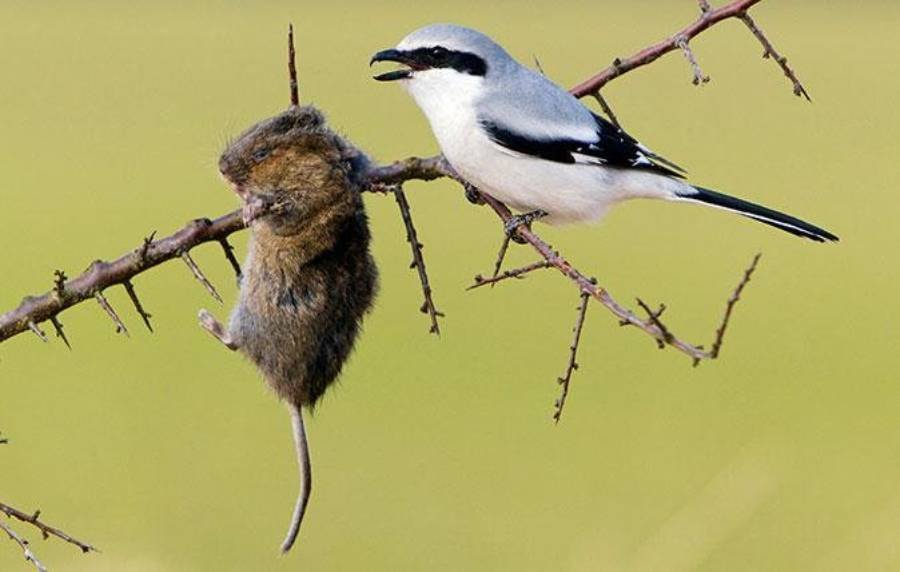
The shrike spiritually symbolizes patience, precision, strategy, hidden strength, independence, protection, and survival. Although it is a relatively small bird, the shrike is an efficient predator that watches its surroundings carefully, selects the right opportunity, and acts with remarkable accuracy. These traits give the bird a spiritual association with purposeful patience: waiting is valuable when it leads to clear and decisive action.
Shrike symbolism also reflects the contrast between appearance and capability. Its modest size can represent strength that is not immediately visible, while its hunting behavior represents focus, resourcefulness, and the willingness to protect what matters. Seeing a shrike can therefore serve as a symbolic reminder to observe a situation before responding, establish clear boundaries, conserve valuable resources, and direct energy toward a specific goal.
The meaning changes with context. A shrike encounter may emphasize timing or protection, while a shrike spirit animal can represent independence and strategic thinking. In dreams, the bird’s behavior can shift the interpretation toward conflict, patience, opportunity, or controlled strength. Understanding these meanings begins with the shrike’s distinctive traits and how they translate into spiritual symbolism.
What Does a Shrike Mean Spiritually?
A shrike spiritually represents patience, precision, strategic action, hidden strength, independence, protection, and survival. These meanings come largely from the contrast between the bird’s small appearance and its highly effective predatory behavior. Rather than relying on size or obvious physical power, a shrike observes its surroundings, identifies an opportunity, and acts with purpose.
The shrike’s connection with patience is especially important because its symbolism is not about passive waiting. It represents purposeful observation before action. In a spiritual context, this pattern can symbolize the value of gathering information, recognizing the right moment, and committing to a decision once the circumstances are clear. The message is relevant when a person is caught between acting impulsively and delaying a necessary choice.
The bird also carries symbolism connected with self-reliance and resourcefulness. Shrikes hunt independently and use their environment to handle and store prey, including placing prey on thorns or other sharp objects. Symbolically, this behavior connects the shrike with using available resources intelligently rather than depending entirely on external support. Its strength comes from strategy as much as physical capability.
For this reason, shrike symbolism combines two qualities that can appear contradictory: restraint and decisiveness. The shrike represents knowing when to remain still and when to act without hesitation. Spiritually, it points toward controlled strength rather than aggression for its own sake.
What Are the Main Spiritual Meanings of a Shrike?
There are 7 main spiritual meanings associated with the shrike: patience, precision, strategy, hidden strength, independence, protection, and survival. Each meaning reflects a recognizable characteristic of the bird and provides a different way to interpret shrike symbolism.
Patience is one of the strongest spiritual meanings of the shrike. The bird’s hunting behavior depends on watching its environment and recognizing an appropriate opportunity before committing to an attack. Spiritually, this represents deliberate waiting rather than inactivity. The lesson is to avoid forcing an outcome before the necessary information, resources, or timing is available.
Precision represents directing effort toward a clearly defined objective. A shrike does not symbolize scattered action because successful hunting requires identifying and pursuing a specific target. In personal terms, this symbolism applies when attention is divided among competing priorities. The shrike represents narrowing that attention and putting energy into the goal that matters most.
Strategy represents thinking before acting. This meaning extends beyond patience because waiting alone does not create progress. The symbolic pattern of the shrike is observation followed by selection and action. A person facing a difficult decision can interpret this symbolism as a reminder to understand the situation first, choose a course deliberately, and then follow through.
Hidden strength represents capability that is greater than outward appearance suggests. Shrikes are relatively small birds, yet they are capable predators. This contrast makes the bird a fitting symbol for inner strength, underestimated ability, and confidence based on competence rather than appearance. The spiritual lesson is not that size or dominance creates strength, but that effectiveness can come from skill, timing, and determination.
Independence represents trusting personal judgment and developing self-reliance. Shrike symbolism emphasizes the ability to observe conditions and respond without waiting for constant approval from others. This does not mean rejecting cooperation. Instead, it represents knowing when a decision belongs to you and accepting responsibility for the action that follows.
Protection represents maintaining clear boundaries around what matters. The shrike’s territorial and predatory traits give this symbolism a firmer quality than simple defensiveness. Spiritually, protection can mean identifying which relationships, commitments, values, or resources deserve your attention and preventing unnecessary demands from consuming them. Healthy boundaries protect priorities without requiring unnecessary hostility.
Survival represents resourcefulness, preparation, and adaptation. The shrike’s distinctive use of its environment, including thorns and other sharp structures for handling or storing prey, creates a strong symbolic connection with making practical use of available resources. Spiritually, this meaning becomes relevant during periods of uncertainty: survival does not depend only on possessing more resources, but also on recognizing how to use what is already available.
Together, these 7 meanings create a consistent spiritual pattern. The shrike symbolizes controlled power: observe carefully, protect what matters, use resources intelligently, and act precisely when the right moment arrives. Its symbolism favors purposeful action over impulsiveness and strategic patience over indefinite waiting.
What Does It Mean Spiritually When You See a Shrike?
Seeing a shrike spiritually symbolizes a need to observe carefully, identify what matters, wait for the right moment, and then act decisively. The meaning comes from the shrike’s combination of patience and precision. Instead of representing action for its own sake, an encounter with this bird points toward purposeful action based on awareness and timing.
A shrike encounter is especially relevant when you are facing a decision but do not yet have enough clarity to act. The bird’s symbolism suggests observing the situation before committing your energy to it. This does not mean postponing the decision indefinitely. The shrike represents a specific sequence: assess the environment, recognize the opportunity, choose a target, and act. For example, when deciding whether to pursue a new goal, the symbolic lesson is to evaluate the available information first and commit once the direction becomes clear.
Seeing a shrike can also symbolize stronger personal boundaries. Because shrike symbolism includes independence, territorial awareness, and protection of resources, its appearance can draw attention to where your time, attention, or emotional energy is being spent. The message is particularly relevant when external demands repeatedly interfere with an important priority. In this context, the shrike represents protecting what matters without becoming unnecessarily hostile or defensive.
A shrike appearing near your home can carry a similar meaning centered on protection and personal space. The home symbolically represents security, privacy, family life, and the boundaries separating your private world from outside demands. A shrike encountered in this setting can therefore be interpreted as a reminder to examine whether those boundaries are clear and whether the people and responsibilities receiving your energy genuinely deserve it.
Repeatedly seeing shrikes places greater emphasis on attention and unresolved action. A recurring shrike encounter can symbolize a lesson involving patience, boundaries, focus, or a decision that still requires action. The useful question is not simply why the bird keeps appearing, but which shrike-associated theme repeatedly matches your present circumstances. Someone who has already gathered enough information but continues postponing a decision, for example, may connect repeated encounters with the shrike’s symbolism of decisive action.
The physical encounter itself can also have an ordinary explanation because shrikes are real birds with natural habitats and behavioral patterns. Spiritual interpretation therefore does not require treating every sighting as supernatural communication. Instead, the encounter can function as a symbolic prompt: observe what is happening, protect what matters, and determine whether the situation calls for patience or precise action.
Is Seeing a Shrike a Good or Bad Spiritual Sign?
Seeing a shrike is neither inherently a good nor a bad spiritual sign. Its symbolism contains constructive meanings such as patience, focus, resilience, preparedness, independence, and protection, but the same traits can also reveal warnings about aggression, excessive defensiveness, fixation, hesitation, or poorly directed action. The context of the encounter determines which interpretation is most relevant.
As a positive spiritual sign, the shrike represents controlled strength and effective timing. Seeing one during a period of uncertainty can symbolize the value of remaining observant until a clear path appears. During a demanding period, it can represent resourcefulness and the ability to work effectively with what is already available. When a difficult decision has finally become clear, shrike symbolism shifts from patience toward commitment and decisive action.
The shrike can also carry a warning when its stronger characteristics become excessive. Protection can become defensiveness, patience can become hesitation, focus can become fixation, and decisive action can become aggression. These contrasts are important because spiritual symbolism is most useful when it reflects both sides of a trait. For example, someone who constantly protects personal boundaries even when no genuine threat exists may need flexibility rather than stronger defenses.
The shrike’s predatory behavior does not automatically make it a bad omen. Hunting is part of the bird’s natural survival strategy, and interpreting that behavior only as cruelty removes the traits that make shrike symbolism distinctive: precision, preparation, resourcefulness, and survival. Its use of thorns and other sharp objects for handling prey can appear severe from a human perspective, but symbolically it reinforces the theme of using available tools effectively.
The clearest interpretation therefore depends on your current circumstances. A positive shrike sign encourages strategic patience, focused action, resilience, and healthy boundaries; a warning sign asks whether those same qualities have turned into hesitation, fixation, isolation, or unnecessary aggression. In both cases, the central message remains connected to conscious control over when to wait, what to protect, and when to act.
What Does a Shrike Spirit Animal Mean?
A shrike spirit animal represents strategic thinking, patience, independence, observation, resourcefulness, and decisive action. Its central lesson is to use awareness before action rather than reacting immediately to every challenge. The shrike observes its surroundings, identifies a target, and commits when the opportunity is right, creating a symbolic pattern of patience followed by precision.
People who identify with the shrike spirit animal may connect strongly with self-reliance and focused decision-making. The symbolism favors knowing what deserves attention instead of distributing energy equally across every opportunity or problem. For example, when several goals compete for limited time, the shrike represents selecting the priority with the greatest importance and concentrating resources there.
The shrike spirit animal also teaches a distinction between patience and hesitation. Patience has a purpose: it creates time to observe conditions, gather information, and recognize the right opportunity. Hesitation continues after enough information is already available. Shrike symbolism therefore does not encourage endless waiting. It represents remaining still while observation has value and acting once further delay no longer improves the decision.
Personal boundaries form another part of this symbolism. The shrike represents protecting time, energy, priorities, and personal space without treating every outside influence as a threat. Strong boundaries determine what deserves access to limited resources, while excessive defensiveness creates unnecessary isolation. The spiritual lesson is to protect deliberately rather than react defensively.
The shrike spirit animal ultimately represents controlled strength rather than visible dominance. Its small size compared with its predatory ability reinforces the idea that effectiveness depends on skill, preparation, and timing as much as outward power. Connecting with shrike symbolism can therefore serve as a reminder to trust developed abilities, use available resources intelligently, and act confidently when circumstances require a clear decision.
Read more: 9 Spiritual Meanings of White Pigeon Explained
What Does Dreaming About a Shrike Mean?
Dreaming about a shrike symbolizes decision-making, strategic patience, hidden strength, personal boundaries, or conflict, depending on what the shrike is doing in the dream. The bird’s behavior provides the strongest clue to interpretation because an attacking shrike carries a different symbolic context from a calm bird or one catching prey.
The dreamer’s circumstances also affect the interpretation. A shrike appearing during a period of indecision can represent the tension between waiting and taking action. The same bird appearing during conflict can place greater emphasis on protection or defensiveness. Rather than assigning one fixed meaning to every shrike dream, the interpretation should connect the bird’s behavior with the dominant situation or emotion represented in the dream.
What Does a Shrike Attacking in a Dream Mean?
A shrike attacking in a dream symbolizes conflict, defensive behavior, pressure, or the need for decisive action. The aggressive behavior shifts shrike symbolism away from quiet observation and toward confrontation. The dream can reflect a situation in which avoiding a problem is no longer resolving it.
The direction of the attack changes the interpretation. Being attacked by the shrike can represent feeling pressured, challenged, or overly defensive about a personal boundary. Watching the shrike attack something else can instead symbolize observing conflict or recognizing that decisive action is occurring around you. In either case, the central theme is active tension rather than passive waiting.
The dream can also function as a warning about excessive aggression. Shrike symbolism values precision and controlled action, not uncontrolled hostility. If anger or defensiveness dominates the dream, the symbolic lesson may be to direct that energy toward solving the actual problem instead of reacting to everything surrounding it.
What Does a Calm Shrike in a Dream Mean?
A calm shrike in a dream symbolizes patience, observation, self-control, and strength held in reserve. Because the bird is capable of decisive action but remains still, its calm state emphasizes controlled potential rather than immediate action.
This dream is especially relevant to situations where more observation has value. A person waiting for additional information before making a major choice, for example, can interpret the calm shrike as a symbol of deliberate patience. The message is not to remain inactive permanently but to avoid moving before the situation becomes sufficiently clear.
A calm shrike can also represent confidence that does not require constant demonstration. The bird’s capabilities remain present even when it is not hunting or defending itself. Symbolically, this connects the dream with quiet confidence: strength remains strength even when it is not being displayed.
What Does a Shrike Catching Prey in a Dream Mean?
A shrike catching prey in a dream symbolizes focused pursuit, opportunity, precision, and successful action. The hunting sequence represents movement from observation to execution, making this dream particularly relevant when a goal has progressed from planning to the point where action is required.
The prey can symbolically represent an objective, resource, or opportunity rather than something negative. Catching it therefore reflects the completion of a sequence: identify the target, choose the moment, and commit. For someone who has spent substantial time preparing for a project or decision, this imagery can represent readiness to turn preparation into measurable action.
The dream also carries a resourcefulness theme when the shrike handles or stores its prey. This behavior connects preparation with future needs rather than immediate consumption alone. Spiritually, the image can symbolize using present opportunities wisely, preserving valuable resources, and preparing for circumstances beyond the immediate moment.
Across these dream scenarios, one pattern remains consistent: the shrike connects observation with purposeful action. An attacking shrike emphasizes conflict, a calm shrike emphasizes controlled patience, and a hunting shrike emphasizes execution. The bird’s behavior determines which part of that symbolic sequence deserves the most attention.
What Can the Shrike Teach You About Patience and Action?
The shrike teaches that patience is most valuable when it prepares you for precise action. Its spiritual symbolism follows a clear sequence: observe the situation, identify what matters, wait while waiting improves your understanding, and act once the right moment arrives. This makes the shrike a symbol of purposeful patience rather than passive delay.
Observation comes first because effective action requires awareness. The shrike’s hunting behavior provides the physical basis for this symbolism: locating prey and choosing an opportunity precede the attack. Applied spiritually, the same pattern represents gathering relevant information before making a decision. For example, when choosing between two important opportunities, the shrike’s lesson is to evaluate their consequences rather than committing simply because one demands an immediate response.
Timing is the second part of the lesson. Waiting has value only while it improves the quality of the eventual decision. Once the necessary information is available and the opportunity is clear, continued delay changes patience into hesitation. This distinction matters because both behaviors involve waiting, but only one serves a defined purpose. Shrike symbolism encourages enough restraint to avoid impulsive choices without allowing uncertainty to become an excuse for permanent inaction.
Precision turns preparation into focused effort. Instead of distributing attention across every possible goal, the shrike symbolizes choosing a specific target and directing resources toward it. This principle applies to time, attention, relationships, work, and personal priorities. Someone pursuing several competing goals, for example, can use this symbolism as a prompt to determine which objective deserves immediate attention and which ones should remain secondary.
The shrike also teaches that decisive action does not require aggression. Its broader symbolism combines strength with control, making the quality of an action as important as its force. A clear boundary, a deliberate decision, or a focused commitment can resolve a situation without unnecessary confrontation. Controlled action protects energy by directing it toward the actual problem instead of every surrounding distraction.
Resourcefulness completes the lesson because action depends partly on recognizing what is already available. The shrike’s distinctive use of its surroundings when handling and storing prey connects naturally with preparation and practical use of resources. Spiritually, this represents looking at existing skills, knowledge, relationships, time, and opportunities before assuming that progress requires something new.
The central lesson of shrike symbolism is therefore a balance between restraint and commitment. Observe before acting, wait with a purpose, protect what matters, use what you have, and act precisely when the moment is right. Patience without action eventually becomes stagnation, while action without observation becomes impulsiveness. The shrike represents the point where preparation becomes purposeful movement.