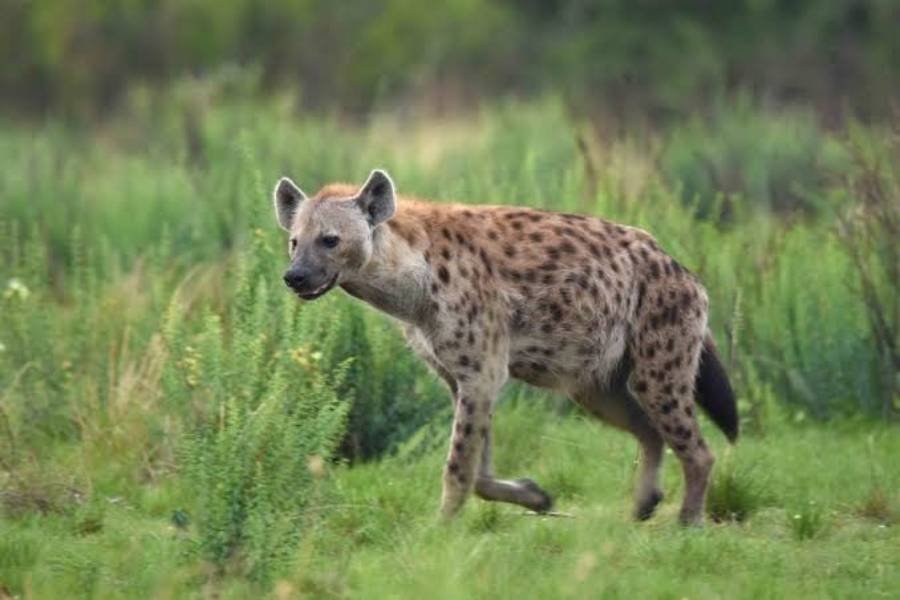
The spiritual meanings of a hyena center on survival, adaptability, resourcefulness, community, communication, intuition, and confronting the shadow self. As an animal that survives in demanding environments and maintains complex social relationships, the hyena can represent the ability to adapt when circumstances change, use available resources wisely, and recognize the value of cooperation. Its symbolism also has a darker side, where it can represent hidden fears, social conflict, deception, or aspects of yourself that you would rather avoid.
A hyena does not have one universal spiritual meaning. Its interpretation changes according to the situation in which it appears and the cultural or spiritual framework used to understand it. Seeing a hyena, dreaming about one, or identifying with the hyena as a spirit animal can therefore carry different messages. Even characteristics commonly associated with hyenas, including their distinctive vocalizations and scavenging behavior, have contributed to both positive and negative symbolism.
Understanding hyena symbolism requires looking at these meanings in context. The following sections explain what a hyena means spiritually, whether it is a positive or negative symbol, what different hyena encounters and dreams can represent, and how cultural traditions have shaped its spiritual symbolism.
What Does a Hyena Mean Spiritually?
A hyena spiritually symbolizes survival, adaptability, resourcefulness, community, communication, intuition, and the courage to confront hidden aspects of yourself. These meanings come from the characteristics people associate with hyenas, including their ability to survive in demanding environments, respond to changing conditions, and maintain complex social relationships. Rather than representing one fixed message, hyena symbolism combines several themes that become more or less relevant depending on the context of an encounter, dream, or spiritual interpretation.
Survival is one of the strongest spiritual meanings associated with the hyena. Hyenas persist in environments where access to food, territory, and other resources can involve intense competition. In spiritual interpretation, this ability represents resilience during periods of uncertainty or hardship. A hyena can therefore symbolize the need to remain persistent when circumstances become difficult rather than allowing temporary setbacks to determine the final outcome.
Adaptability is another central meaning because hyenas use different strategies to obtain food and respond to their surroundings. Spiritually, this adaptability represents changing your approach when an existing strategy no longer works. The message is not simply to endure a difficult situation but to recognize when survival requires adjustment. For example, encountering hyena imagery during a major life transition can be interpreted as a reminder to evaluate available options instead of remaining attached to one familiar solution.
Resourcefulness is closely connected with adaptability but focuses on making effective use of what is already available. Hyenas have frequently been portrayed only as scavengers, although their feeding behavior is more complex than this stereotype suggests. Within symbolic interpretation, however, the association with using available resources has created a broader theme of resourcefulness. A hyena can represent finding value in overlooked opportunities, skills, relationships, or information rather than assuming progress always requires something new.
Community is also important to hyena symbolism because some hyena species, particularly spotted hyenas, live within highly structured social groups called clans. This social organization gives the hyena a symbolic connection with cooperation, belonging, hierarchy, and relationships. Spiritually, the hyena can serve as a reminder that resilience does not always come from independence. Support from family, friends, or a wider community can become an important resource when facing challenges.
Communication adds another layer to this community symbolism. Hyenas use multiple vocalizations to communicate, and their famous “laugh” is only one part of a much broader communication system. Spiritually, this characteristic can represent expression, listening, and recognizing signals within relationships. It can also symbolize misunderstanding: an outward expression may not reveal what someone is actually experiencing. This makes the hyena relevant to situations where clearer communication or closer attention to social cues is needed.
The hyena can also symbolize intuition and awareness. Survival requires responding to information from the surrounding environment and from other members of a social group. In spiritual interpretation, these characteristics become a metaphor for noticing patterns, trusting informed instincts, and paying attention to details that are easy to dismiss. This meaning does not imply that seeing a hyena predicts future events; instead, it provides a symbolic framework for examining what you may already be noticing in your circumstances.
A final spiritual meaning of the hyena concerns the shadow self: traits, fears, emotions, or uncomfortable truths that a person prefers not to acknowledge. Hyenas have accumulated negative associations in folklore and popular culture, making them useful symbols for qualities people reject or fear. From this perspective, a hyena can represent the need to examine an uncomfortable part of yourself rather than immediately judging or suppressing it. Fear, jealousy, insecurity, anger, or the desire for social approval are examples of traits that may become more useful when they are recognized and understood instead of ignored.
Is a Hyena a Positive or Negative Spiritual Symbol?
A hyena can be both a positive and negative spiritual symbol, depending on the behavior, situation, and cultural context connected with it. Its positive meanings center on resilience, adaptability, cooperation, resourcefulness, and persistence, while its negative meanings include deception, opportunism, social conflict, hidden motives, and unresolved fears. These interpretations are symbolic rather than statements that hyenas themselves possess good or bad moral qualities.
The positive symbolism of a hyena begins with resilience. A hyena represents the ability to continue functioning under pressure instead of withdrawing when circumstances become difficult. Spiritually, this meaning is relevant during periods of uncertainty, rejection, competition, or major change. Someone facing repeated setbacks, for example, might interpret the hyena as a symbol of persistence: difficulties require a stronger or more flexible response rather than immediate surrender.
Adaptability and resourcefulness strengthen this positive interpretation. Hyenas survive by responding effectively to their environment and using available opportunities. As a spiritual symbol, the hyena can therefore represent working with the resources you already possess. Those resources may include knowledge, practical skills, supportive relationships, previous experience, or opportunities that initially appear insignificant. The central lesson is to evaluate what is available before assuming that progress depends on acquiring something new.
Cooperation gives the hyena another positive meaning. The social behavior associated with hyenas, especially the clan structure of spotted hyenas, connects them symbolically with community and collective strength. This interpretation emphasizes knowing when to rely on other people and when individual effort is insufficient. In personal relationships, the hyena can represent the importance of communication, social awareness, and understanding your role within a family, friendship, workplace, or community.
The negative spiritual meanings of a hyena focus more heavily on how the animal has been represented in folklore, cultural narratives, and popular imagination. Deception and hidden motives are two recurring interpretations. In this context, hyena symbolism can point toward a situation in which appearances and intentions do not align. Applied as a tool for self-reflection, this meaning encourages closer examination of unclear motives, including your own, rather than assuming that another person is necessarily being deceptive.
Opportunism is another negative interpretation, particularly when taking advantage of circumstances comes at someone else’s expense. This meaning is the shadow counterpart of resourcefulness. Resourcefulness involves using opportunities constructively, while opportunism symbolically represents pursuing personal advantage without considering its effect on others. The distinction makes the hyena a useful symbol for examining not only what you want but also how you are trying to obtain it.
Social conflict can also appear within negative hyena symbolism. Because community, hierarchy, and communication are central themes associated with the animal, their negative counterparts include competition, exclusion, rivalry, and the misuse of group influence. A hyena appearing in a spiritual context may therefore prompt reflection on whether a social environment provides genuine support or creates unnecessary pressure to conform.
Fear and the shadow self form the final negative dimension. A disturbing image of a hyena can symbolize an emotion, behavior, or truth that has been pushed aside because confronting it feels uncomfortable. In this interpretation, the hyena is not necessarily an omen of something bad approaching. It functions as a symbolic representation of something that already requires attention, such as resentment, insecurity, jealousy, anger, or fear of rejection.
For this reason, whether a hyena is a good or bad spiritual symbol depends primarily on context. A calm hyena may emphasize resilience, awareness, or social connection, while a threatening hyena may bring attention to conflict, fear, or avoidance. The positive and negative meanings are also connected: adaptability can become opportunism, confidence can become dominance, and community can become social pressure when expressed without balance.
What Does Seeing a Hyena Mean Spiritually?
Seeing a hyena spiritually represents adaptability, awareness, survival, social relationships, or the need to confront something you have been avoiding. The specific interpretation depends on 3 main factors: what the hyena is doing, how you feel during the encounter, and what is happening in your life at that time. A calm encounter and a threatening encounter therefore do not carry the same symbolic meaning.
Seeing a calm or non-threatening hyena can symbolize awareness and adaptability. The hyena survives by responding to its surroundings rather than depending on a single strategy, so its appearance can represent the need to observe a changing situation before deciding how to respond. For example, during a career change, relationship transition, or period of financial uncertainty, hyena symbolism can encourage you to identify the resources and options already available instead of continuing with an approach that is no longer effective.
A hyena appearing around other hyenas can place greater emphasis on community and social relationships. In this context, the encounter can symbolize cooperation, hierarchy, belonging, or your position within a group. It may encourage reflection on whether your current relationships provide mutual support or create unhealthy competition. This interpretation is especially relevant when an important decision involves family members, friends, colleagues, or another social group rather than you alone.
A threatening or aggressive hyena carries a different symbolic emphasis. It can represent fear, unresolved conflict, social pressure, or a problem you would prefer not to confront. The threat should not automatically be interpreted as a prediction of danger. Within spiritual symbolism, the encounter works more effectively as a prompt for identifying the source of existing discomfort. Fear of rejection, an unresolved disagreement, or anxiety about a difficult decision are examples of issues that can fit this interpretation.
Your emotional response provides another important clue. Feeling curious or calm around the hyena can point toward confidence, awareness, and acceptance of change. Feeling frightened can shift the meaning toward vulnerability, avoidance, or uncertainty. Feeling threatened by a group of hyenas can place greater emphasis on social pressure or conflict. The same animal can therefore represent different spiritual themes because the surrounding context changes the meaning.
What Does Seeing a Hyena Repeatedly Mean?
Seeing a hyena repeatedly can spiritually symbolize a recurring issue involving adaptability, survival, communication, relationships, or an avoided problem. Repetition gives greater prominence to the symbolism, but it does not prove that the encounters are supernatural messages. The practical interpretation is to identify which hyena-associated theme repeatedly corresponds with your current circumstances.
For example, repeated hyena imagery during a period of rapid change can emphasize adaptability. Repeated encounters while experiencing conflict within a family or workplace can instead emphasize communication and group dynamics. If the hyena consistently creates fear or discomfort, the symbolism may point toward an unresolved concern that continues to demand attention.
Patterns matter more than frequency alone. Consider where the hyena appears, what it is doing, how you respond emotionally, and whether the same theme is present across several encounters. These details provide a stronger basis for spiritual reflection than treating every repeated sighting as a fixed omen.
What Does It Mean When a Hyena Crosses Your Path?
A hyena crossing your path can symbolize the need to adapt, remain alert, use your resources wisely, or reconsider how you are approaching a current challenge. The symbolism of an animal crossing your path centers on interruption: something enters your attention and creates an opportunity to examine the direction you are currently taking.
A calm hyena crossing your path can emphasize flexibility and awareness. It can represent continuing toward a goal while remaining willing to change your method when circumstances require it. This interpretation is particularly relevant when persistence alone has stopped producing results. The symbolic lesson is not necessarily to abandon the goal but to reconsider the strategy used to reach it.
A hyena that stops, watches, follows, or behaves aggressively changes the interpretation. Being watched can emphasize awareness or the feeling of being evaluated, while being followed can symbolize a concern that remains unresolved despite attempts to move past it. Aggression shifts the focus toward conflict, fear, boundaries, or pressure. These meanings remain symbolic interpretations rather than predictions of future events.
The most useful way to interpret a hyena crossing your path is therefore to connect the encounter with your immediate circumstances. The hyena represents a symbolic theme; the context determines which aspect of that theme is relevant. This approach avoids assigning the same spiritual meaning to every encounter and keeps the interpretation connected to the person’s actual experience.
What Does a Hyena Spirit Animal Mean?
A hyena spirit animal represents adaptability, resourcefulness, resilience, communication, and social intelligence. Its central spiritual lesson is to survive challenges by understanding your environment, using available resources effectively, and recognizing when cooperation is more valuable than acting alone. The hyena spirit animal also carries a shadow meaning: adaptability and social intelligence need to be balanced with honesty, healthy boundaries, and self-awareness.
Adaptability is one of the strongest traits represented by the hyena spirit animal. Life does not always reward a fixed strategy, especially when circumstances change faster than expected. Hyena symbolism emphasizes adjusting your method without immediately abandoning your objective. For example, a failed plan, unexpected career change, or difficult relationship transition may require a different approach rather than simply greater effort. In this context, the hyena represents flexibility as a form of strength.
Resourcefulness adds a practical dimension to this meaning. The hyena spirit animal encourages you to recognize value in resources that are already available. These resources can include existing skills, previous experiences, supportive relationships, knowledge, time, or opportunities that have been overlooked. The lesson is not to take whatever is available without consideration for others. Instead, it is to identify useful possibilities before concluding that you lack what is necessary to move forward.
Resilience represents the ability to remain functional when circumstances become difficult. The hyena spirit animal does not symbolize avoiding hardship; it symbolizes responding to hardship without allowing it to define your direction. This distinction matters because resilience involves both persistence and adjustment. Continuing an ineffective strategy indefinitely is stubbornness, while changing the strategy and continuing toward a meaningful objective reflects adaptability combined with resilience.
Communication and social intelligence form another major part of hyena spirit animal symbolism. Hyenas, particularly spotted hyenas, are associated with complex social structures and varied vocal communication. Symbolically, these characteristics emphasize understanding relationships, expressing intentions clearly, noticing social cues, and knowing when collaboration is necessary. The spiritual lesson can apply to family relationships, friendships, workplaces, and other situations where an individual’s actions affect a larger group.
The hyena spirit animal can also represent the need to examine your relationship with belonging. Community provides protection and support, but group membership can also produce competition, hierarchy, and pressure to conform. Hyena symbolism therefore raises a practical question: are your relationships helping you become more resilient, or are you changing yourself primarily to maintain acceptance? This interpretation connects the social side of the hyena with personal boundaries and self-awareness.
There is also a shadow side to the hyena spirit animal. Resourcefulness can become opportunism when personal advantage consistently comes at another person’s expense. Social intelligence can become manipulation when knowledge of other people is used dishonestly. Confidence can become dominance, while cooperation can become dependency. The spiritual lesson is to use the hyena’s symbolic strengths without allowing those strengths to develop into their destructive counterparts.
For someone who identifies strongly with hyena symbolism, 5 lessons stand out: adapt when circumstances change, use existing resources intelligently, remain resilient under pressure, communicate clearly within relationships, and confront uncomfortable aspects of yourself. These lessons make the hyena spirit animal a symbol of practical survival rather than passive endurance. Its message centers on knowing when to persist, when to adjust, and when to examine your own behavior before blaming external circumstances.
What Does Dreaming About a Hyena Mean Spiritually?
Dreaming about a hyena spiritually symbolizes survival, social tension, adaptability, hidden fears, or an issue that requires closer attention. The meaning depends on 3 main details: the hyena’s behavior, your emotional response, and what happens between you and the animal. A peaceful hyena dream can emphasize confidence or acceptance, while an aggressive or pursuing hyena shifts the interpretation toward conflict, pressure, fear, or avoidance.
A calm hyena in a dream can represent resilience and confidence in your ability to handle an uncertain situation. The animal is present without creating an immediate threat, so the symbolism centers more strongly on observation, awareness, and adaptation. For example, remaining calm beside a hyena can reflect a period in which you are learning to tolerate uncertainty rather than reacting to every unfamiliar situation as a danger.
A friendly hyena can carry a stronger meaning of acceptance and reconciliation. Because hyenas are frequently portrayed negatively, responding positively to one in a dream can symbolize accepting a quality, emotion, or part of yourself that you previously rejected. This does not mean every friendly hyena has the same interpretation. Your emotional response remains important: trust suggests acceptance, while discomfort around an apparently friendly animal can point toward uncertainty about someone’s intentions or your own judgment.
Dreaming about several hyenas places greater emphasis on community and group dynamics. A peaceful pack can represent belonging, cooperation, or support, while a threatening pack can symbolize peer pressure, rivalry, exclusion, or fear of being judged by a group. The relevant group might be a family, friendship circle, workplace, or another community that currently has a strong influence on your decisions.
What Does Dreaming About an Aggressive Hyena Mean?
Dreaming about an aggressive hyena can symbolize conflict, pressure, defensiveness, or a fear that has become difficult to ignore. Aggression changes the hyena from a general symbol of adaptability and survival into a representation of confrontation. The dream may therefore be useful for identifying where tension already exists rather than treating the animal as a prediction that something harmful will happen.
The source of the aggression provides additional context. A hyena attacking without warning can represent feeling vulnerable to unpredictable conflict, while a hyena becoming aggressive after being approached can symbolize a boundary that has been crossed. Fighting back can reflect readiness to confront a problem, whereas freezing or hiding can represent uncertainty about how to respond. These differences show why the action within the dream matters as much as the animal itself.
An aggressive hyena can also represent an internal conflict. Anger, jealousy, insecurity, resentment, or fear can become symbolically threatening when those emotions remain unacknowledged. In this interpretation, fighting the hyena represents struggling against an unwanted part of yourself. Recognizing the emotion does not require acting on it; it allows you to understand what triggers it and decide how to respond constructively.
What Does Dreaming About Being Chased by a Hyena Mean?
Dreaming about being chased by a hyena can symbolize avoidance, persistent pressure, or an unresolved problem that continues to demand attention. Chase dreams naturally create a relationship between pursuit and escape, making avoidance the central symbolic mechanism. The hyena represents the issue being avoided, while running represents the effort to distance yourself from it.
The identity of that issue depends on the dreamer’s circumstances. It can relate to an overdue decision, unresolved disagreement, demanding responsibility, fear of rejection, or another concern that repeatedly returns to attention. For example, someone avoiding a difficult conversation may interpret the pursuing hyena as a representation of conflict that remains psychologically present despite attempts to postpone it.
What happens at the end of the chase can refine the interpretation. Escaping can represent temporary relief or confidence in overcoming pressure. Hiding can symbolize postponement rather than resolution. Turning around to face the hyena can represent growing readiness to address the underlying issue. Being surrounded by several hyenas shifts the emphasis toward multiple pressures or a social situation in which the dreamer feels outnumbered.
Hyena dreams are therefore most useful when interpreted through context rather than through a fixed dream dictionary. The hyena provides the symbolic theme, while its behavior, your emotions, and your current circumstances determine the most relevant meaning. Dreams are not reliable predictions of future events, so spiritual interpretation works best as a form of reflection rather than as proof that a specific event or omen will occur.
What Does a Hyena Symbolize in Different Cultures?
A hyena symbolizes different ideas across cultures, including power, danger, transformation, disorder, survival, and connections with the supernatural. There is no single cultural meaning of the hyena. Interpretations differ between communities, religious traditions, folklore, and historical periods, so broad claims such as “the hyena means this in African culture” oversimplify traditions that developed independently.
In several African traditions, the hyena has acquired both negative and powerful supernatural associations. Folklore can connect the animal with fear, death, witchcraft, spiritual danger, or beings capable of crossing boundaries between ordinary and supernatural worlds. These associations partly reflect the hyena’s nocturnal activity, distinctive vocalizations, feeding behavior, and presence around places humans considered dangerous. Within a spiritual interpretation, these characteristics can make the hyena a symbol of what exists outside familiar boundaries.
The hyena is not exclusively a negative symbol, however. Its ability to survive difficult conditions creates associations with endurance, strength, adaptability, and resourcefulness. These meanings illustrate an important feature of animal symbolism: the same characteristic can produce different interpretations. An animal capable of surviving where others struggle can be viewed as threatening in one narrative and remarkably resilient in another.
Folklore has also connected hyenas with transformation and blurred identities. Stories involving human-hyena transformation or supernatural relationships between people and hyenas give the animal a symbolic position between categories: human and animal, familiar and wild, ordinary and supernatural. In spiritual interpretation, this boundary-crossing theme can represent transformation, hidden identity, or aspects of a person that are not immediately visible.
Hyena symbolism also appears in traditions outside Africa. In parts of the Middle East and surrounding regions, folklore has sometimes associated hyenas with supernatural powers, danger, deception, or unusual influence over humans. These traditions should be understood within their specific historical and cultural contexts rather than combined into a universal definition of hyena symbolism.
Modern popular culture has further shaped how people interpret the animal. Hyenas are frequently portrayed as sinister, treacherous, cowardly, or threatening characters. Repeated exposure to these portrayals can influence contemporary spiritual interpretations, particularly associations with deception and hidden motives. However, these fictional representations do not provide a complete description of actual hyena behavior and should not be treated as evidence that the animal itself possesses negative moral traits.
For spiritual interpretation, cultural context therefore changes the meaning considerably. The hyena can represent fear and danger in one tradition while emphasizing survival, transformation, or resilience in another. Identifying the specific tradition behind a symbolic claim is more accurate than assigning one cultural meaning to the animal across unrelated communities.
Why Is the Hyena Associated With Laughter?
The hyena is associated with laughter because some of its vocalizations sound similar to human laughter, but a hyena does not “laugh” because it finds something funny. The familiar sound is most strongly associated with spotted hyenas and functions as communication. This distinction matters spiritually because symbolism based on the hyena’s “laughter” should not begin with the assumption that the animal is expressing human amusement.
The laughing association gives the hyena a symbolic connection with communication and misunderstood appearances. A sound that humans interpret as laughter can communicate something very different within hyena social behavior. Spiritually, this contrast can represent situations in which outward appearances do not accurately reveal internal states. Someone who laughs while uncomfortable, hides anxiety behind humor, or misreads another person’s emotional signals provides a human parallel to this symbolism.
Laughter symbolism can also represent the social role of communication. Hyenas rely on vocal signals as part of their interactions, making sound relevant to group relationships rather than merely individual expression. In a spiritual context, the hyena can therefore encourage attention to how something is communicated as well as what is being communicated. Tone, timing, emotional context, and the relationship between individuals can change the meaning of the same words or behavior.
A darker interpretation connects hyena laughter with mockery, nervousness, or concealed intentions. This association appears strongly in human storytelling and popular representations of hyenas. When used for spiritual reflection, it can symbolize the difference between authentic expression and a social mask. The useful question is not whether hyena laughter predicts deception, but whether communication in a particular situation accurately reflects what the people involved think or feel.
The spiritual meaning of hyena laughter therefore centers less on humor and more on communication, social signals, emotional ambiguity, and the difference between appearance and reality. Understanding the behavior behind the famous sound creates a more coherent interpretation than treating laughter itself as evidence of either happiness or malicious intent.
Read more: 7 Spiritual Meanings of Fennec Fox Explained
Does a Hyena Symbolize Death or Bad Luck?
A hyena does not universally symbolize death or bad luck, although some cultural traditions and folklore associate it with death, danger, fear, or supernatural forces. These negative meanings developed within specific cultural contexts and should not be treated as a universal spiritual interpretation. In other contexts, the hyena represents survival, resilience, adaptability, and transformation rather than misfortune.
The association with death partly comes from the hyena’s long-standing connection with scavenging and carrion in human imagination. Animals seen around carcasses can become symbolically linked with mortality, decay, and the boundary between life and death. This association does not mean that seeing a hyena predicts a death. Spiritually, death symbolism can instead represent endings, transition, or the need to release something that has reached the end of its role in your life.
Bad-luck symbolism develops in a similar way. No encounter with a hyena inherently predicts misfortune. Negative interpretations are more accurately understood as products of folklore, cultural beliefs, and the emotions humans have historically attached to the animal. A frightening encounter, disturbing dream, or threatening representation of a hyena can therefore symbolize fear and uncertainty without functioning as a literal warning that something bad will happen.
The hyena’s association with darkness and nocturnal activity also contributes to this interpretation. Darkness commonly represents the unknown, hidden information, fear, or aspects of life that are difficult to understand. When these themes combine with the hyena’s unusual vocalizations and cultural reputation, the animal can become a powerful symbol for confronting uncertainty. In this sense, a frightening hyena can represent fear itself rather than the event a person fears.
Transformation provides a different interpretation of death symbolism. Symbolic death frequently refers to the ending of one state before another begins, such as leaving an old identity, relationship, belief, or stage of life behind. Because hyena folklore can place the animal near boundaries between familiar and unfamiliar states, the hyena can fit this broader theme of transition. The emphasis is on change rather than literal death.
For these reasons, seeing or dreaming about a hyena should not automatically be interpreted as a sign of death or approaching bad luck. Context provides a more useful interpretation. A threatening hyena may reflect fear or unresolved conflict, while a calm hyena may emphasize survival and resilience. The same central entity produces different meanings because the circumstances surrounding it change.
How Do You Interpret the Spiritual Meaning of a Hyena Encounter?
Interpret the spiritual meaning of a hyena encounter by examining 4 factors: the context of the encounter, your emotional response, the hyena’s behavior, and the cultural or personal symbolism you associate with the animal. Using these factors prevents a single symbolic definition from being applied to every sighting, dream, or recurring image.
First, identify the context. Determine whether you physically saw a hyena, encountered one repeatedly in images or stories, or dreamed about one. These situations carry different interpretive weight. A dream primarily provides material for personal reflection, while an actual encounter also has an ordinary environmental explanation. Spiritual interpretation can be added to the experience without replacing its practical context.
Second, identify the strongest emotion associated with the encounter. Fear can point toward vulnerability, uncertainty, conflict, or avoidance. Curiosity can emphasize discovery and awareness. Calmness can represent confidence or acceptance, while discomfort can suggest that a situation deserves closer examination. Emotional context helps narrow the interpretation because the same hyena image can produce completely different meanings for two people.
Third, examine what the hyena is doing. A calm hyena can emphasize awareness, resilience, or adaptability. An aggressive hyena can represent conflict, boundaries, or pressure. A pursuing hyena can symbolize an issue that feels difficult to escape, while a group of hyenas can shift attention toward community, hierarchy, belonging, or social pressure. Behavior provides a more specific symbolic mechanism than the animal’s presence alone.
Fourth, consider the cultural and personal framework behind your interpretation. Hyenas do not carry one universal meaning across spiritual traditions. Cultural stories may emphasize danger, transformation, supernatural associations, or survival, while personal experiences can create entirely different associations. Identifying where a meaning comes from helps distinguish inherited symbolism from your own response to the animal.
For example, imagine repeatedly dreaming about being followed by a hyena while postponing an important decision. The context is a recurring dream, the dominant emotion is anxiety, the hyena’s behavior involves pursuit, and the personal situation contains an unresolved issue. Together, these details support an interpretation centered on avoidance and persistent pressure more strongly than an interpretation involving bad luck.
A different example produces a different meaning. Seeing a calm hyena while thinking about a major life transition can connect more naturally with adaptability, survival, and resourcefulness. The symbolism encourages reflection on how you are responding to change and which existing resources can help you move forward.
The most useful hyena spiritual meaning is therefore the one that fits the complete context rather than the most dramatic interpretation. Hyena symbolism can provide a framework for reflecting on resilience, relationships, communication, fear, adaptability, and hidden aspects of yourself, but it should not be treated as a guaranteed prediction of future events.