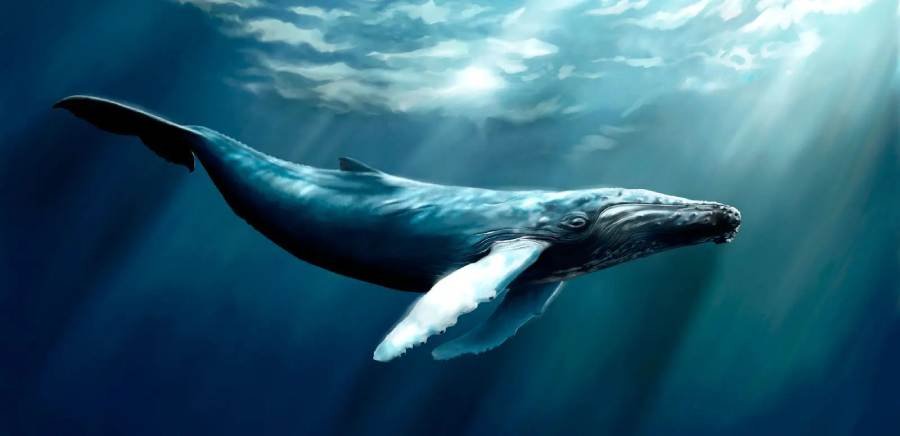
Whales spiritually symbolize wisdom, emotional depth, intuition, communication, inner strength, transformation, spiritual guidance, connection, and protection. Their association with the vast ocean gives them a strong symbolic connection to the subconscious and emotions, while their size and strength represent resilience and personal power. Whale vocalizations, particularly the complex songs of humpback whales, also contribute to their symbolism of communication, self-expression, and connection.
The spiritual meaning of a whale can change according to the context in which the animal appears. Seeing a whale in the ocean, repeatedly encountering whale imagery, dreaming about a whale, or identifying with whale symbolism can each lead to a different interpretation. The whale’s behavior, species, and the emotions associated with the experience can further shape its meaning.
This guide explores 9 main whale spiritual meanings and explains why whales are associated with specific spiritual qualities. It also covers the meaning of seeing a whale, whale spirit animal and totem symbolism, whale dreams, different whale species, cultural traditions, and ways to interpret whale symbolism within your own life.
What Does a Whale Mean Spiritually?
A whale spiritually represents 9 main meanings: wisdom, emotional depth, intuition, communication, inner strength, transformation, spiritual guidance, connection, and protection. These meanings come from both the observable characteristics of whales and the symbolic relationship between whales and the ocean. Because whales live and navigate through deep water, they are frequently associated in modern spiritual interpretation with exploring emotions, trusting inner awareness, and moving through periods of personal change.
Wisdom is one of the strongest meanings associated with whales. Their long lives, complex social behavior, and ability to navigate enormous marine environments contribute to an image of accumulated knowledge and calm awareness. Spiritually, whale wisdom represents looking beyond immediate circumstances and using experience to make deliberate decisions. A whale appearing during an uncertain period can therefore serve as a symbolic reminder to rely on knowledge already gained rather than react only to the present situation.
Emotional depth connects the whale to feelings and the inner self. The ocean commonly functions as a metaphor for emotions and the subconscious, while whales move between its depths and surface. This creates a symbolic parallel with exploring emotions that are not immediately visible. A whale descending into deep water can represent introspection, while its return to the surface can symbolize bringing an emotion, memory, or realization into conscious awareness.
Intuition represents the ability to recognize an inner direction without depending entirely on external guidance. Whales travel across vast marine environments and maintain behaviors that allow them to navigate, communicate, feed, and migrate. In spiritual symbolism, these characteristics create an association between the whale and trusting internal signals. This meaning becomes especially relevant when a person is facing a decision but already senses which direction aligns with their values.
Communication is connected strongly to whale vocalization. Whales use sound for communication, and humpback whales are particularly known for complex songs. Symbolically, whale song represents expressing what needs to be communicated while also listening for signals from others. The spiritual message is not simply to speak more; it can represent communicating deliberately, listening carefully, and recognizing when something important has remained unexpressed.
Inner strength comes from the whale’s immense physical presence without requiring aggression as its defining characteristic. In spiritual interpretation, this combination can represent quiet strength: the ability to remain grounded while experiencing emotional pressure or significant change. The symbolism is particularly relevant to resilience because strength does not always require confrontation. A person can remain powerful while responding calmly.
Transformation is associated with movement, migration, diving, and resurfacing. These behaviors create natural metaphors for entering an unfamiliar phase, moving through it, and emerging with a different perspective. Whale symbolism can therefore represent major transitions such as changing a career, ending or beginning a relationship, reconsidering personal beliefs, or entering a new stage of life.
Spiritual guidance develops from the whale’s broader associations with wisdom and intuition. In this context, the whale does not need to be interpreted as a literal supernatural messenger. Instead, its symbolism can provide a framework for examining direction, values, and decisions. Encountering whale imagery during a period of uncertainty may prompt questions about what a person already knows, what they are avoiding, and which direction feels consistent with their deeper priorities.
Connection and community reflect the social relationships found among many cetaceans. Spiritually, this meaning emphasizes relationships, belonging, cooperation, and maintaining bonds while preserving individual strength. Whale symbolism can be relevant when a person has become overly isolated or when family and community relationships require greater attention.
Protection combines size, strength, social connection, and the whale’s commanding presence. Symbolically, protection can refer to creating emotional boundaries, protecting people who depend on you, or developing enough inner stability to face difficult circumstances. Rather than representing avoidance of challenges, the whale represents having sufficient strength and awareness to move through them.
Why Do Whales Symbolize Wisdom and Emotional Depth?
Whales symbolize wisdom and emotional depth because their characteristics create strong associations with longevity, experience, deep water, complex behavior, and the hidden world beneath the ocean’s surface. These associations connect observable whale traits with broader spiritual metaphors. The symbolic meaning should therefore be distinguished from a scientific claim that whales possess a particular spiritual quality.
Wisdom is associated with accumulated experience rather than physical size alone. Whales include long-lived species, and their lives involve navigation, communication, social interaction, feeding strategies, and movement through large marine environments. These characteristics make the whale a fitting symbol for knowledge acquired over time. In personal spiritual interpretation, whale wisdom can represent using previous experiences to understand a current problem instead of treating every challenge as entirely new.
Emotional depth comes primarily from the whale’s relationship with deep water. Water has long served as a metaphor for feelings, while depths that cannot be seen from the surface naturally suggest experiences hidden from immediate awareness. A whale moving beneath the surface consequently provides a useful image for exploring emotions, memories, fears, and desires that have not been fully examined.
The whale’s repeated movement between depth and surface strengthens this interpretation. A whale can descend beyond ordinary human sight and later return to breathe at the surface. Symbolically, the same pattern can represent entering an emotional issue, understanding what lies beneath it, and bringing that understanding into conscious awareness. For example, someone repeatedly avoiding grief may interpret whale imagery as a prompt to examine the emotion rather than continue suppressing it.
Wisdom and emotional depth are therefore closely connected within whale spiritual symbolism. Emotional exploration without perspective can become overwhelming, while wisdom without emotional awareness can become detached. The whale combines these themes into a symbolic message of going deeper while retaining enough awareness to return, reflect, and act on what has been discovered.
Why Do Whales Symbolize Intuition and Spiritual Guidance?
Whales symbolize intuition and spiritual guidance because they navigate an immense environment that humans cannot easily see or understand from the surface. In spiritual symbolism, this ability to move through deep and open water represents trusting an inner sense of direction when the complete path is not visible. The whale therefore becomes a symbol of navigating uncertainty without needing every answer in advance.
Intuition in whale symbolism is closely connected to awareness rather than prediction. A person may have enough experience, emotional information, and subtle signals to recognize that a situation feels right or wrong before being able to explain the conclusion logically. The whale represents paying attention to these internal signals while continuing to evaluate reality. For example, someone considering a major life change may already recognize persistent dissatisfaction, changing priorities, or a stronger attraction to another direction. Whale symbolism can encourage closer examination of those signals rather than automatically dismissing them.
Spiritual guidance extends this idea from awareness to direction. A whale moving through deep water provides a metaphor for progressing through a period in which the destination or outcome remains uncertain. The relevant message is to identify stable reference points such as personal values, previous experience, emotional patterns, and long-term priorities. These reference points can provide direction even when circumstances continue to change.
Seeing a whale or repeatedly encountering whale imagery does not prove that a supernatural force is predicting a specific event. A stronger spiritual interpretation treats the whale as a symbol that encourages reflection on intuition, direction, and the parts of life that require deeper attention. This distinction keeps whale symbolism useful without turning a personal spiritual interpretation into a factual prediction.
Why Do Whales Symbolize Communication?
Whales symbolize communication because vocalization is an important part of their behavior, making sound one of the clearest connections between observable whale characteristics and spiritual symbolism. Different cetaceans produce clicks, calls, whistles, and other vocalizations, while humpback whales are especially associated with elaborate songs. These behaviors create a natural symbolic relationship between whales and expression, listening, connection, and being heard.
Whale symbolism emphasizes that communication involves both sending and receiving information. Expression without listening creates one-sided communication, while listening without expression can leave important needs or ideas unspoken. The whale can therefore represent finding a balance between the two. In a personal context, this symbolism may become relevant when someone needs to communicate a boundary, express an emotion, resolve a misunderstanding, or listen more carefully to another person’s perspective.
Whale song adds another layer to this meaning because sound travels through an environment where visual communication is limited. Symbolically, this suggests that meaningful communication does not depend only on what is immediately visible. Tone, timing, repetition, emotional awareness, and attentive listening can influence how a message is understood. For example, repeatedly telling someone what you need without examining how the message is delivered may not resolve a communication problem.
Communication also connects whale symbolism with authenticity. The spiritual message of the whale is not simply “speak more,” but to express what matters clearly and listen for what matters in return. Someone who continually suppresses an important concern may interpret whale imagery as a reminder to give that concern a voice. Someone who dominates conversations may draw the opposite lesson: meaningful communication also requires silence and attention.
Why Do Whales Symbolize Strength, Protection, and Transformation?
Whales symbolize strength, protection, and transformation through their immense physical presence, social relationships, movement through the ocean, and repeated transitions between depth and surface. These three meanings describe different forms of power: strength concerns the capacity to endure, protection concerns how that capacity is used, and transformation concerns the ability to move from one state or stage of life into another.
Strength is one of the most immediate associations created by a whale’s size. Spiritually, however, whale strength is more useful as a symbol of resilience than domination. A whale does not need to appear aggressive for its power to be obvious. This creates the idea of quiet strength: remaining emotionally grounded, maintaining boundaries, and continuing forward without turning every difficulty into a confrontation. For example, leaving a harmful situation calmly can require greater inner strength than remaining in it simply to prove endurance.
Protection extends this strength toward relationships and personal boundaries. Whales and other cetaceans display social behaviors that make connection an important part of how humans interpret them symbolically. Within a spiritual framework, protection can therefore represent safeguarding emotional well-being, supporting family or community, and recognizing when stronger boundaries are required. Protection does not mean eliminating every uncomfortable experience; it means identifying what deserves care and responding deliberately when it is threatened.
Transformation is represented by movement. Whales travel through changing marine environments, and many species undertake long migrations between important habitats. Their movement between deep water and the surface also creates a powerful visual metaphor: descent, exploration, resurfacing, and continuation. Spiritually, this pattern can represent entering a difficult or unfamiliar stage, confronting what exists beneath the surface, and emerging with greater awareness.
This transformation symbolism applies particularly well to major transitions, including a career change, the beginning or end of a relationship, a shift in identity, or a change in spiritual outlook. The whale represents transformation as a process of moving through change rather than escaping it. The person enters unfamiliar emotional territory, adapts to new conditions, and eventually carries what was learned into the next stage.
Strength, protection, and transformation consequently reinforce one another within whale symbolism. Strength provides the capacity to enter change, protection preserves what remains important during the transition, and transformation allows growth beyond the previous state. Together, these meanings make the whale a symbol of powerful but deliberate change rather than sudden or uncontrolled disruption.
What Does Seeing a Whale Mean Spiritually?
Seeing a whale spiritually symbolizes a call to pay closer attention to your emotions, intuition, communication, inner strength, or an important transition in your life. The exact interpretation depends on the context of the encounter, the whale’s behavior, your emotional response, and whether the experience occurs once or becomes a recurring pattern. Seeing a whale is therefore better interpreted through the circumstances surrounding the experience than through a single fixed meaning.
Seeing a whale in person can represent awareness of something larger or deeper than your immediate concerns. The animal’s size and its emergence from beneath the ocean surface create a natural metaphor for something significant entering conscious awareness. For example, seeing a whale during a period of major personal change may prompt reflection on an emotion, decision, or direction that has previously remained beneath the surface. The symbolism comes from the relationship between the experience and the person’s circumstances rather than from the encounter predicting what will happen next.
The whale’s behavior provides another layer of interpretation. A whale swimming calmly can symbolize emotional stability, confidence, or moving comfortably through uncertainty. A whale diving may represent introspection or the need to examine an issue more deeply. A whale resurfacing can symbolize recognition, clarity, or bringing an internal realization into conscious awareness. These interpretations use observable behavior as the basis for symbolism instead of assigning the same spiritual message to every whale encounter.
Repeatedly seeing whales can carry greater personal significance because repetition naturally draws attention to a symbol. Recurring whales in dreams, artwork, conversations, meditation, or media may encourage you to identify what was happening in your life each time the symbol appeared. If the same emotional or practical issue is present across several encounters, that pattern provides a stronger basis for personal interpretation than the whale image alone.
Your emotional reaction also matters. Feeling peaceful during a whale encounter creates a different symbolic context from feeling afraid, overwhelmed, or sad. Peace may connect the whale with trust or emotional stability, while fear may point toward an issue that feels too large to confront. The most useful spiritual meaning comes from combining the whale symbol with context, behavior, emotion, and repetition rather than treating the encounter as a guaranteed supernatural sign.
What Does a Whale Spirit Animal Represent?
A whale spirit animal represents wisdom, intuition, emotional awareness, communication, inner strength, and the ability to navigate major life transitions. In contemporary spiritual interpretation, identifying strongly with whale symbolism can reflect a preference for depth, reflection, meaningful communication, and strong emotional connections rather than superficial experiences.
Wisdom is central to the whale spirit animal because the whale represents learning through experience and seeing beyond immediate circumstances. Someone who identifies with this symbolism may value observation before action and prefer decisions based on long-term perspective. The corresponding spiritual lesson is to use accumulated experience rather than repeatedly approaching familiar problems as if they were entirely new.
Intuition and emotional awareness add an inward dimension to the whale spirit animal. Because the whale moves through deep water, it can represent the ability to explore emotions without remaining permanently submerged in them. The lesson is not to follow every feeling automatically. Instead, whale symbolism encourages recognizing emotions, examining their causes, and determining what information they provide. For example, recurring anxiety about a particular situation may deserve investigation even when its cause is not immediately obvious.
Communication represents another major lesson. Whale vocalizations create a symbolic connection with expressing important thoughts and listening carefully to others. A person drawn to the whale spirit animal may interpret this as encouragement to communicate a neglected need, establish a boundary, or pay greater attention to what another person is trying to express. Effective communication requires both a voice and the willingness to listen.
Inner strength becomes particularly relevant during difficult transitions. The whale represents power that does not depend on constant aggression, making it a symbol of calm resilience. Someone experiencing a career change, relationship transition, relocation, or shift in personal identity may use whale symbolism as a reminder that uncertainty does not eliminate the ability to move deliberately.
The whale spirit animal can therefore be understood through 4 practical lessons: go deeper before reaching conclusions, trust informed intuition, communicate what matters, and move through change with deliberate strength. These lessons keep the symbolism connected to reflection and behavior rather than treating the whale as a source of fixed predictions about future events.
What Does a Whale Totem Symbolize?
A whale totem can symbolize wisdom, protection, family connection, communication, emotional depth, and continuity across generations, but the meaning of a totem depends on the cultural tradition in which the term is used. “Totem” should not automatically be treated as another name for a modern spirit animal because totemic traditions can carry specific family, clan, ancestral, ceremonial, or community meanings.
In general spiritual writing, the whale is sometimes described as a totem of protection and connection because its size, social behavior, and association with the ocean create symbolic relationships with strength and belonging. Under this modern interpretation, whale symbolism can encourage a person to protect important relationships while maintaining healthy emotional boundaries. It can also represent recognizing that personal strength exists alongside dependence on family and community.
Communication and continuity are also relevant to whale totem symbolism. Whale vocalizations provide an observable foundation for associations with voice and connection, while cultural interpretations may add meanings involving ancestry, kinship, or inherited knowledge. These meanings should be attributed to the specific tradition that supports them rather than presented as universal beliefs shared by all cultures.
The distinction between a whale totem and a whale spirit animal is therefore important. A spirit animal is commonly used in contemporary spirituality as a personal symbolic guide, while a totem can refer to a culturally specific relationship between an animal and a family, clan, community, or tradition. The terms can overlap in popular spiritual content, but using them interchangeably can remove the cultural context that gives totem symbolism its actual meaning.
For a personal spiritual practice outside a specific totemic tradition, terms such as “whale symbolism” or “whale spiritual meaning” provide a clearer way to explore qualities such as wisdom, emotional depth, protection, and connection without claiming participation in a cultural practice to which those meanings may not belong.
What Does Dreaming About a Whale Mean Spiritually?
Dreaming about a whale spiritually represents deep emotions, subconscious awareness, intuition, personal transformation, or an issue that has become too significant to ignore. The meaning depends on what the whale is doing, the condition of the ocean, your interaction with the animal, and the emotion you experience during the dream. A calm swimming whale therefore carries a different symbolic meaning from a stranded, injured, or dead whale.
Whales are strongly connected with emotional depth in dream symbolism because they live beneath the ocean’s surface. Within this symbolic framework, the ocean represents the emotional or subconscious world, while the whale represents something substantial moving within it. A whale appearing from deep water can therefore symbolize an emotion, memory, desire, or realization becoming more visible to conscious awareness. For example, dreaming about a whale while avoiding an important personal decision may reflect the growing emotional significance of that unresolved issue.
The size of the whale also influences its dream symbolism. A small object in a dream can be overlooked, but a whale naturally dominates its surroundings. Spiritually, this scale can represent an emotion or life situation that demands attention. Feeling peaceful around the whale may suggest acceptance of that depth, while feeling frightened may indicate that the situation feels emotionally overwhelming. The whale itself does not establish whether the dream is positive or negative; the surrounding context provides that distinction.
Dreaming about communicating with or closely approaching a whale can symbolize a stronger relationship with intuition or emotional awareness. The interaction suggests engagement rather than observation from a distance. For example, peacefully approaching a whale may represent a willingness to understand an emotion that was previously avoided. Hearing a whale without seeing it can carry a different message, emphasizing listening, communication, or awareness of something that has not yet become completely clear.
Whale dreams are best interpreted as symbolic reflections rather than predictions. A dream about a whale does not establish that a specific future event will occur. Its spiritual value comes from examining how the whale, water, behavior, and emotions correspond with circumstances already present in your life.
What Does Dreaming About a Swimming Whale Mean?
Dreaming about a swimming whale can symbolize emotional movement, inner exploration, confidence, and progress through a period of change. A whale moving naturally through the ocean creates an image of being capable of navigating depth without becoming trapped by it. This makes the dream particularly relevant to situations involving emotional adjustment or personal transition.
The direction and quality of movement add context. A whale swimming calmly through clear water can represent emotional stability or growing confidence in a chosen direction. A whale moving through rough water may symbolize maintaining strength while circumstances remain difficult. A whale diving into deeper water can represent introspection, while one rising toward the surface may symbolize an emotion or realization becoming conscious.
Your position relative to the whale also changes the interpretation. Swimming peacefully beside a whale may represent greater comfort with your emotions or intuition, while watching it disappear into the distance may symbolize separation from an important emotional issue or the end of a particular phase. These meanings remain interpretive rather than predictive and should be considered alongside events occurring in waking life.
What Does Dreaming About a Stranded or Dead Whale Mean?
Dreaming about a stranded or dead whale can symbolize emotional disconnection, blocked expression, the end of an important phase, or a loss of direction. Both images contrast with the whale’s natural ability to move through water, making restriction or absence of movement central to the symbolism.
A stranded whale can represent something powerful that is no longer functioning in the environment it needs. Spiritually, this may correspond with feeling emotionally stuck, disconnected from intuition, unable to communicate an important concern, or trapped in circumstances that conflict with personal values. For example, someone who feels unable to use their abilities in a restrictive situation may identify with the image of a whale unable to return to the ocean.
A dead whale carries stronger symbolism of ending and transition. It can represent the conclusion of a relationship, identity, belief, emotional attachment, or stage of personal development. Death imagery in a symbolic dream does not necessarily indicate physical death or predict tragedy. Instead, it frequently provides a visual representation of something that has ended or needs to be released before another stage can begin.
The emotional response remains essential to distinguishing these meanings. Grief may point toward difficulty accepting an ending, relief may indicate readiness to release something, and fear may reflect uncertainty about what follows. The dream’s meaning comes from the relationship between the whale’s condition and your current emotional context, not from treating the image as a literal warning.
Do Different Types of Whales Have Different Spiritual Meanings?
Different types of whales can have different spiritual meanings because their size, behavior, appearance, vocalizations, and cultural associations create distinct symbolic connections. The core meanings of wisdom, emotional depth, intuition, strength, and transformation can remain consistent, while particular species emphasize specific attributes.
Species-specific symbolism works best when the interpretation has an identifiable connection to the animal. A blue whale, for example, naturally emphasizes magnitude and presence because of its extraordinary size. A humpback whale has a stronger connection with communication because humpback songs are among its most recognizable characteristics. These associations create a clearer semantic relationship than assigning unrelated spiritual qualities to each species.
The context in which a particular whale appears remains important. Dreaming about a blue whale may emphasize scale, depth, or quiet strength, while encountering humpback imagery may place greater emphasis on expression, communication, or movement. Personal associations can modify these interpretations, especially when someone has a memorable previous experience with a particular whale species.
What Is the Spiritual Meaning of a Blue Whale?
The spiritual meaning of a blue whale centers on immense inner strength, emotional depth, calm presence, and gaining perspective beyond immediate problems. As the largest animal known to live on Earth, the blue whale naturally creates symbolism around magnitude without requiring aggression to communicate power.
Its immense size can represent recognizing personal capacity or viewing a problem from a broader perspective. An issue that appears overwhelming at one level may change when considered against long-term priorities, previous experiences, and larger goals. In this sense, blue whale symbolism encourages perspective rather than avoidance.
The blue whale’s association with the open ocean reinforces emotional depth and independence. Spiritually, encountering a blue whale in a dream or recurring imagery can represent moving into deeper self-reflection while maintaining stability. A calm blue whale may therefore symbolize quiet confidence: strength that remains present without needing constant demonstration.
What Is the Spiritual Meaning of a Humpback Whale?
The spiritual meaning of a humpback whale centers on communication, self-expression, emotional connection, journey, and transformation. Its strong symbolic association with sound comes from the complex songs produced by male humpback whales, while its long-distance migrations provide a natural foundation for symbolism involving journeys and life transitions.
Communication is the most distinctive theme. Humpback whale song creates an association with finding and using one’s voice, but its spiritual meaning also includes listening and recognizing patterns in communication. Someone repeatedly encountering humpback symbolism may use it as a prompt to examine whether an important emotion, need, boundary, or idea remains unexpressed.
Migration adds the theme of transformation. Humpback whales travel long distances between important habitats, creating a symbolic pattern of departure, movement, arrival, and return. In a personal context, this can represent progressing through a transition while recognizing that transformation is rarely a single moment. Changing careers, relocating, rebuilding after a relationship, or adopting a different worldview all involve stages rather than an immediate shift.
Together, song and migration make the humpback whale a particularly strong symbol of expressing yourself while moving through change. Its spiritual meaning combines communication with direction: recognize what needs to be expressed, understand where you are in the journey, and continue moving toward the next stage with greater awareness.
What Do Whales Symbolize in Different Cultures?
Whales symbolize themes such as ancestry, protection, power, kinship, navigation, abundance, and spiritual connection in different cultural traditions, but there is no single universal cultural meaning of the whale. The meaning depends on the community, its relationship with the ocean, and the stories or traditions through which whales are understood. Cultural whale symbolism should therefore be interpreted within a specific tradition rather than combined into a generalized spiritual definition.
For coastal and ocean-oriented communities, whales can hold particular significance because encounters with them are connected to the environment in which those communities developed. Their enormous size, movement across the ocean, social behavior, and relationship with marine ecosystems provide several foundations for symbolic meaning. However, similar symbolism appearing in two traditions does not mean those traditions understand whales in exactly the same way.
This distinction is especially important when discussing Indigenous traditions. Terms such as “Indigenous whale symbolism” describe too broad a category to establish one spiritual meaning. Different peoples maintain distinct histories, narratives, relationships with animals, and spiritual practices. A culturally responsible interpretation identifies the specific community whenever possible and avoids presenting modern spiritual meanings as traditional beliefs.
What Do Whales Symbolize in Māori Traditions?
In Māori traditions, whales can be associated with ancestry, kinship, protection, guidance, and the relationship between people and the ocean. Whales, or tohorā, appear within Māori cultural contexts in which relationships between humans, ancestors, the natural world, and the sea carry significance beyond viewing the animal only as a biological species.
Whale symbolism can be connected with whakapapa, the framework of genealogy and relationships that links people across generations and connects them with the wider living world. Within this context, a whale can carry meanings involving ancestry and continuity rather than simply representing an individual personality trait. This differs from modern interpretations that reduce whale symbolism to qualities such as “strength” or “intuition.”
Stories involving whales can also connect them with guidance and protection. The precise meaning depends on the narrative and iwi or community involved, so these associations should not be treated as one fixed Māori doctrine about whales. The important distinction is that whale symbolism can operate through relationships, genealogy, place, and particular narratives rather than through a universal list of spiritual meanings.
This cultural context also explains why terms such as whale “spirit animal” should not automatically be applied to Māori traditions. Māori relationships with whales have their own terminology and cultural frameworks, which should be described on their own terms rather than translated into a generic modern spiritual system.
What Do Whales Symbolize in Indigenous North American Traditions?
Whale symbolism in Indigenous North American traditions varies by nation and cannot accurately be reduced to one meaning shared by all Indigenous peoples. Among communities with strong historical relationships with the Pacific coast and marine environments, whales can appear within stories, art, social identities, subsistence traditions, and relationships between humans and the ocean.
The orca provides a useful example of why specificity matters. In Northwest Coast contexts, killer whales appear prominently in the cultural traditions of particular peoples, but their meanings depend on the nation, family, story, crest system, and cultural setting involved. Associations may involve kinship, power, ancestry, protection, or relationships between marine and human worlds, but these meanings should be attributed to the tradition that supports them.
This differs substantially from saying that “Native Americans believe whales mean protection.” Such a statement combines hundreds of distinct peoples into a single belief system and removes the context that gives the symbolism meaning. A more accurate approach identifies the nation or community first and then explains how the whale functions within that specific cultural framework.
Modern spiritual interpretations can still draw personal meaning from whale imagery, but they should remain separate from claims about Indigenous beliefs. Personal whale symbolism describes an individual’s interpretation; Indigenous whale traditions describe culturally specific systems of knowledge and relationships. Keeping those categories separate preserves both semantic accuracy and cultural context.
What Does a Whale Symbolize in the Bible?
A whale in popular Biblical symbolism represents themes such as spiritual crisis, confinement, obedience, repentance, deliverance, and transformation, primarily because of the story of Jonah. However, an important distinction is that the creature that swallows Jonah is described as a “great fish” in the Biblical narrative rather than unambiguously identified as a whale. The familiar image of “Jonah and the whale” comes from later translation, interpretation, art, and popular retellings.
The central symbolism of the Jonah narrative comes from what happens during the encounter rather than from the biological identity of the sea creature. Jonah attempts to flee from the task given to him, encounters a violent storm, is thrown into the sea, and is swallowed by a great fish. He remains inside it for three days and three nights before being released. This sequence creates a symbolic structure of avoidance, descent, confinement, reflection, and return.
Confinement is therefore one of the strongest meanings associated with the Biblical whale image. Jonah’s time inside the creature separates him from his previous course of action and creates a period in which escape through ordinary means is impossible. Spiritually, this can symbolize a situation that forces reflection when avoidance is no longer possible. A period of isolation, failure, or uncertainty may similarly cause someone to reconsider choices that were previously ignored.
The story also creates an association with transformation and second chances. Jonah emerges from the great fish alive and receives another opportunity to respond to his calling. In symbolic interpretation, the movement from sea to confinement and then back to land resembles a transition from resistance through reflection to renewed action. The emphasis is not that a whale predicts transformation but that the narrative uses a great sea creature as part of a larger story about changing direction.
Biblical whale symbolism should consequently be distinguished from broader spiritual meanings such as intuition or emotional depth. In the Jonah context, the strongest themes come from the narrative itself: avoidance, consequence, reflection, deliverance, and renewed responsibility. This keeps the interpretation grounded in the Biblical story rather than importing unrelated modern whale symbolism into it.
How Can You Interpret the Spiritual Meaning of a Whale in Your Life?
Interpret the spiritual meaning of a whale in your life by examining 4 factors: context, emotion, behavior, and pattern. These factors provide a structured way to understand why a whale symbol feels personally significant without assuming that every whale encounter carries a predetermined supernatural message.
Context identifies what was happening when the whale appeared. Consider whether you saw the whale physically, encountered it repeatedly in images, experienced it during meditation, or dreamed about it. Then identify the major circumstances occurring in your life at the same time. A whale appearing while you are considering a major career change has a different interpretive context from one appearing while you are struggling to communicate within a relationship.
Emotion identifies your immediate response to the whale. Feelings such as peace, awe, fear, sadness, curiosity, or relief provide information that the image alone cannot supply. Feeling calm beside a whale in a dream may correspond with growing comfort around emotional depth, while feeling overwhelmed by an enormous whale may reflect a situation that currently feels larger than your ability to manage it.
Behavior identifies what the whale is doing. A swimming whale can represent movement, a diving whale can suggest introspection, and a resurfacing whale can symbolize something entering conscious awareness. A stranded whale creates a different symbolic structure because an animal adapted to moving through water has become unable to move within its natural environment. The behavior therefore narrows the range of interpretations that fit the experience.
Pattern determines whether the whale is an isolated image or a recurring symbol. One encounter may simply be memorable, while repeated whale dreams or imagery can provide a stronger reason for personal reflection. Look for what remains consistent across those experiences. If whale imagery repeatedly appears during periods involving difficult conversations, for example, communication may be more relevant than generic meanings such as protection or transformation.
The strongest interpretation combines all 4 factors rather than selecting a meaning from a fixed list. For example, repeatedly dreaming about a humpback whale singing while struggling to express an important concern creates a clear symbolic connection between pattern, whale behavior, communication, and waking-life context. Dreaming once about a distant whale without a strong emotional response provides far less information.
Whale spiritual meaning is most useful as a framework for reflection rather than a fixed prediction about what will happen next. Wisdom, emotional depth, intuition, communication, strength, and transformation provide starting points, but context determines which meaning is relevant. The goal is not to ask only “What does a whale symbolize?” but to identify why this particular whale image, behavior, or encounter has become meaningful within your present circumstances.