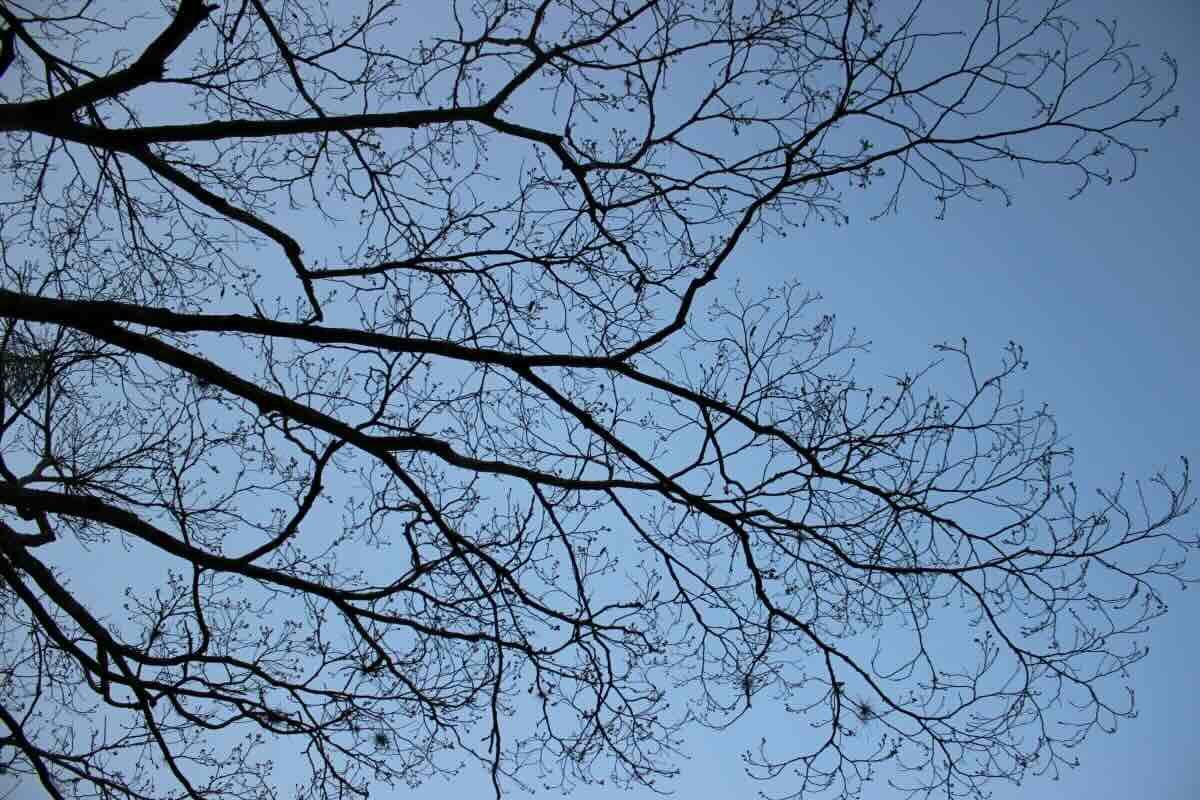
Tree branches spiritually symbolize growth, expansion, connection, life direction, spiritual development, resilience, and renewal. A branch begins from a stable trunk and extends outward or upward, creating new paths while remaining connected to the tree that supports it. This natural structure explains why branches are widely associated with personal development, relationships, family connections, and the different directions a person can take in life.
The spiritual meaning of tree branches also changes according to their condition and direction. Upward-growing branches represent aspiration and spiritual growth, while spreading branches reflect expansion and connection with others. Flowering branches symbolize emerging potential and renewal. Bare branches represent transition and periods when growth is not yet visible, whereas broken, falling, or dead branches can represent disruption, release, endings, and the opportunity to move beyond what no longer supports growth.
Tree branches therefore carry both positive and transitional meanings rather than one fixed spiritual message. Their symbolism reflects a natural cycle in which growth, change, loss, and renewal remain connected. Understanding these different states provides a clearer way to interpret what tree branches symbolize spiritually and how their meanings relate to personal and spiritual experiences.
What Do Tree Branches Mean Spiritually?
Tree branches spiritually symbolize 7 main concepts: growth, expansion, connection, life direction, spiritual development, resilience, and renewal. These meanings come from the way branches develop from a central trunk, extend in different directions, respond to changing conditions, and repeatedly produce new growth. A branch remains part of the tree while continuously moving beyond its original position, making it a natural symbol of development without losing connection to one’s foundation.
Growth is one of the strongest spiritual meanings of tree branches because branches increase in length, form new shoots, and develop new leaves over time. Spiritually, this process represents personal development and the gradual expansion of awareness. Growth does not require abandoning what came before. Just as a new branch develops from established wood, personal growth can build on previous experiences, lessons, relationships, and values.
Expansion represents movement beyond existing boundaries. Branches extend outward into previously unoccupied space and create smaller branches as the tree matures. In spiritual symbolism, this pattern can represent entering new stages of life, exploring new possibilities, or widening one’s perspective. A person who develops a new purpose, relationship, skill, or way of thinking reflects the same symbolic pattern of moving outward from an established foundation.
Connection is represented by the relationship between individual branches and the larger tree. Although branches can grow in different directions, they remain connected through the trunk and share the same root system. This structure makes branches symbols of family, relationships, ancestry, and interconnectedness. Individual lives can follow separate paths while remaining connected through shared origins, experiences, or relationships.
Life direction is another meaning because a tree rarely produces branches that follow one identical path. Branches divide, turn, and continue in multiple directions. This physical pattern provides a symbolic model for choices and different possibilities in life. One decision can create another set of choices, just as one branch can divide into several smaller branches.
Spiritual development is especially associated with branches that reach upward. Their movement from the trunk toward the open sky can symbolize aspiration, greater awareness, and movement beyond present limitations. The symbolism does not mean that the physical direction of a branch predicts a spiritual event. Instead, upward growth provides a visual metaphor for the human desire to develop beyond a current state.
Resilience comes from a branch’s ability to remain part of a living tree while facing wind, seasonal changes, and other environmental pressures. A branch may bend, lose leaves, or change its growth direction without ending its development. Spiritually, this represents adapting to difficult circumstances while maintaining the capacity to continue growing.
Renewal completes the symbolic cycle. Branches can lose their leaves and appear inactive before producing buds and leaves again. This recurring pattern represents the possibility of beginning another stage after a period of loss, rest, or limited visible progress. For this reason, the spiritual meaning of tree branches includes not only continuous growth but also the cycles of change that make new growth possible.
Why Do Tree Branches Symbolize Growth and Expansion?
Tree branches symbolize growth and expansion because they continuously develop beyond their existing boundaries while remaining connected to the structure that supports them. A branch grows from the trunk, extends farther from its starting point, produces smaller branches, and eventually supports buds, leaves, flowers, or fruit. Each stage adds something to the existing structure rather than replacing it.
Growth and expansion have related but distinct spiritual meanings. Growth represents development from an existing foundation, while expansion represents movement into new areas. A young branch becoming longer and stronger illustrates growth. That same branch dividing into several directions illustrates expansion. Spiritually, the distinction helps explain how a person can deepen existing qualities while simultaneously opening new areas of life.
This symbolism also shows why spiritual growth does not have to follow a straight path. Tree branches change direction as they develop, and different branches from the same trunk can occupy entirely different spaces. Personal development can follow a similar pattern through changes in priorities, relationships, beliefs, responsibilities, and goals. A change in direction does not automatically represent a failure to grow; it can represent a different form of expansion.
The connection between old wood and new growth adds another layer to the symbolism. New branches depend on an established tree, yet their development changes the tree’s overall shape. In spiritual terms, past experiences can function as a foundation without permanently determining future direction. Tree branches therefore represent a form of growth in which foundation and expansion exist together: what has already developed provides support for what develops next.
Why Do Tree Branches Symbolize Connection and Family?
Tree branches symbolize connection and family because separate branches grow from the same trunk and remain connected to a shared root system. This structure creates a natural representation of ancestry, generations, family relationships, and shared origins. Each branch develops independently, but its existence remains connected to the larger tree.
The relationship between roots, trunk, and branches strengthens this symbolism. Roots represent the foundation from which the tree receives support, while the trunk connects that foundation to every major branch. The branches then divide into smaller branches and new growth. Spiritually, this structure resembles generations within a family: ancestors form the foundation, family lines develop from shared origins, and individual members continue in different directions. The familiar concept of a “family tree” reflects this same visual relationship between lineage and branching growth.
Branches also represent individuality within connection. Two branches growing from the same trunk do not need to have the same length, shape, or direction. One may grow upward while another extends outward, yet both remain parts of the same living structure. In a spiritual context, this represents how family members can develop different beliefs, goals, relationships, and ways of life without erasing their shared history.
The symbolism extends beyond biological family. Interconnected branches can represent friendships, partnerships, communities, and other relationships that become part of a person’s support system. A mature tree gains much of its visible form from multiple branches existing together rather than from a single branch. In the same way, connection can represent the relationships that contribute to a person’s identity and development while still allowing individual growth.
What Do Tree Branches Symbolize About Your Life Path?
Tree branches symbolize different life paths because they divide from common starting points and continue growing in multiple directions. A single branch can separate into smaller branches, and each new branch can divide again. Spiritually, this branching pattern represents choices, possibilities, decisions, and the different directions that can emerge as life develops.
A branching path also illustrates how one decision can create several later possibilities. Choosing a career, beginning a relationship, moving to a new place, or committing to a personal goal can change the options available afterward. The symbolism comes from the structure of the branch itself: each point of division creates a new direction without removing the path that came before it.
Branches rarely develop as perfectly straight lines, which adds another meaning to the symbol. They turn, divide, adjust their direction, and continue growing according to the conditions around them. A person’s life path can develop in a similar way. Changing direction after gaining new experience does not necessarily mean returning to the beginning. It can represent growth that continues from everything already learned.
Tree branches can therefore symbolize possibility rather than a predetermined destiny. Seeing a branch divide into several directions does not predict which path a person should choose or guarantee a particular future event. Its spiritual value lies in the metaphor: life can contain multiple directions, and each choice can create a new set of experiences and possibilities while remaining connected to the path that preceded it.
What Do Tree Branches Growing Upward Mean Spiritually?
Tree branches growing upward spiritually symbolize aspiration, spiritual growth, higher awareness, and the desire to move beyond current limitations. Their direction creates this symbolism: branches begin closer to the earth and extend upward toward open space and the sky. This movement provides a natural metaphor for progressing from an existing state toward a higher goal.
Upward growth particularly represents aspiration because the branch continues reaching beyond its previous position. In personal life, this can symbolize pursuing greater knowledge, developing a stronger sense of purpose, improving self-awareness, or moving toward a meaningful goal. The important element is direction. The branch does not remain where it began; its growth continuously creates a new point from which further development can occur.
The connection between the trunk and upward branches also gives this symbolism a sense of balance. A branch can extend higher only while remaining supported by the larger tree. Spiritually, this can represent the relationship between having a stable foundation and pursuing further development. Personal values, previous experiences, relationships, and accumulated knowledge can provide that foundation while a person continues exploring new levels of awareness.
Upward branches should be interpreted as a symbol of spiritual aspiration rather than a prediction of spiritual advancement. Their physical direction does not prove that a supernatural message or future event is present. Instead, the image provides a symbolic framework for reflecting on progress, purpose, and the areas of life in which a person wants to grow beyond present boundaries.
What Do Spreading or Intertwined Tree Branches Mean Spiritually?
Spreading tree branches symbolize expansion and openness, while intertwined branches symbolize connection, relationships, and mutual support. Both forms involve branches extending beyond their original position, but their spiritual meanings differ according to how the branches relate to the space and other branches around them.
Spreading branches represent expansion because they extend outward and occupy a wider area as the tree matures. Spiritually, this pattern can represent widening one’s experiences, relationships, knowledge, or influence. For example, forming new friendships, exploring a different perspective, entering a new community, or developing a new area of life can all reflect the symbolic movement from a limited space into a broader one.
Intertwined branches emphasize relationships rather than expansion alone. When branches cross, overlap, or grow alongside one another, they create an image of separate paths becoming connected. This makes them a symbol of family bonds, friendship, partnership, community, and interconnected lives. Two branches can remain individually identifiable while sharing the same space, reflecting how close relationships can create connection without eliminating individuality.
The difference between spreading and intertwined branches therefore comes from their primary relationship. Spreading branches represent reaching outward, while intertwined branches represent growing in connection with others. Together, they show two complementary forms of spiritual development: expanding beyond existing boundaries and developing meaningful connections while that expansion takes place.
What Do Flowering Tree Branches Mean Spiritually?
Flowering tree branches spiritually symbolize renewal, emerging potential, abundance, and growth becoming visible. Flowers appear after a branch has developed enough to support new buds, making flowering a transition from preparation to visible expression. Spiritually, this process represents a stage in which previous effort or inner development begins to produce recognizable change.
Renewal is one of the strongest meanings because flowering commonly follows a period when visible growth has slowed or disappeared. A branch that looked inactive can produce buds and flowers when its growth cycle resumes. This change creates a natural metaphor for beginning again after rest, uncertainty, loss, or transition. The new flowers do not erase the previous season; they demonstrate that another stage of development has started.
Flowers also represent potential because they appear before fruit and seeds in many flowering trees. The sequence of bud → flower → fruit → seed provides a symbolic progression from possibility to expression and eventual result. A flowering branch can therefore represent a goal, relationship, creative project, or personal change that has moved beyond the earliest stage but has not yet reached its final outcome.
Abundance becomes part of the symbolism when a branch produces numerous flowers rather than a single point of growth. Spiritually, this can represent a period in which several possibilities emerge at the same time. However, flowering symbolizes potential and development rather than guaranteed success. Just as not every flower becomes mature fruit, an emerging opportunity still requires the conditions necessary for continued growth.
What Do Bare Tree Branches Mean Spiritually?
Bare tree branches spiritually symbolize transition, dormancy, vulnerability, patience, and periods when growth is not externally visible. A branch without leaves can appear empty, but its appearance alone does not mean that it is dead. This distinction makes bare branches a useful symbol for stages of life in which visible progress has slowed while the possibility of future growth remains.
Dormancy gives bare branches much of this spiritual meaning. Deciduous trees lose their leaves as part of a recurring seasonal cycle, and their branches can remain alive until conditions support new growth. Spiritually, this pattern represents a period of rest or reduced outward activity rather than permanent failure. A person may experience a similar stage between major goals, relationships, responsibilities, or periods of personal development.
Bare branches also symbolize vulnerability because their underlying structure becomes visible when leaves are absent. Without foliage covering them, the shape, divisions, scars, and irregularities of branches are easier to see. In spiritual interpretation, this can represent periods when distractions or external identities fall away and a person’s underlying priorities, emotions, or circumstances become more visible.
Patience completes the symbolism because a dormant branch cannot be forced through every stage of its natural cycle at once. The absence of leaves is followed by new growth only when the conditions and season change. In the same symbolic sense, periods without obvious progress can still have a place within a larger process of development.
A bare branch is therefore different from a dead branch. Bare branches primarily represent temporary transition and dormant potential, while dead branches more strongly symbolize endings and release. This distinction prevents every image of leafless branches from being interpreted as loss or a negative spiritual sign.
What Does a Broken or Falling Tree Branch Mean Spiritually?
A broken or falling tree branch spiritually symbolizes disruption, separation, release, sudden change, and the need to adapt when an existing connection ends. Both states involve a branch losing part or all of its physical connection to the tree, which creates a natural symbolic relationship with experiences that interrupt an established direction in life.
A broken branch most strongly represents disruption because its previous pattern of growth has been interrupted. Spiritually, this can reflect an unexpected change in a relationship, goal, identity, responsibility, or life direction. The break marks a division between what existed before and what must develop afterward. It does not automatically mean that all growth has ended, because the remaining tree can continue developing and may produce new growth around the damaged area.
Broken branches can also symbolize vulnerability and adaptation. A damaged branch changes the structure of the tree, requiring future growth to occur under different conditions. The same symbolism can apply to personal experiences in which returning to an earlier situation is impossible or undesirable. Adaptation then becomes part of growth because development continues from a changed starting point rather than restoring everything exactly as it was.
A falling branch places greater emphasis on release and separation. Once a branch falls, its connection to the tree has ended, creating a clear physical transition from attachment to detachment. Spiritually, this can symbolize releasing a relationship, belief, responsibility, habit, or direction that has reached an ending. The resulting open space can also represent the possibility of redirecting energy toward another area of growth.
A broken or falling branch should not automatically be interpreted as a bad omen or a prediction that something negative will happen. Its spiritual meaning works primarily as symbolism. Context determines whether the image is more relevant to disruption, release, adaptation, or transition, rather than the branch providing a fixed supernatural message about future events.
What Do Dead Tree Branches Mean Spiritually?
Dead tree branches spiritually symbolize endings, release, detachment, and parts of life that no longer contribute to continued growth. Unlike a bare branch that may remain alive during dormancy, a dead branch has permanently stopped developing. This difference makes death rather than temporary inactivity the central feature of its symbolism.
Endings are the most direct interpretation. A dead branch was once part of active growth but has reached a stage where it can no longer produce the same development. Spiritually, this can represent a relationship, belief, habit, role, goal, or phase of life that previously had value but no longer supports the direction in which a person is developing.
Release follows naturally from this ending. Trees can shed dead branches, and dead wood can eventually break away as the living parts of the tree continue growing. As a spiritual metaphor, this process represents recognizing what has completed its purpose and reducing attachment to it. The focus is not simply on loss but on distinguishing between what remains capable of growth and what belongs to an earlier stage.
Dead branches can therefore carry a meaning of renewal when interpreted within the larger life cycle of a tree. An ending and a new beginning are not the same event, but an ending can create space in which a different form of growth becomes possible. This creates the symbolic sequence of ending → release → space → new growth.
The distinction between bare, broken, and dead branches is important when interpreting tree branch symbolism. Bare branches represent dormant or temporarily hidden growth; broken branches represent disruption and adaptation; dead branches represent completion and release. Separating these states gives each symbol a specific meaning instead of treating every branch without leaves or visible growth as a sign of loss.
What Is the Spiritual Difference Between Roots and Branches?
Tree roots spiritually symbolize grounding, foundation, and ancestry, while tree branches symbolize growth, expansion, connection, and life direction. The difference comes from their physical roles and directions of growth. Roots extend into the earth and stabilize the tree, whereas branches extend away from the trunk into new spaces. Together, they represent two complementary aspects of spiritual development: maintaining a foundation while continuing to grow.
Roots are associated with grounding because they anchor the tree and connect it to the soil. In spiritual symbolism, this makes them a representation of origins, ancestry, stability, and the experiences or values that provide a foundation for life. The expression “putting down roots” reflects a similar idea: becoming established and developing a stable connection to a place, community, family, or way of life.
Branches represent the opposite direction without representing the opposite purpose. They move outward and upward while remaining dependent on the roots and trunk. Spiritually, this structure symbolizes developing beyond an existing foundation rather than separating completely from it. A person can explore new relationships, goals, ideas, and life directions while still carrying the influence of previous experiences and origins.
Other parts of a tree add further meanings to this symbolic structure. The trunk represents stability and continuity, leaves represent renewal and cyclical change, flowers represent emerging potential, and fruit represents results or fulfillment. These meanings create a connected system in which each part represents a different stage or function. Roots provide the foundation, the trunk maintains continuity, branches create new directions, and leaves, flowers, and fruit express different forms of development.
The spiritual relationship between roots and branches can therefore be summarized as foundation and expansion. Strong roots alone do not create outward development, while branches cannot continue growing without support from the rest of the tree. As a spiritual metaphor, the complete tree represents the relationship between where a person comes from and where that person continues to grow.
What Does the Tree of Life Reveal About the Meaning of Branches?
Within Tree of Life symbolism, branches represent growth, connection, expansion, and the many expressions that emerge from a shared foundation. The image connects roots, trunk, and branches into one structure, making branches part of a larger symbolic relationship between origins and continued development.
The roots and branches create an especially important contrast. Roots extend downward and establish the tree’s foundation, while branches extend upward and outward into new spaces. The trunk connects these two directions. Spiritually, this structure can represent the relationship between origins, present existence, and future development: a person remains influenced by what came before while continuing to form new experiences and directions.
The Tree of Life also reinforces the meaning of interconnectedness. A mature tree contains numerous branches, but they belong to one larger structure rather than existing as completely separate forms. This makes branches useful symbols for individuals, families, generations, communities, or different paths that remain connected through a shared source.
Tree branches ultimately represent growth that remains connected to its foundation. Whether they are growing upward, spreading outward, flowering, bare, broken, falling, or dead, their spiritual meanings emerge from the same underlying cycle of connection, change, development, loss, and renewal. Within the Tree of Life, branches therefore show that expansion does not require abandoning one’s roots; new directions can develop while remaining part of a larger and interconnected whole.