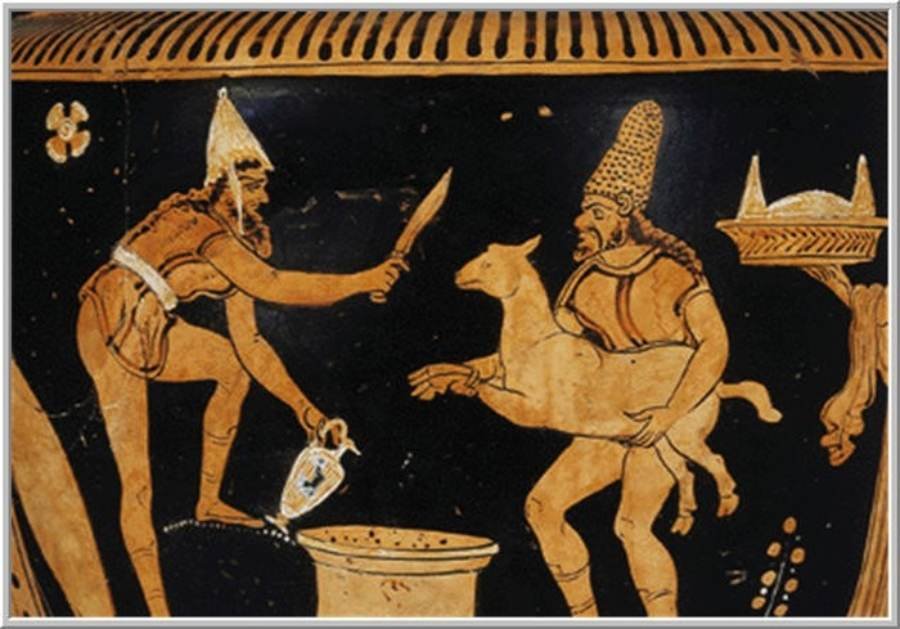
The scapegoat spiritually symbolizes transferred blame, unwanted burdens, sacrifice, purification, rejection, release, and transformation. At its core, the symbol represents a person or being made to carry something that others want removed from themselves. That burden may represent guilt, shame, wrongdoing, conflict, or responsibility.
The spiritual symbolism of the scapegoat has deep religious roots. In Leviticus 16, a goat is associated with the removal of the Israelites’ sins during the Day of Atonement ritual. The animal is sent into the wilderness after the people’s iniquities are symbolically placed upon it. This movement from the community into the wilderness creates a powerful pattern of burden, separation, and removal that continues to influence how the scapegoat is understood today.
Beyond its biblical context, the scapegoat can represent personal and collective spiritual experiences. A person who becomes a scapegoat may carry blame that belongs to a family, group, or community. From a spiritual perspective, this symbolism raises questions about responsibility, projection, boundaries, forgiveness, and the parts of ourselves we refuse to acknowledge. Understanding these connections reveals why the scapegoat is not only a symbol of suffering and rejection but also one of release, self-awareness, and transformation.
What Does a Scapegoat Mean Spiritually?
A scapegoat spiritually represents a person or being that carries blame, guilt, shame, or unwanted burdens on behalf of others. The central idea is transfer: something considered negative is assigned to an external recipient so that another person or group can separate itself from it. This makes the scapegoat a symbol of both burden and removal. In a spiritual context, the burden does not have to be literal wrongdoing. It can represent unresolved guilt, suppressed emotions, family conflict, collective shame, or responsibility that people refuse to acknowledge themselves.
The scapegoat also symbolizes the difference between genuine responsibility and transferred responsibility. A person is responsible for their own actions, but scapegoating occurs when responsibility belonging to other people is placed upon a single target. For example, a family experiencing unresolved conflict may repeatedly blame one member for problems created by several people. Spiritually, the scapegoat then represents the danger of accepting an identity built around accusations, expectations, or shame that originated elsewhere.
A second layer of the symbol involves separation and release. The scapegoat carries what is unwanted and is then removed from the group, creating the symbolic sequence of burden → separation → removal. This pattern explains why the scapegoat can represent rejection and exclusion while simultaneously being associated with purification and release. The group experiences relief because the burden has been externalized, but the scapegoat bears the cost of that process.
The spiritual scapegoat should therefore be distinguished from the everyday use of the term. In ordinary language, a scapegoat is someone unfairly blamed for another person’s mistakes. Spiritually, the symbol has a broader meaning because it raises questions about what people do with guilt, shame, responsibility, and unwanted parts of themselves. It asks whether those burdens are consciously acknowledged and resolved or simply transferred to someone else.
What Are the Spiritual Meanings of the Scapegoat?
There are 9 main spiritual meanings of the scapegoat: blame, transferred burdens, sacrifice, purification, rejection, projection, the shadow self, release, and transformation. These meanings are interconnected because each describes a different stage or consequence of transferring something unwanted from one person or group onto another.
1. Blame. The scapegoat symbolizes blame because it becomes the target held responsible for a problem. Spiritually, blame becomes significant when it replaces honest self-examination. Instead of recognizing personal wrongdoing, unresolved conflict, or shared responsibility, a person or group directs the problem toward an external target. A family, for example, may describe one member as the cause of every conflict even when the problems involve several relationships. The scapegoat therefore represents what happens when accountability is replaced by blame.
2. Transferred burdens. The scapegoat represents burdens that originate with someone else but are carried by another person. These burdens can include guilt, shame, expectations, emotional conflict, or responsibility. The spiritual lesson concerns ownership: carrying another person’s pain through compassion is different from accepting responsibility for that person’s choices. Someone who is repeatedly told that they are responsible for another person’s anger may eventually internalize that burden even though the anger originates with the other individual.
3. Sacrifice. The scapegoat symbolizes sacrifice because one individual bears a cost that allows a larger group to experience relief or restored order. The cost may involve reputation, belonging, emotional security, or social acceptance. This does not mean every sacrifice is an example of scapegoating. The distinction is that a scapegoat receives a burden connected to the needs or conflicts of others. Spiritually, the symbol encourages examination of who pays the price when a community attempts to preserve harmony without addressing the actual source of its problems.
4. Purification. Purification is one of the oldest layers of scapegoat symbolism. The underlying pattern is impurity → transfer → removal → cleansing. Something regarded as undesirable is symbolically placed outside the individual or community and then removed. In spiritual interpretation, this can represent the desire to become free from guilt, wrongdoing, or emotional heaviness. However, genuine purification requires acknowledgment and change. Simply assigning unwanted qualities to another person does not resolve their source.
5. Rejection. The scapegoat symbolizes rejection because the recipient of the burden is separated from those who transferred it. Separation may appear as exclusion from a family, community, friendship group, or other social structure. Spiritually, this theme raises questions about belonging and identity. A rejected person may begin to believe that exclusion proves something about their worth. The scapegoat symbol challenges that assumption by showing that rejection can also reflect the fears, conflicts, or needs of the group performing the rejection.
6. Projection. The scapegoat represents projection when people attribute qualities, emotions, or faults they resist recognizing in themselves to someone else. The external person becomes easier to condemn than the internal problem is to confront. For example, someone unwilling to acknowledge their own jealousy may repeatedly accuse another person of being jealous. Spiritually, recognizing projection redirects attention from controlling the external target toward examining the internal source of the judgment.
7. The shadow self. The scapegoat is connected to the shadow because both concepts involve qualities that are rejected from conscious identity. The shadow represents aspects of oneself that a person does not want to recognize or integrate. When these qualities are projected outward, another individual can become a symbolic container for them. A group that sees itself as completely harmonious, for example, may concentrate its anger and conflict onto one member rather than acknowledging that conflict exists throughout the group. The scapegoat can therefore reveal what an individual or collective identity refuses to see in itself.
8. Release. The scapegoat symbolizes release because the transferred burden is ultimately carried away from its original source. Spiritually, release can represent letting go of guilt, shame, resentment, or an identity imposed by others. Healthy release differs from scapegoating because it does not require transferring pain to a new target. A person can acknowledge a mistake, make amends, learn from it, and release excessive guilt without making someone else responsible for the discomfort.
9. Transformation. The final spiritual meaning of the scapegoat is transformation. Once misplaced blame, inherited shame, or projected identity is recognized, a person has an opportunity to relate to those burdens differently. The process follows the symbolic movement of burden → recognition → separation → release → transformation. For someone who has been scapegoated, transformation can mean recognizing which responsibilities genuinely belong to them, rejecting those that do not, and rebuilding an identity that is no longer defined by the role assigned by others.
What Is the Biblical Origin of the Scapegoat?
The biblical origin of the scapegoat comes from the Day of Atonement ritual described in Leviticus 16, where one goat carries the Israelites’ confessed sins into the wilderness. The ritual involves two goats presented before God. One is designated for the Lord and offered as a sin offering, while the other remains alive and is associated with Azazel before being sent away. Together, the two goats form part of a larger purification and atonement ritual concerning the people and the sanctuary.
The living goat provides the clearest foundation for later scapegoat symbolism. According to Leviticus 16, Aaron places both hands on the goat’s head and confesses over it the Israelites’ iniquities, transgressions, and sins. The goat then carries these iniquities away to a remote place. The sequence creates a concrete symbolic pattern: confession → transfer → carrying → removal. The goat does not simply represent wrongdoing; it becomes the bearer through which that wrongdoing is symbolically removed from the community.
This biblical context explains why the scapegoat later became associated with guilt, burden, purification, and release. The original ritual, however, should not be reduced to the modern idea of unfairly blaming an innocent person. Its biblical function belongs to a specific ritual of atonement and purification. The modern meaning of “scapegoat” developed into the idea of a person made to bear responsibility for the faults of others, while spiritual interpretations draw additional symbolism from the older themes of carrying and removing burdens.
What Does Azazel Mean in the Scapegoat Ritual?
Azazel is the figure or term associated with the living goat sent into the wilderness in Leviticus 16, but its exact meaning has been interpreted in different ways. This distinction matters because Azazel should not automatically be presented as one specific spiritual being or concept when discussing the biblical text. Interpretations have included a wilderness-associated figure, a destination, and other understandings of the Hebrew term.
For the spiritual meaning of the scapegoat, the most important point is the function of the ritual rather than choosing one disputed interpretation of Azazel. The goat associated with Azazel carries the confessed iniquities away from the community. This reinforces the central themes of separation and removal: what has been placed upon the goat leaves the place from which it came.
Azazel therefore adds a wilderness dimension to scapegoat symbolism. The burden is not merely identified; it is carried beyond the community’s boundaries. In later spiritual interpretation, this movement can symbolize the need to confront what is unwanted before releasing it. The ritual itself should remain distinct from modern practices such as shadow work, but the pattern provides a useful symbolic framework for understanding why the scapegoat became connected with guilt, separation, and release.
Why Was the Scapegoat Sent Into the Wilderness?
The scapegoat was sent into the wilderness to carry the confessed iniquities of the Israelites away from the community as part of the Day of Atonement ritual. Leviticus 16 describes the goat as bearing the iniquities to a remote land. The wilderness therefore serves an important function in the ritual: the burden placed upon the goat is physically removed from the community rather than remaining within it.
This creates the symbolic sequence of burden → separation → removal. First, the iniquities are acknowledged through confession. Second, they are symbolically placed upon the goat. Third, the goat is separated from the community. Finally, it carries the burden away. The spiritual significance of this sequence lies in the distinction between recognizing a burden and releasing it. Something must first be identified before it can meaningfully be left behind.
The wilderness can also symbolize separation from an established social and sacred order. Within the scapegoat narrative, movement toward a remote place makes the removal visible and final. This helps explain why later spiritual readings associate the scapegoat with exile, rejection, letting go, and the removal of unwanted burdens. These are interpretations drawn from the structure of the ritual rather than explicit definitions assigned to the wilderness by the biblical passage itself.
For personal spiritual reflection, the wilderness motif can represent creating distance from guilt, shame, or identities that no longer belong to a person. The lesson is not to transfer those burdens onto someone else. A healthier parallel is to identify what genuinely belongs to you, take responsibility for it, and release what does not. In this sense, the scapegoat’s journey into the wilderness provides a symbolic distinction between release through awareness and relief through blame.
What Is the Spiritual Meaning of Being the Scapegoat?
Being the scapegoat spiritually represents carrying blame, shame, responsibility, or emotional burdens that other people have placed upon you. The central spiritual lesson is not that suffering makes someone special, but that personal identity should be separated from burdens that originate with other people. Being blamed repeatedly can make an assigned role feel like an accurate description of who you are, even when the role reflects unresolved problems within a family, relationship, or group.
The first distinction is between responsibility and transferred responsibility. Genuine responsibility comes from your own choices and actions. Transferred responsibility occurs when you are expected to answer for another person’s behavior, emotions, or conflicts. For example, accepting responsibility for words that hurt someone is accountability. Accepting the belief that you are responsible for every argument within a family is different. Spiritually, recognizing this boundary allows you to acknowledge your own mistakes without carrying guilt that belongs elsewhere.
Being the scapegoat can also symbolize rejection. A group may preserve its preferred image of itself by identifying one person as the source of its problems. The scapegoated person becomes the outsider while the remaining members avoid confronting conflicts within the group. Rejection in this context does not automatically prove that the rejected person is wrong, unworthy, or spiritually deficient. It can reveal a conflict between the identity assigned by others and the identity a person develops through honest self-examination.
The experience can lead to spiritual growth, but scapegoating itself is not spiritually beneficial or necessary for growth. Transformation comes from how a person responds to the experience. Examining accusations honestly, accepting valid responsibility, rejecting false responsibility, and establishing clearer boundaries can turn an imposed role into an opportunity for greater self-awareness. The lesson is not to celebrate rejection but to stop allowing another person’s unresolved burden to define your identity.
How Is Scapegoating Connected to Shadow Work?
Scapegoating is connected to shadow work through projection, because qualities that a person or group refuses to recognize internally can be attributed to an external target. Shadow work involves examining rejected, suppressed, or uncomfortable aspects of the self rather than automatically locating them in other people. Scapegoating represents the opposite movement: the unwanted quality is pushed outward and associated with someone else.
The mechanism can be expressed as unaccepted quality → projection → external target → blame. A person who strongly identifies as generous, for example, may have difficulty acknowledging their own selfish impulses. Instead of recognizing that both generosity and self-interest can exist within the same person, they may become unusually focused on another person’s selfish behavior. When repeated accusations make that individual responsible for broader problems, projection can contribute to a scapegoating pattern.
Shadow work interrupts this process by redirecting the question. Instead of asking only, “What is wrong with this person?” it also asks, “Why does this quality produce such a strong reaction in me, and does any part of it exist within my own behavior?” This does not mean every criticism is projection. Another person can genuinely behave dishonestly, selfishly, or irresponsibly. Shadow work requires distinguishing observable behavior from judgments intensified by qualities a person does not want to recognize in themselves.
What Can a Scapegoat Reveal About the Collective Shadow?
A scapegoat can reveal a collective shadow by becoming the person onto whom a family, group, or community concentrates qualities and conflicts it does not want to recognize as shared problems. The collective shadow operates at the group level rather than only within one individual. A group develops an identity around what it believes it is, while characteristics inconsistent with that identity become difficult to acknowledge.
A family that defines itself as peaceful provides a simple example. Anger may still exist among several family members, but openly recognizing that anger would challenge the family’s preferred identity. If one member expresses frustration more visibly, the group may label that person as “the angry one.” Attention then remains focused on that individual while resentment, hostility, or poor communication among the other members receives less examination. The scapegoat becomes a container for a quality that exists more broadly than the group admits.
Recognizing the collective shadow does not mean assuming that the scapegoat is innocent in every conflict. The purpose is to restore accurate responsibility. Each person remains accountable for their own behavior, including the scapegoated individual. The spiritual problem begins when one person is made responsible for what belongs to several people. Examining the collective shadow replaces this simplified narrative with a more precise question: which emotions, behaviors, and responsibilities genuinely belong to each person?
Shadow work can therefore help break a scapegoating pattern by making projection more visible. The process involves identifying repeated accusations, examining whether responsibility has been distributed accurately, recognizing disowned emotions, and establishing boundaries when blame continues to be transferred. The goal is not to find a new person to blame. It is to stop using another person as a container for what must be acknowledged within oneself.
What Spiritual Lessons Can You Learn From Being a Scapegoat?
There are 5 main spiritual lessons you can learn from being a scapegoat: separate blame from responsibility, take ownership of your own actions, recognize projection, establish boundaries, and release shame without transferring it to someone else. These lessons do not mean that being scapegoated is necessary for spiritual development. They describe ways to respond to the experience without allowing an imposed role to determine your identity.
1. Do not carry responsibility that belongs to someone else. Being repeatedly blamed can make another person’s emotions or actions feel like your responsibility. The spiritual lesson is to distinguish what you caused from what was assigned to you. If someone becomes angry because you set a reasonable boundary, for example, you are responsible for communicating that boundary respectfully, but you are not automatically responsible for their anger. This distinction prevents compassion from turning into unnecessary guilt.
2. Take responsibility for what genuinely belongs to you. Rejecting false blame should not become a reason to reject all criticism. Spiritual maturity requires examining your behavior without either absorbing every accusation or dismissing every uncomfortable truth. If you contributed to a conflict through dishonesty, harsh words, or avoidance, acknowledging that behavior restores genuine accountability. The goal is accurate responsibility: neither carrying too much nor refusing to carry what is actually yours.
3. Recognize projection before internalizing blame. Repeated accusations can become part of a person’s self-image when they are accepted without examination. Recognizing projection creates space between what another person says and what you believe about yourself. For example, being repeatedly called selfish does not by itself establish that selfishness defines your character. Examine specific behavior, compare the accusation with observable actions, and determine whether the criticism reflects your conduct, the other person’s expectations, or a combination of both.
4. Establish boundaries around repeated scapegoating. Boundaries define which responsibilities, behaviors, and forms of communication you will accept. They are especially important when the same blame pattern continues after attempts at honest discussion. A boundary might involve refusing responsibility for another adult’s choices, ending a conversation when it becomes abusive, or limiting participation in situations where accusations repeatedly replace constructive communication. Spiritually, boundaries protect the distinction between compassion for others and surrendering your identity to their judgments.
5. Release shame without giving it to someone else. The deepest lesson of the scapegoat symbol concerns how unwanted burdens are released. Scapegoating creates relief by moving the burden onto another target, but healthy release does not require a replacement victim. Shame can instead be examined, connected to its actual source, addressed through accountability where necessary, and released when it no longer serves a constructive purpose. This breaks the cycle in which one person’s unresolved burden becomes another person’s identity.
Together, these 5 lessons transform the symbolism of the scapegoat from a pattern of transferred blame into a framework for self-examination. The central question changes from “Who should carry this burden?” to “Whose responsibility is this, and what should be done with it?” That shift creates space for accountability without unnecessary shame and compassion without self-erasure.
Read more: Spiritual Meaning Of Diamond
How Can You Heal Spiritually After Being Scapegoated?
Spiritual healing after being scapegoated begins by separating your identity from assigned blame, identifying which responsibilities genuinely belong to you, and releasing guilt or shame that does not. Healing does not require pretending the experience never happened. It requires changing your relationship with the role so that accusations from a family, relationship, or group no longer function as the primary definition of who you are.
The first step is to separate identity from accusation. An accusation describes another person’s judgment about you; it does not automatically establish a fact about your character. Examine specific claims instead of accepting broad labels. “You forgot to do something you promised” describes an action that can be evaluated. “You ruin everything” turns many events into a fixed identity. The first statement allows accountability, while the second can reinforce a scapegoat role by making one person responsible for problems far beyond a single action.
The second step is to identify genuine responsibility. Ask what you actually did, what consequences followed from your actions, and what corrective action belongs to you. This process prevents healing from becoming denial. If an accusation contains truth, acknowledge that part and address it. If responsibility belongs partly or entirely to someone else, leave that responsibility with its source. Accurate ownership weakens the scapegoat pattern because it prevents both excessive guilt and avoidance of accountability.
The third step is to release misplaced guilt and shame. Guilt relates to what you believe you have done, while shame can become attached to what you believe you are. When blame has been repeated for a long period, specific accusations can develop into beliefs such as “I am the problem” or “Everything goes wrong because of me.” Spiritual reflection can challenge these beliefs by returning attention to concrete actions, values, and responsibilities rather than inherited labels.
The fourth step is to establish boundaries that prevent the role from being continually reinforced. A boundary can define what conversations you will participate in, which responsibilities you will accept, and how you respond when blame becomes generalized or abusive. For example, you can acknowledge responsibility for a specific mistake while refusing responsibility for another person’s choices. The purpose of the boundary is not retaliation. It is to prevent responsibility from becoming distorted.
Healing also requires avoiding the temptation to reverse the scapegoat pattern. After recognizing that you were unfairly blamed, it can be tempting to identify another person as the sole cause of everything that happened. Doing so preserves the same structure with a different target. A more complete spiritual response recognizes wrongdoing where it occurred while allowing different people to carry their own responsibilities.
The final movement is release without transfer. You do not need another person to carry your shame in order to become free from it. You can acknowledge what belongs to you, make changes where necessary, and let go of what was never yours. This reverses the destructive mechanism of scapegoating: instead of passing burdens from person to person, each person becomes responsible for confronting and transforming their own.
Is the Scapegoat a Negative or Positive Spiritual Symbol?
The scapegoat is both a negative and transformative spiritual symbol, although its negative meanings of blame, burden, sacrifice, and rejection come first. Its positive meanings emerge from what happens when those burdens are recognized and released. The symbol therefore does not suggest that being blamed or rejected is inherently beneficial. Instead, it shows how awareness of misplaced responsibility can lead to purification, release, stronger boundaries, and personal transformation.
The negative side of the scapegoat appears most clearly through blame and burden. A scapegoat carries something unwanted by another person or group, whether that burden represents guilt, wrongdoing, shame, conflict, or responsibility. When this pattern appears between people, the scapegoated individual may become identified with problems that have several causes. The spiritual danger is internalization: repeated blame can turn an external judgment into an internal belief about identity.
Sacrifice and rejection form the second negative dimension. The scapegoat may lose belonging, reputation, emotional security, or acceptance so that a group can maintain its preferred understanding of itself. This explains why exclusion is central to the symbol. The scapegoat becomes separated from the group while carrying what the group wants removed. The result may create relief for others without resolving the underlying source of their conflict.
The transformative side begins with recognition. Once blame and projection are identified, responsibility can be redistributed according to actual actions rather than assigned roles. A person who has been scapegoated can acknowledge genuine mistakes without accepting responsibility for everything that happens around them. Likewise, someone who recognizes that they have scapegoated another person can examine the guilt, fear, anger, or unwanted qualities that were being projected outward.
Purification and release represent the next stage of the symbol. In its biblical foundation, the scapegoat carries confessed iniquities away from the community. In personal spiritual reflection, this pattern can represent identifying a burden before releasing it. The crucial difference is that healthy spiritual release does not require another person to become the bearer. Guilt can lead to accountability, shame can be examined, resentment can be addressed, and an imposed identity can be rejected without transferring those burdens elsewhere.
Transformation completes the symbolism. For someone who has carried misplaced blame, transformation means developing an identity based on honest self-knowledge rather than the role assigned by others. For someone who has projected blame, transformation means reclaiming responsibility for what was previously externalized. In both cases, the spiritual movement is away from unconscious transfer and toward conscious ownership.
The complete spiritual pattern of the scapegoat can therefore be expressed as blame → burden → separation → recognition → release → transformation. Its darker meanings reveal what happens when individuals or groups refuse to carry their own unresolved burdens. Its transformative meanings reveal what becomes possible when those burdens are recognized, assigned to their true source, and released without creating another scapegoat.