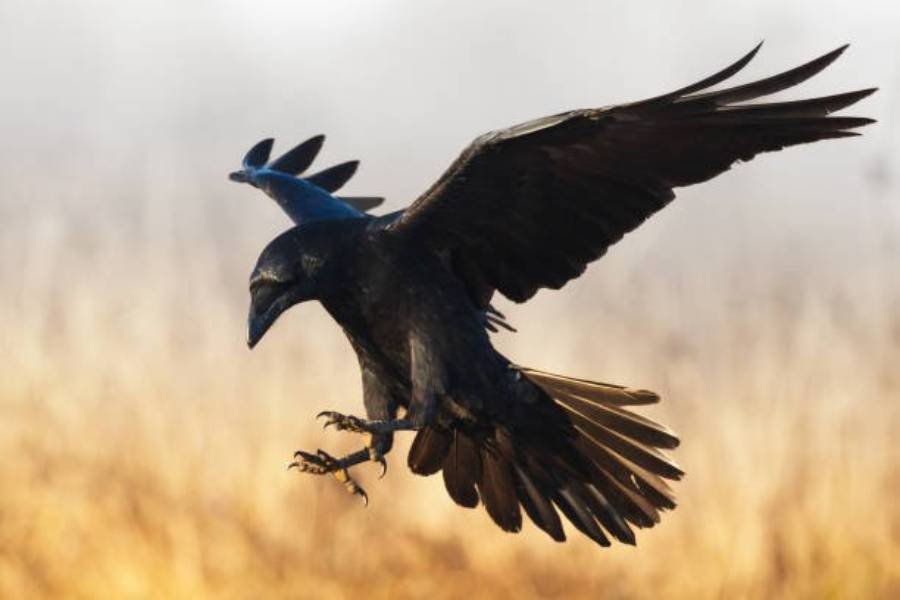
Ravens and crows spiritually symbolize transformation, intelligence, intuition, mystery, spiritual messages, protection, and the cycle of death and rebirth. Their dark appearance, remarkable intelligence, distinctive calls, and long-standing presence in mythology and folklore have connected these birds with both the unknown and periods of significant change. Seeing one does not automatically predict a negative event; its symbolic meaning depends on the species, behavior, number of birds, location, and cultural or personal context surrounding the encounter.
Ravens and crows share several spiritual associations, but their symbolism is not identical. Ravens are more strongly associated with mystery, transformation, hidden knowledge, and transitions, while crows commonly represent intelligence, adaptability, awareness, communication, and social connection. These associations also vary between spiritual traditions, mythology, and folklore rather than forming one universal interpretation.
The meaning can become more specific when a raven or crow repeatedly appears, crosses your path, follows you, circles overhead, calls nearby, or appears in a dream. The number of birds can also change the symbolic interpretation. This guide explains the spiritual meanings of ravens and crows, their differences, encounter symbolism, number meanings, dreams, connections with death and omens, and their roles within different cultural traditions.
What Do Ravens and Crows Mean Spiritually?
Ravens and crows have 7 main spiritual meanings: transformation, intelligence, intuition, mystery, spiritual messages, protection, and death and rebirth. These meanings come from a combination of the birds’ observable characteristics and the symbolic roles assigned to them through mythology, folklore, and spiritual traditions. The exact interpretation varies according to the bird, encounter, and cultural context.
Transformation is one of the strongest spiritual meanings associated with ravens and crows. Both birds are connected symbolically with endings, transitions, and the beginning of a new stage. In this context, an ending does not necessarily mean physical death. It can represent leaving a relationship, changing a career, abandoning an old belief, or moving into a different stage of personal development. A raven or crow appearing during such a period can therefore be interpreted as a symbol of transition rather than a prediction of what will happen next.
Intelligence and awareness are associated with ravens and crows because corvids display advanced problem-solving and adaptive behaviors. Spiritually, these characteristics translate into symbolism related to observation, resourcefulness, and paying closer attention to a situation before acting. A crow appearing during a difficult decision, for example, may be interpreted as a reminder to observe the available information and adapt rather than continue using an approach that is not working.
Intuition and mystery connect ravens and crows with information that is hidden, overlooked, or not immediately understood. Their black plumage and historical associations with darkness have strengthened this symbolism. Darkness in spiritual interpretation does not have to represent evil; it can represent the unknown, the unconscious, or something that has not yet been revealed. A raven encounter can therefore symbolize a need to examine an unresolved situation or acknowledge information that has been ignored.
Ravens and crows are also interpreted as spiritual messengers in several symbolic traditions. This meaning treats their appearance or distinctive calls as prompts for attention, reflection, or awareness. It does not establish that every raven or crow carries a supernatural message. The useful interpretation comes from combining the encounter with its context, such as what was happening at the time, whether the bird appeared repeatedly, and whether the experience had personal significance.
Protection is another meaning attributed to ravens and crows, particularly when their intelligence and watchful behavior are interpreted symbolically. Protection in this context can mean recognizing danger, establishing personal boundaries, or becoming more aware of the people and circumstances around you. For example, repeatedly noticing crows during a period of uncertainty may be interpreted as a reminder to remain observant rather than as evidence that the birds are physically protecting you.
Death and rebirth complete the transformation symbolism of ravens and crows. Their historical connection with death, carrion, and dark imagery has given them a negative reputation in some traditions, but spiritual interpretations frequently extend death symbolism to closure and renewal. The end of one identity, habit, relationship, or life stage creates the conditions for another to begin. For this reason, raven and crow symbolism can represent both an ending and the transformation that follows it.
What Is the Difference Between Raven and Crow Spiritual Meaning?
Raven and crow spiritual meanings overlap, but ravens are more strongly associated with mystery, transformation, hidden knowledge, and major transitions, while crows are commonly associated with intelligence, adaptability, awareness, communication, and community. The distinction is not absolute because mythology, folklore, and modern spiritual practices assign different meanings to both birds.
Raven symbolism places greater emphasis on mystery and transformation. A raven can represent entering an unfamiliar stage, confronting hidden aspects of yourself, gaining knowledge through introspection, or leaving an old identity behind. Its symbolism therefore fits experiences involving profound personal change, uncertainty, and exploration of what is not immediately visible or understood.
Crow symbolism places greater emphasis on awareness and adaptability. Crows are highly social and observant birds, so spiritual interpretations frequently connect them with communication, intelligence, resourcefulness, and relationships with others. Seeing a crow can consequently be interpreted as a prompt to pay attention to your environment, reconsider how you communicate, or adapt your approach to a changing situation.
The two birds share symbolism related to intelligence, change, intuition, death, and spiritual messages, which explains why their meanings are frequently combined. However, identifying whether you encountered a raven or a crow can add specificity to the interpretation. A raven encounter may place greater symbolic emphasis on inner transformation or mystery, whereas a crow encounter may emphasize observation, adaptation, or social connections.
Neither distinction should be treated as a universal spiritual rule. The meaning changes according to cultural tradition, personal belief, and encounter context. A raven in Norse mythology, for example, carries a different contextual meaning from a crow interpreted through modern spiritual symbolism. The strongest interpretation therefore considers both the species and the symbolic framework being used rather than assigning one fixed meaning to every raven or crow.
What Does Seeing a Raven Mean Spiritually?
Seeing a raven spiritually represents transformation, introspection, hidden knowledge, heightened awareness, or the transition from one stage of life to another. The raven’s meaning becomes more specific when the circumstances of the encounter are considered, including where the raven appeared, what it was doing, whether the encounter happened repeatedly, and what was occurring in your life at the time.
A raven crossing your path can symbolize a transition that requires attention. Crossing paths creates a natural symbolic boundary between what came before the encounter and what comes after it, which is why this experience is often interpreted in relation to change. For example, seeing a raven while considering a career change, ending a relationship, or moving to a new place may encourage reflection on the transition already taking place. The encounter does not predict the outcome of that decision; its spiritual significance comes from how the symbolism relates to the existing situation.
Seeing a raven repeatedly can symbolize a subject that deserves deeper examination. Repetition increases the prominence of an encounter and can make the experience feel personally significant. Within a spiritual interpretation, recurring ravens may represent unresolved change, overlooked information, or a need for greater self-awareness. A person repeatedly encountering ravens during a period of uncertainty, for instance, might use the experience as a prompt to identify what remains unclear rather than interpret the birds as a literal instruction.
A raven visiting your home can represent change, awareness, or reflection connected with your personal life. The home commonly symbolizes security, family, privacy, and personal boundaries, so a raven appearing around a roof, yard, balcony, or window can take on meanings related to these areas. The interpretation should still account for natural explanations, such as food, nesting sites, or familiar bird behavior. A spiritual meaning and a biological explanation do not have to be treated as mutually exclusive.
The strongest spiritual interpretation of seeing a raven therefore comes from connecting the raven’s symbolism with the context of the encounter. Transformation is more relevant when a major change is already occurring, while introspection becomes more relevant when the person faces uncertainty or unresolved questions. This contextual approach provides a more precise interpretation than assuming every raven appearance carries the same spiritual message.
What Does Seeing a Crow Mean Spiritually?
Seeing a crow spiritually represents awareness, intelligence, adaptability, communication, change, or social connection. Crow symbolism places particular emphasis on observing what is happening around you and responding intelligently to changing circumstances. The bird’s behavior, frequency of appearance, location, and number can further refine this interpretation.
A crow crossing your path can symbolize a need to notice something before making your next move. Because crows are associated with observation and adaptability, crossing-path symbolism can relate to decisions, changing circumstances, or information that deserves closer attention. For example, encountering a crow while dealing with a difficult choice can symbolically reinforce the value of examining the situation before acting rather than functioning as a prediction about which choice will succeed.
Repeated crow sightings can represent recurring themes that require awareness or adaptation. The relevant theme might involve communication, relationships, work, personal boundaries, or another situation that continues to demand attention. If the same type of encounter occurs several times, recording the location, behavior of the crow, and circumstances surrounding each sighting can help identify whether the experience has a consistent personal meaning.
A crow visiting your home can symbolize awareness involving family, relationships, security, or personal boundaries because these concepts are closely associated with the home. A single crow sitting near a window may create a different symbolic impression from several crows gathering regularly in a yard. The first encounter emphasizes the individual bird and its behavior, while the second introduces number and group symbolism that can relate more strongly to community and social connections.
Crow encounters can also highlight communication when vocalization is a prominent part of the experience. A crow repeatedly cawing nearby may be interpreted symbolically as a call for attention because its sound is the dominant characteristic of the encounter. However, crows naturally vocalize to communicate with other birds, respond to threats, and interact with their environment. The spiritual interpretation concerns what the encounter represents to the observer rather than establishing that the crow is deliberately delivering a supernatural message.
The spiritual meaning of seeing a crow is therefore most useful when the symbolism matches the circumstances rather than being applied as a fixed rule. Awareness fits encounters occurring around overlooked information, adaptability fits periods of change, and communication fits situations involving relationships or unresolved conversations. This keeps crow symbolism specific to the encounter instead of assigning identical meanings to every sighting.
What Does the Number of Ravens or Crows You See Mean?
The number of ravens or crows you see can change the spiritual interpretation of an encounter, with one bird emphasizing individuality, two emphasizing partnership, three emphasizing development, and four or more emphasizing community or collective change. Number meanings belong primarily to folklore, numerological traditions, and modern spiritual interpretation, so they should not be treated as universal meanings shared across every culture.
What Does Seeing One Raven or Crow Mean?
Seeing one raven or crow can symbolize independence, self-awareness, personal transformation, or a message that relates specifically to you. A solitary bird places the symbolic focus on the individual rather than relationships or community. For a raven, this meaning can lean toward introspection, mystery, and inner transformation. For a crow, it can lean toward awareness, intelligence, and independent decision-making.
Context determines which interpretation is most relevant. Seeing one raven during a major personal transition, for example, can symbolize the need to examine how your identity is changing. Seeing one crow while facing a difficult decision can instead represent observation and the need to evaluate the situation carefully. Neither encounter establishes that a specific future event will occur.
What Does Seeing Two Ravens or Crows Mean?
Seeing two ravens or crows can symbolize partnership, balance, duality, or an important relationship. The presence of a pair shifts the symbolic focus from the individual toward interaction between two people, choices, forces, or aspects of life.
Two birds may therefore carry particular significance when relationships are already central to your circumstances. For example, seeing two crows during a period of conflict with a partner can be interpreted through themes of communication, cooperation, and balance. Two ravens may place greater emphasis on undergoing a transition together or reconciling two opposing aspects of a situation.
What Does Seeing Three Ravens or Crows Mean?
Seeing three ravens or crows can symbolize development, progression, or the completion of a symbolic cycle. Groups of three have acquired significance in numerous religious, folkloric, and numerological systems, although the exact interpretation differs between traditions.
In a personal spiritual interpretation, three birds can represent movement from one condition into another through an intermediate stage. This makes the symbolism particularly relevant to gradual change rather than an immediate event. Three ravens appearing during a period of personal growth, for example, might be interpreted as reflecting an ongoing transformation rather than announcing its outcome.
What Does Seeing Four or More Ravens or Crows Mean?
Seeing four or more ravens or crows can symbolize community, collective energy, social relationships, or a larger period of change. As the number of birds increases, interpretation shifts away from individual symbolism and toward the group.
This association is particularly relevant to crows because their social behavior is one of their defining characteristics. A gathering of crows can therefore symbolically relate to family, friendships, teamwork, social pressures, or your position within a community. A larger gathering of ravens or crows may also represent circumstances involving several people rather than a change affecting only one individual.
Large groups have natural explanations as well. Crows can gather to roost, feed, respond to threats, and interact socially. The presence of many birds therefore does not prove that a spiritual event is occurring. Number symbolism provides an interpretive framework for people who assign personal or spiritual significance to the encounter.
What Does It Mean When a Raven or Crow Follows You?
A raven or crow following you can spiritually symbolize heightened attention, observation, unresolved change, or something in your life that requires closer examination. The symbolism comes primarily from the sense of continued attention created by the encounter. A bird that remains nearby feels more personally significant than one that appears briefly and disappears.
For ravens, following symbolism can emphasize introspection and unresolved transformation. If a raven repeatedly moves in the same direction as you during a period of major change, the encounter can serve as a symbolic prompt to examine what you are leaving behind and what the transition requires from you. The raven does not determine the direction of the change; it represents themes already associated with transformation and the unknown.
For crows, following symbolism more strongly emphasizes awareness, observation, and adaptability. A crow remaining nearby can symbolically suggest that a situation deserves closer attention or that your response needs to change. For example, during an unresolved conflict, the encounter may be interpreted as a reminder to observe patterns of communication and reconsider how you are responding to them.
Natural behavior should also be considered before assigning a spiritual explanation. Ravens and crows can remain close to people because they associate humans with food, recognize familiar individuals, defend territory, protect young birds, or simply move through the same area. A bird appearing to follow someone therefore has a behavioral explanation in many circumstances.
The most precise spiritual interpretation combines the bird species, repetition, behavior, location, and your current circumstances. A single crow briefly moving alongside you is different from a raven appearing repeatedly at several meaningful moments. The encounter can hold personal symbolic value without being treated as proof that the bird was intentionally sent to deliver a supernatural message.
What Does It Mean When Ravens or Crows Circle Above You?
Ravens or crows circling above you can spiritually symbolize heightened awareness, a need for perspective, observation, or an approaching transition. The circular movement creates symbolism related to cycles and repeated patterns, while the birds’ position overhead can represent seeing a situation from a broader perspective. The meaning becomes more specific when the behavior occurs repeatedly or during an important period of change.
Perspective is a particularly relevant interpretation because viewing something from above symbolically represents moving beyond immediate details. A person facing a complicated decision, for example, might interpret circling ravens or crows as a prompt to consider the entire situation rather than focusing on one problem. Raven symbolism can add themes of transformation and the unknown, while crow symbolism can add themes of intelligence and adaptability.
Circling can also symbolize cycles that have not yet been completed. A recurring relationship problem, repeated behavioral pattern, or unresolved decision can fit this interpretation because each involves returning to the same point. In this context, the encounter serves as a symbolic reminder to identify what keeps repeating and determine what needs to change before the cycle can end.
Natural bird behavior remains an important part of the context. Ravens and crows may circle while using air currents, observing food sources, interacting with other birds, or responding to activity below. Circling overhead therefore does not establish that the birds are monitoring a person or predicting an event. A spiritual interpretation describes the symbolic significance assigned to the experience rather than replacing its natural explanation.
What Does Hearing a Raven or Crow Caw Mean Spiritually?
Hearing a raven or crow caw can spiritually symbolize communication, attention, warning, or a need to become more aware of your surroundings. Sound is the dominant element of this encounter, so its symbolism centers more strongly on receiving, expressing, or noticing information than on transformation alone.
A sudden call that attracts your attention can represent a symbolic prompt to notice what you have overlooked. This interpretation is especially relevant when communication is already an important issue in your life. For example, hearing repeated crow calls while dealing with an unresolved conversation may encourage reflection on what has been left unsaid, misunderstood, or ignored.
The emotional response produced by the call also affects personal interpretation. A call that creates curiosity can be associated with awareness or discovery, while one experienced during a tense situation may be interpreted as a warning. The sound itself does not objectively confirm either meaning. The distinction comes from the relationship between the encounter, the observer’s circumstances, and the symbolic framework being applied.
Ravens and crows also use vocalizations naturally to communicate with other birds, signal threats, maintain social relationships, and respond to their environment. Hearing a crow caw is therefore not evidence by itself that a spiritual message has been directed toward you. Within spiritual symbolism, the encounter becomes meaningful when the sound prompts reflection that connects with a relevant situation in your life.
What Does Dreaming About Ravens or Crows Mean?
Dreaming about ravens or crows can symbolize transformation, hidden thoughts, awareness, fear, unresolved conflict, or the ending of a life stage. The strongest interpretation depends on what the bird does in the dream, how you respond to it, and the emotional tone of the experience. A calm raven watching from a distance carries a different symbolic context from an aggressive crow or a dead bird.
A black raven or crow in a dream can represent mystery, the unknown, or information that has not yet reached conscious awareness. Black is frequently used symbolically to represent what is hidden or unseen, while ravens and crows already carry associations with observation and mystery. A calm black raven appearing during a period of uncertainty, for example, can be interpreted as an invitation to examine information or emotions that have not yet been fully acknowledged.
A raven or crow attacking you in a dream can symbolize conflict, fear, pressure, or a problem you are avoiding. The aggressive behavior shifts the interpretation away from passive observation and toward confrontation. If the dream occurs during an ongoing disagreement or stressful decision, the attacking bird may symbolically represent the emotional pressure associated with that unresolved situation rather than an external threat that will occur in the future.
A dead raven or crow in a dream can symbolize closure, the end of a cycle, or release from an old pattern. Death symbolism in dreams does not inherently predict physical death. Within the broader symbolism of ravens and crows, death can function as the ending stage of transformation, after which another identity, relationship, habit, or phase becomes possible.
The emotional tone of the dream provides an additional interpretive constraint. Fear can point toward anxiety or unresolved conflict, curiosity toward hidden knowledge, and relief toward closure or release. For this reason, interpreting a raven or crow dream requires examining the bird’s behavior, your emotional response, the surrounding events in the dream, and your current circumstances rather than assigning one universal meaning to every appearance.
Do Ravens and Crows Symbolize Death?
Ravens and crows can symbolize death, but seeing one does not mean that a physical death will occur. Their death symbolism is better understood as a combination of historical associations with mortality and spiritual themes of endings, transition, transformation, and rebirth. In this context, death can represent the end of a relationship, identity, habit, belief, or stage of life rather than the literal death of a person.
The association between ravens, crows, and death partly comes from their connection with carrion and places where dead animals or humans were historically present. Their black plumage also strengthened their visual association with darkness, mourning, and the unknown. Over time, these characteristics contributed to the appearance of ravens and crows in folklore, mythology, literature, and spiritual traditions involving mortality and the boundary between known and unknown experiences.
Transformation gives death symbolism a second meaning: an ending creates space for something new to begin. A person leaving a long-term relationship, abandoning an established identity, or entering a completely different stage of life can experience a symbolic form of death without physical mortality. Seeing a raven during such a period may therefore be interpreted as representing the closure of the previous stage and the transformation that follows it.
Crow symbolism can express a similar transition but may place greater emphasis on adapting after the ending. For example, losing a job ends one professional stage, while finding a new direction requires awareness, intelligence, and adaptability. A crow encounter during that period can consequently fit both death symbolism, through the ending, and renewal symbolism, through the process of adapting to what comes next.
The distinction between symbol and prediction is essential. A raven sitting near a house, a group of crows gathering outside, or a raven appearing in a dream does not establish that someone will die. Interpreting these encounters as literal death predictions turns symbolic associations into claims they cannot reliably support. Within spiritual interpretation, death is more usefully understood as one possible symbol whose relevance depends on the circumstances surrounding the encounter.
Are Ravens and Crows Bad Omens?
Ravens and crows are not inherently bad omens, and seeing one does not reliably predict misfortune. Their negative reputation comes from specific cultural associations with death, darkness, battle, carrion, and the unknown. Other symbolic interpretations connect the same birds with intelligence, wisdom, protection, communication, transformation, and adaptability.
An omen is traditionally understood as a sign interpreted as indicating a future event. Raven and crow encounters have been treated as omens within different forms of folklore and spiritual belief, but the predicted meaning is not consistent. One tradition may associate a particular encounter with danger, while another may connect a similar bird with knowledge, protection, or transformation. This variation means there is no single universal rule that makes the appearance of a raven or crow either good or bad.
The circumstances of an encounter can also change its emotional interpretation. A crow calling outside during an already stressful event may feel threatening because the observer connects the sound with the existing tension. The same crow encountered during a peaceful walk may instead represent curiosity, intelligence, or awareness. The bird has not necessarily changed its symbolic properties; the surrounding context changes which attributes become most relevant.
Repeated encounters should also be interpreted through context rather than automatically classified as warnings. Seeing ravens several days in a row can occur because the birds live, feed, nest, or travel through the same area. Someone who assigns spiritual significance to the repetition may use it as a prompt to examine recurring patterns, decisions, or changes in their own life without assuming that misfortune is approaching.
A useful distinction is therefore between traditional omen symbolism and literal prediction. Ravens and crows can represent warnings within folklore or personal spiritual practice, but warning is only one attribute among several. Transformation, intelligence, awareness, protection, communication, and renewal provide alternative interpretations. The most relevant meaning depends on the species, behavior, number of birds, location, cultural framework, and circumstances of the person experiencing the encounter.
What Do Ravens and Crows Symbolize in Different Cultures?
Ravens and crows symbolize different concepts across cultural traditions, including wisdom, memory, prophecy, warfare, death, transformation, and relationships with the spiritual world. There is no universal cultural meaning for either bird. Their symbolism changes according to the stories, religious systems, historical contexts, and individual communities in which they appear.
Cultural context is particularly important because similar characteristics can produce different symbolic meanings. Black plumage may connect ravens or crows with death and the unknown in one tradition, while their intelligence may connect them with knowledge or guidance in another. Their ability to fly, vocalize conspicuously, and interact with human environments has also contributed to messenger symbolism. The bird itself therefore remains the central entity, while the cultural framework determines which attributes receive greater symbolic importance.
What Do Ravens Symbolize in Norse Mythology?
Ravens in Norse mythology strongly symbolize thought, memory, knowledge, and the gathering of information through their association with Odin. Two ravens, Huginn and Muninn, accompany Odin and travel through the world before returning with information. Their relationship with Odin makes the raven an important symbolic entity in discussions of knowledge and awareness within Norse mythology.
Huginn is commonly associated with thought, while Muninn is associated with memory. Together, they create a symbolic relationship between acquiring information and retaining or reflecting on it. This makes Norse raven symbolism more specific than a general claim that ravens represent wisdom. The symbolism emerges from the ravens’ roles and relationship with Odin rather than from their appearance alone.
Ravens also occur within a broader Norse context involving Odin, warfare, death, and those who fall in battle. This strengthens their association with mortality, but death is not their only attribute. Knowledge, observation, memory, and Odin’s search for information are equally important when interpreting raven symbolism within this mythological context.
What Do Ravens and Crows Symbolize in Celtic Traditions?
Ravens and crows in Celtic traditions can symbolize warfare, death, prophecy, sovereignty, and transformation, but their meanings depend on the specific deity, story, and historical tradition being examined. Treating all Celtic raven and crow symbolism as a single belief removes important distinctions between sources and contexts.
One prominent association involves the Morrígan, an Irish mythological figure connected with warfare, conflict, sovereignty, and prophecy. Corvid imagery is frequently discussed in relation to the Morrígan, strengthening the symbolic connection between these birds and battle or death. Within this context, the bird is not simply a generic symbol of bad luck; its meaning emerges from a larger narrative involving conflict, power, fate, and transformation.
Death symbolism in these traditions can consequently overlap with prophecy and transition. A raven or crow associated with battle can represent mortality, while its connection with prophecy introduces themes of knowledge about events or outcomes. These overlapping attributes help explain why modern spiritual interpretations sometimes connect corvids simultaneously with death, intuition, transformation, and hidden knowledge.
What Do Ravens and Crows Symbolize in Indigenous Traditions?
Raven and crow symbolism in Indigenous traditions must be interpreted according to a specific people or cultural tradition because Indigenous communities do not share one universal system of raven or crow beliefs. Meanings can differ substantially between nations, regions, oral traditions, and individual stories.
Raven has particularly significant roles in traditions of several Indigenous peoples of the Pacific Northwest Coast. Depending on the specific tradition and narrative, Raven can appear in stories involving creation, transformation, knowledge, light, or trickster-like actions. These meanings should be attributed to the relevant people and story rather than converted into a generalized claim that “Raven means creation” in all Indigenous spirituality.
The distinction also matters when discussing Crow. A cultural or tribal name that includes the English word “Crow” should not automatically be treated as evidence for a universal spiritual meaning of the crow bird. Likewise, a story from one Indigenous nation should not be presented as representative of Native American or Indigenous spirituality as a whole.
For spiritual interpretation, these traditions demonstrate an important principle: cultural symbolism gains meaning from its original context. A raven can represent knowledge in one narrative, transformation in another, and several connected attributes within another. Identifying the tradition, story, and role of the bird produces a more accurate interpretation than assigning one cultural meaning to every raven or crow encounter.
What Does Finding a Raven or Crow Feather Mean Spiritually?
Finding a raven or crow feather can spiritually symbolize transformation, protection, awareness, wisdom, or a transition that deserves attention. The feather carries symbolism associated with the bird it comes from, while its connection with flight adds themes of perspective, freedom, movement, and transition. Its meaning depends on the circumstances in which it is found and the spiritual framework used to interpret the experience.
A raven feather can symbolize transformation, mystery, introspection, or hidden knowledge because these attributes are strongly associated with raven symbolism. Finding one during a period of personal change may therefore be interpreted as a reminder to examine what is ending, what remains uncertain, and what the next stage requires. For example, someone changing careers may connect the feather with leaving an established identity and entering an unfamiliar stage rather than treating it as a prediction that the career change will succeed.
A crow feather can symbolize awareness, intelligence, adaptability, or communication. This interpretation becomes particularly relevant when the person finding the feather is dealing with a decision, relationship, or situation that requires closer observation. In this context, the feather functions as a symbolic reminder of crow attributes rather than evidence that a crow deliberately left a spiritual message.
Black feathers can also acquire symbolism related to mystery, protection, the unknown, and transition. Black does not inherently represent evil or misfortune. Within spiritual symbolism, darkness can represent what has not yet been understood, an ending that precedes renewal, or an aspect of life that requires deeper examination.
The location and timing of the discovery can refine its personal meaning. A feather found near home can be interpreted through themes involving family, security, or personal boundaries, while one found during a journey may fit themes of movement and transition. A feather appearing during an important decision can similarly be interpreted through awareness or intuition. These contextual details provide a more precise symbolic interpretation than assigning one fixed meaning to every black feather.
Finding a feather should still be separated from claims about supernatural causation. A naturally shed feather can have personal spiritual significance without proving that it was intentionally placed as a message. Anyone intending to collect or keep wild bird feathers should also check the wildlife laws that apply in their location because legal protections and possession rules vary by species and jurisdiction.
Read more: Spiritual Meanings of a Skunk Crossing Your Path
How Can You Tell Whether You Saw a Raven or a Crow?
You can distinguish a raven from a crow by comparing 6 characteristics: body size, bill shape, throat feathers, tail shape, vocalization, and flight behavior. Correct identification can improve spiritual interpretation because raven and crow symbolism overlaps but places different emphasis on specific attributes.
Ravens are generally larger and heavier-looking than crows, with a more substantial bill and noticeably shaggy throat feathers. Crows usually have a smaller overall profile, a less massive bill, and smoother-looking throat feathers. Size can be difficult to judge when a bird is alone, so it works best when combined with several other characteristics rather than used as the only identification method.
Tail shape provides another useful distinction when the bird is flying. A raven’s tail tends to form a wedge or diamond-like shape when spread, while a crow’s tail appears more fan-shaped. Observing the tail can therefore be particularly useful when the bird is overhead and details of the bill or throat are difficult to see.
Their calls also differ. Crows are known for the familiar “caw” sound, while ravens generally produce deeper, rougher croaking calls. Both species have more varied vocal abilities than these simplified descriptions suggest, but the contrast can help identify an encounter when the bird is heard clearly.
Flight behavior provides additional context. Ravens can spend more time soaring and gliding, while crows commonly use steadier periods of active wingbeats. Social behavior can offer another clue because crows are frequently encountered in groups, whereas ravens are often seen alone or in pairs. Neither behavior is an absolute identification rule, so several characteristics should be considered together.
Distinguishing the two birds matters because identification determines which symbolic attributes deserve greater emphasis. A confirmed raven encounter can place more interpretive weight on transformation, mystery, introspection, and hidden knowledge. A confirmed crow encounter can place greater weight on awareness, adaptability, intelligence, communication, and community. When identification remains uncertain, interpreting the encounter through the broader symbolism shared by both corvids is more appropriate than forcing a species-specific meaning.
How Should You Interpret a Raven or Crow Encounter?
Interpret a raven or crow encounter by examining 5 contextual factors: the species, number of birds, behavior, location, and your personal or cultural context. These factors help narrow a broad symbol such as transformation or awareness into an interpretation that relates more closely to the actual encounter. No single raven or crow meaning applies equally to every situation.
Identify whether the bird is a raven or crow first. Ravens place greater symbolic emphasis on transformation, mystery, introspection, and hidden knowledge, while crows place greater emphasis on awareness, intelligence, adaptability, communication, and community. When the species cannot be identified confidently, use the meanings shared by both birds, such as change, intelligence, intuition, and heightened awareness, rather than forcing a species-specific interpretation.
Consider the number of birds next. One raven or crow emphasizes individuality, personal awareness, or an individual transition. Two can shift the meaning toward partnership, balance, or duality. Three can represent development or progression within symbolic and numerological interpretations. Four or more place greater emphasis on community, relationships, collective circumstances, or changes involving several people.
Examine what the raven or crow was doing. Behavior changes the dominant attribute of an encounter. A bird crossing your path fits transition symbolism, while a raven or crow that repeatedly appears emphasizes attention and recurring themes. Following can represent observation or something requiring closer examination. Circling can emphasize perspective and cycles, while repeated cawing places communication and awareness at the center of the interpretation.
Use the location to determine which area of life provides the strongest context. A raven or crow appearing around your home can connect symbolically with family, security, privacy, or personal boundaries. An encounter during a journey can fit movement and transition. A bird appearing during a significant decision can instead make awareness, intuition, or adaptability more relevant. Location does not determine the meaning by itself; it helps identify which symbolic attribute best matches the situation.
Finally, interpret the encounter through your personal circumstances and the cultural framework you are using. A raven encountered during a major life transition may carry stronger transformation symbolism, while a crow appearing during an unresolved disagreement may make communication and awareness more relevant. Cultural interpretations should remain connected to their original traditions rather than being combined into one universal system of raven and crow symbolism.
For example, seeing one raven cross your path while preparing for a major career change combines raven + one bird + crossing behavior + transition context. Transformation and introspection are therefore more relevant interpretations than community or partnership. Seeing several crows repeatedly gathering near your home combines crow + group + repeated behavior + home context, making community, awareness, relationships, or family-related reflection more contextually relevant.
Natural explanations remain compatible with personal spiritual interpretation. Ravens and crows travel, forage, communicate, defend territory, and interact with people as part of normal bird behavior. A spiritual interpretation describes the symbolic meaning you assign to an encounter; it does not establish that the bird caused, predicted, or was supernaturally sent to announce an event. Using this distinction allows raven and crow symbolism to function as a framework for reflection without turning symbolic associations into literal predictions.