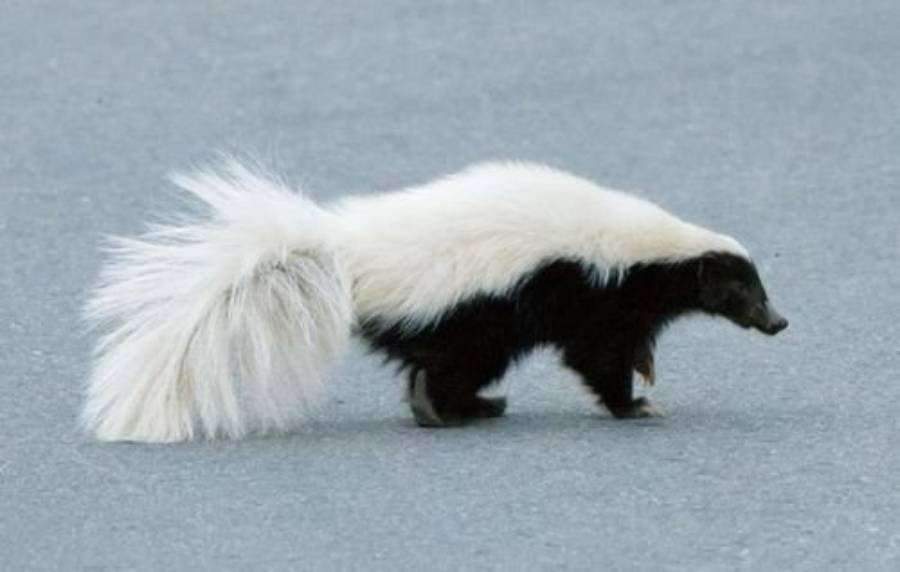
A skunk crossing your path is commonly interpreted as a spiritual symbol of protection, personal boundaries, confidence, self-respect, awareness, and independence. Rather than representing aggression, a skunk symbolizes the ability to protect your space and command respect without unnecessary confrontation. Its distinctive appearance and powerful defense mechanism reinforce themes of individuality, self-assurance, and knowing when to stand your ground.
There are 9 main spiritual meanings of a skunk crossing your path: protection, personal boundaries, confidence, self-respect, warning, independence, authenticity, awareness, and transformation. The meaning that applies most closely depends on what is happening in your life when the encounter occurs. For example, seeing a skunk during a difficult relationship may prompt reflection on personal boundaries, while encountering one during a major decision may relate more closely to independence and trusting your judgment.
A skunk encounter does not predict a specific future event. Spiritual interpretations treat the animal as a symbolic prompt for reflection. The circumstances of the encounter, your emotional response, and recurring themes in your life provide the context for deciding which meaning is most relevant.
What Does It Mean Spiritually When a Skunk Crosses Your Path?
A skunk crossing your path spiritually represents the need to protect your boundaries, respect your individuality, and respond to challenges without unnecessary confrontation. The skunk has an effective defense mechanism, but defense is different from aggression. Symbolically, this distinction connects the animal with knowing when to stand your ground and when a conflict does not deserve your energy.
The encounter can be especially relevant when your personal boundaries are being tested. A boundary defines what behavior, demands, or treatment you are willing to accept from other people. Skunk symbolism emphasizes making those limits recognizable before a situation escalates. In practical terms, this could mean saying no to an unreasonable request, distancing yourself from a draining relationship, or communicating expectations before resentment develops.
A skunk crossing your path can also represent confidence and self-respect. The symbolic lesson is not to intimidate other people but to become secure enough that constant approval is unnecessary. For example, someone facing criticism for an important personal decision might interpret the encounter as a reminder to evaluate the criticism carefully without abandoning a decision simply to satisfy others.
The circumstances surrounding the encounter determine which interpretation is most relevant. A skunk appearing during relationship conflict may draw attention to boundaries, while an encounter during a period of self-doubt may resonate more strongly with confidence and independence. These meanings function as symbolic interpretations rather than predictions that a specific event will occur.
What Are the 9 Spiritual Meanings of a Skunk Crossing Your Path?
There are 9 main spiritual meanings of a skunk crossing your path: protection, personal boundaries, confidence, self-respect, warning, independence, authenticity, awareness, and transformation. Each meaning reflects a different aspect of how the skunk protects itself, maintains its space, and interacts with potential threats.
1. Protection
Protection is one of the strongest spiritual meanings associated with a skunk crossing your path. The skunk symbolizes having the means to defend yourself without needing to use them at every opportunity. Its symbolism therefore favors measured protection rather than constant confrontation.
In personal life, protection can involve emotional, mental, or physical space. For example, protecting yourself emotionally might mean limiting contact with someone who repeatedly disrespects you rather than continuing the same conflict. The message is to recognize what needs protection and establish an appropriate defense before the situation becomes more damaging.
2. Personal boundaries
A skunk crossing your path can symbolize the need to establish or reinforce personal boundaries. Boundaries communicate where your limits are and how you expect other people to treat you. They protect relationships by making acceptable and unacceptable behavior clearer.
This meaning becomes especially relevant when you repeatedly agree to things that create resentment, exhaustion, or discomfort. For example, constantly accepting extra responsibilities because you fear disappointing someone can indicate a weak boundary. The skunk symbolizes making your limits clear without becoming unnecessarily hostile toward the people around you.
3. Confidence
A skunk can represent quiet confidence because effective self-protection reduces the need to prove strength through aggression. Spiritually, this meaning points toward trusting your abilities and decisions without constantly seeking validation from other people.
Quiet confidence becomes important when external opinions begin controlling your choices. For example, receiving criticism does not automatically mean you should abandon a career decision, relationship choice, or personal goal. Skunk symbolism encourages evaluating useful feedback while maintaining confidence in decisions that remain consistent with your values and circumstances.
4. Self-respect
Seeing a skunk cross your path can represent self-respect and the standards you maintain for how others treat you. Self-respect differs from confidence: confidence concerns trust in your abilities, while self-respect concerns recognizing your worth and refusing treatment that violates your standards.
This symbolism may resonate when maintaining a relationship, job, or social connection requires repeatedly accepting disrespect. For example, forgiving an occasional mistake differs from accepting a persistent pattern of humiliation or manipulation. The skunk represents recognizing that protecting your dignity sometimes requires distance rather than another confrontation.
5. Warning
A skunk crossing your path can function symbolically as a warning to notice a problem before it escalates. This interpretation does not mean that the animal predicts danger. Instead, the encounter can serve as a prompt to examine warning signs you have already noticed but have not addressed.
The warning may concern a relationship, decision, conflict, or repeated behavior. For example, if someone repeatedly ignores a boundary after you communicate it clearly, the relevant message is not to expect a supernatural prediction. It is to pay attention to the pattern already in front of you and decide whether a stronger response is necessary.
6. Independence
A skunk can symbolize independence and the ability to move through life without relying excessively on external approval. Independence does not require rejecting support from others. It means retaining enough autonomy to make important decisions according to your own judgment.
This meaning is particularly relevant when fear of criticism prevents action. For example, a person may postpone a meaningful project because friends or relatives do not understand it. A skunk crossing the path can symbolically prompt that person to distinguish useful advice from an unnecessary dependence on approval.
7. Authenticity
Skunk symbolism can represent authenticity because the animal’s distinctive identity makes it difficult to overlook or mistake for something else. In spiritual interpretation, this distinctiveness connects with accepting your identity rather than constantly changing yourself to fit another person’s expectations.
Authenticity becomes important when belonging requires hiding preferences, opinions, or values. For example, adapting your communication style to a professional setting is normal, but repeatedly pretending to hold beliefs you reject merely to gain acceptance creates a conflict with personal identity. The skunk symbolizes being recognizable as yourself without turning individuality into hostility toward others.
8. Awareness
A skunk crossing your path can symbolize increased awareness of your surroundings, emotions, and current circumstances. Awareness differs from warning because it does not assume that something is wrong. Its purpose is to notice information before deciding what that information means.
For example, recurring discomfort around a person does not automatically prove that the person has harmful intentions. It does provide information worth examining. The symbolic lesson is to observe patterns, identify what triggers your reaction, and make decisions based on what you actually notice rather than ignoring discomfort or immediately assuming the worst.
9. Transformation
A skunk crossing your path can symbolize transformation when you are changing how you protect yourself, express your identity, or respond to conflict. Transformation is not a prediction that a dramatic life event is about to occur. In this context, it describes a shift in behavior or perspective.
A practical example is moving from people-pleasing to maintaining clear boundaries. Another is learning to respond calmly to criticism instead of becoming defensive or immediately surrendering your position. The transformation represented by the skunk is therefore closely connected to the other meanings: stronger boundaries, greater self-respect, increased awareness, and a more confident way of handling conflict.
Is a Skunk Crossing Your Path a Good or Bad Spiritual Sign?
A skunk crossing your path is not inherently a good or bad spiritual sign; its meaning depends on the circumstances of the encounter and the situation you are experiencing. Positive interpretations center on protection, confidence, independence, and authenticity, while warning interpretations center on weak boundaries, ignored problems, and unnecessary conflict. The same skunk symbolism can therefore carry different messages depending on which theme reflects your current circumstances.
A skunk crossing your path can be interpreted as a positive spiritual sign when it reflects healthy self-protection and confidence. You may already be learning to say no, becoming less dependent on external approval, or protecting your time from demands that conflict with your priorities. In this context, the encounter reinforces an existing strength rather than pointing toward a problem. For example, someone who has recently established a healthy boundary with a demanding friend may associate the skunk with maintaining that boundary without feeling guilty.
The encounter can function as a warning when your boundaries are being ignored or when you have noticed a problem but continue to avoid addressing it. The warning does not predict that something bad will happen. Instead, it directs attention toward information that is already available. Repeated disrespect, unresolved resentment, or an escalating disagreement are examples of situations in which the warning interpretation may be more relevant.
Conflict also changes the interpretation. A skunk is strongly associated with defense, but defense should not be confused with attacking every perceived threat. If you are responding aggressively to minor disagreements, the symbolic lesson may be restraint rather than stronger protection. If you are remaining silent while someone repeatedly violates an important boundary, the lesson may be the opposite: communicate the boundary more clearly and enforce it consistently.
Your emotional reaction during the encounter can provide additional context. Feeling calm may align more closely with confidence or independence, while feeling unusually defensive may prompt reflection on protection or unresolved conflict. These reactions do not establish a fixed spiritual meaning, but they can help identify which symbolic theme is most useful for personal reflection.
What Does It Mean When a Skunk Crosses Your Path at Night?
A skunk crossing your path at night can spiritually symbolize heightened awareness, reflection, and the need to pay attention when the direction ahead feels uncertain. The nighttime setting adds a symbolic layer of limited visibility to the encounter. In spiritual interpretation, this can correspond with situations in which you do not yet have enough information to see the outcome clearly.
The combination of a skunk and darkness connects two complementary themes. The skunk represents protection and boundaries, while nighttime can represent uncertainty and the limits of what you currently know. Together, they can serve as a reminder to move carefully without allowing uncertainty to become fear. For example, someone considering a major career change without knowing exactly how it will develop may interpret the encounter as encouragement to protect financial or personal boundaries while gathering more information before making the next decision.
A nighttime encounter can also emphasize intuition and observation. Intuition in this context does not require assuming that every feeling predicts an event. It means recognizing internal signals and comparing them with observable circumstances. If a situation consistently creates discomfort, for example, the useful response is to identify what specifically produces that reaction rather than dismissing it or automatically treating it as supernatural guidance.
Seeing a skunk at night can also relate to hidden or overlooked issues. A disagreement that has not been addressed, a boundary that remains unclear, or a decision repeatedly postponed can create uncertainty even when the underlying problem is already recognizable. The encounter can symbolically encourage bringing that issue into conscious attention and deciding what action is appropriate.
The nighttime setting does not make a skunk encounter inherently more spiritual than seeing one during the day. Skunks are naturally active during periods when people may encounter them after dark, so the physical event has an ordinary explanation. Its spiritual value comes from how the encounter is used for reflection, particularly around awareness, uncertainty, protection, and the decisions currently requiring your attention.
What Does It Mean If You Keep Seeing Skunks?
If you keep seeing skunks, the repeated encounters can spiritually symbolize a recurring need to examine protection, personal boundaries, self-respect, or independence. A single encounter may draw attention to one situation, while repeated sightings can encourage you to consider whether the same symbolic theme continues to appear in different areas of your life.
Personal boundaries are one of the first themes to examine. Repeated skunk encounters may feel significant when the same boundary problem continues with a partner, relative, friend, or coworker. For example, repeatedly agreeing to requests that interfere with your priorities can create a pattern of frustration rather than an isolated problem. In this context, the skunk symbolizes the need to define the limit clearly and maintain it consistently.
Repeated sightings can also correspond with unresolved self-respect or confidence issues. You may understand that a situation requires action but continue postponing that action because you fear rejection, criticism, or conflict. Seeing skunks repeatedly can serve as a symbolic reminder to distinguish between maintaining peace and sacrificing your standards simply to avoid disagreement.
Another interpretation involves awareness. When the same animal repeatedly captures your attention, you may naturally become more conscious of the ideas you associate with it. Use that attention to identify patterns rather than assuming that every sighting carries a separate message. Ask whether the same relationship, decision, or emotional reaction was present during several encounters. A repeated theme provides a more useful basis for reflection than the number of skunks you have seen.
Repeated sightings also have ordinary environmental explanations. Skunks may live near your home, follow reliable food sources, or travel through the same area regularly. Seeing skunks repeatedly is therefore not proof that a spiritual force is sending repeated messages. Spiritual interpretation becomes useful when the encounter prompts meaningful reflection on an existing pattern in your life rather than when coincidence is treated as certainty.
Read more: Spiritual Meanings of Robin
How Do You Interpret a Skunk Crossing Your Path in Your Own Life?
Interpret a skunk crossing your path by comparing its main symbolic themes with the circumstances, emotions, relationships, and decisions present in your life at the time. The goal is not to search for a fixed prediction. It is to identify which aspect of skunk symbolism most closely reflects an issue you are already experiencing.
Start with personal boundaries. Ask yourself, “Where do I need stronger personal boundaries?” Consider situations in which you regularly feel pressured, resentful, exhausted, or unable to say no. For example, if a coworker repeatedly transfers responsibilities to you and you accept them despite having insufficient time, protection and boundaries may be more relevant than transformation or independence.
Next, examine the difference between protection and overreaction. Ask, “Am I protecting myself or reacting too aggressively?” Healthy protection establishes a limit proportional to the problem, while overreaction treats every disagreement as a threat. If a minor criticism immediately triggers defensiveness, the skunk’s symbolism can represent restraint: having the ability to defend yourself does not mean every situation requires a defensive response.
Then consider independence and external approval. Ask, “Am I seeking approval instead of trusting myself?” Advice from other people can improve a decision, but dependence on approval can prevent you from making choices that differ from their expectations. If you already have sufficient information and your decision aligns with your values, the skunk’s symbolism of independence may encourage greater trust in your judgment.
Finally, examine warning signs and awareness. Ask, “Is there a warning sign I have been ignoring?” Focus on observable patterns rather than predicting hidden dangers. Repeated dishonesty, ignored boundaries, unresolved conflict, or consistent discomfort provide concrete information that deserves attention. The spiritual interpretation is most useful when it directs your attention toward something identifiable rather than creating fear about an unspecified future event.
Your emotional response to the encounter can help refine the interpretation. Feeling vulnerable may point toward protection, feeling controlled may highlight independence, and feeling overlooked or disrespected may connect with boundaries and self-respect. A period of personal change may make transformation more relevant. The most useful meaning is the one that connects the symbolism of the skunk with a recognizable pattern in your current life.
What Does a Skunk Symbolize Beyond Crossing Your Path?
A skunk spiritually symbolizes protection, personal boundaries, confidence, individuality, independence, and awareness beyond the specific experience of one crossing your path. These meanings remain connected to the animal’s distinctive identity and defensive behavior, but the context in which you encounter a skunk changes which symbolic attribute becomes most relevant.
Protection and boundaries form the strongest foundation of skunk symbolism. A skunk has an unmistakable method of discouraging threats, making it a natural symbol for maintaining personal space and communicating limits. Applied to personal reflection, this symbolism emphasizes protecting what matters without creating unnecessary conflict. The relevant issue might be your emotional well-being, time, relationships, values, or another area where clearly defined limits are needed.
Skunks also symbolize confidence and individuality. Their recognizable appearance and reputation make them difficult to ignore, which creates a symbolic connection with being comfortable with your own identity. This meaning becomes relevant when you are suppressing your preferences or changing your behavior primarily to gain acceptance. The lesson is not to reject compromise but to recognize the difference between adapting appropriately and abandoning important parts of yourself.
Independence is another central aspect of skunk symbolism. It represents the ability to rely on your judgment while maintaining enough self-protection to move through uncertain situations. This interpretation may resonate during career decisions, relationship changes, or personal transitions in which other people’s expectations conflict with your priorities. Independence in this context means retaining ownership of the final decision rather than refusing all advice or assistance.
The meaning can become more specific when the circumstances of the encounter change. Seeing a skunk can emphasize general themes of protection and boundaries, while a skunk crossing your path places those themes within the context of your current direction or decisions. Repeated skunk sightings can prompt reflection on recurring patterns, especially unresolved boundary or self-respect issues. Seeing a skunk at night adds themes of awareness and uncertainty because limited visibility changes the context surrounding the encounter.
A skunk appearing in a dream belongs to a different interpretive context. Dream symbolism may depend on what the skunk does, how you respond to it, and which emotions dominate the dream. For example, being chased by a skunk creates a different symbolic relationship from calmly observing one. Dream interpretation should therefore be examined separately rather than assuming that every skunk encounter carries an identical meaning.
Across these situations, skunk symbolism consistently returns to one central principle: protect your space without losing confidence in who you are. Protection without boundaries becomes difficult to maintain, boundaries without self-respect are easily abandoned, and independence without awareness can become isolation. These connected themes explain why a skunk can serve as a powerful symbol for balancing self-protection with confidence, restraint, and authenticity.