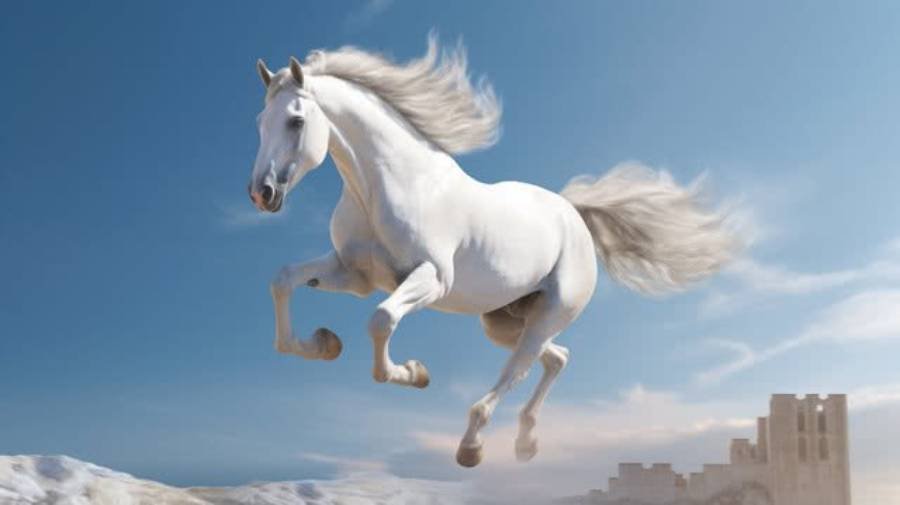
A horse spiritually symbolizes freedom, strength, independence, endurance, courage, intuition, and personal transformation. Its ability to travel great distances, move with speed, and combine physical power with sensitivity has made the horse a symbol of forward movement and personal power in spiritual interpretations. A horse can therefore represent the inner strength to overcome limitations while maintaining the freedom to choose your own direction.
The spiritual meaning of a horse also changes according to the context in which it appears. A wild horse emphasizes independence and unrestricted freedom, while a running horse can represent momentum, energy, and progress. Color adds another symbolic layer: white horses are commonly associated with purity and spiritual awakening, while black horses can represent mystery, hidden strength, and transformation. Seeing a horse, dreaming about one, or repeatedly encountering horse imagery can also carry different meanings depending on the animal’s behavior and your response to it.
This guide explores the core spiritual meanings of horses, including their symbolism in encounters, colors, behaviors, dreams, and spirit-animal traditions. It also explains how to interpret a horse encounter according to its specific context rather than assigning the same spiritual meaning to every experience.
What Does a Horse Symbolize Spiritually?
A horse spiritually symbolizes 7 main qualities: freedom, strength, independence, endurance, courage, intuition, and transformation. These meanings come from the horse’s combination of physical power, speed, sensitivity, stamina, and ability to travel across long distances. In spiritual symbolism, these natural characteristics are interpreted as qualities that help a person move beyond limitations and progress through periods of personal change.
Freedom is one of the strongest spiritual meanings associated with horses. A horse can move quickly across open land, while a wild horse lives without the physical restrictions associated with domestication. This connection between unrestricted movement and autonomy makes the horse a symbol of personal freedom. Spiritually, horse symbolism can therefore reflect a desire to remove restrictions, make independent choices, or pursue a direction that better represents your values.
Strength and power represent the ability to move forward despite resistance. Horses possess enough physical strength to carry riders, pull heavy loads, and sustain movement over considerable distances. Spiritual interpretations transfer this physical characteristic to inner strength. A horse can symbolize the emotional or mental power required to face a difficult situation without allowing that difficulty to determine your direction.
Independence represents self-direction rather than isolation. Horses are social animals, but their symbolism can still emphasize autonomy because freedom of movement is central to the way people perceive them. In a spiritual context, this meaning relates to making deliberate choices, establishing personal boundaries, and taking responsibility for your own direction. A wild horse strengthens this interpretation because it represents freedom from external control.
Endurance symbolizes persistence through a long process. A horse does not represent only speed; it also represents the ability to continue moving. This distinction matters when horse symbolism appears during a demanding period of personal growth. The message is less about reaching an outcome immediately and more about maintaining enough physical, emotional, or spiritual energy to continue toward it.
Courage is connected to using strength despite uncertainty. Horses can respond strongly to danger, yet trained horses can also move through unfamiliar environments while maintaining direction. In symbolic interpretation, courage does not mean an absence of fear. It represents the ability to recognize uncertainty and continue acting with purpose rather than allowing fear to control every decision.
Intuition comes from the horse’s sensitivity to its surroundings. Horses respond to movement, body language, changes in their environment, and the behavior of other animals. Spiritual traditions can interpret this sensitivity as a reminder to notice subtle signals rather than relying exclusively on deliberate thought. In personal symbolism, a horse may therefore represent greater awareness of instincts, emotions, and environmental cues.
Transformation connects the horse’s symbolism of movement with personal change. Movement takes a person from one position to another, so the horse naturally lends itself to symbolic interpretations involving transition and progress. A horse appearing during a major life change can represent movement away from an old state and toward a new direction. The transformation itself depends on the person’s circumstances; the horse primarily symbolizes the energy, strength, and freedom required to make that transition.
What Is the Spiritual Meaning of Seeing a Horse?
Seeing a horse spiritually symbolizes freedom, forward movement, inner strength, and the need to choose your own direction. The horse’s specific meaning depends on what it is doing, how it interacts with you, and what is happening in your life at the time. A horse standing calmly can emphasize stability and controlled strength, while a horse moving freely can place greater emphasis on independence, momentum, and personal freedom.
Seeing a horse during a period of restriction can symbolize a desire for greater autonomy. This interpretation comes from the strong association between horses and unrestricted movement. For example, someone who feels limited by a relationship, career, routine, or personal expectation may interpret a horse encounter as a symbolic reminder to examine which restrictions are necessary and which ones prevent meaningful progress. The horse does not determine which decision to make; its symbolism directs attention toward freedom and self-direction.
A horse can also represent forward movement when you are experiencing a transition. Horses have historically been associated with travel and movement from one place to another, which gives them a natural symbolic connection with life journeys. Seeing one while starting a new job, ending a relationship, moving to another place, or changing a long-standing habit can therefore represent the process of leaving one stage and entering another. In this context, the spiritual meaning centers on movement rather than the final destination.
Repeatedly seeing horses can strengthen the personal relevance of their symbolism, especially when the encounters consistently attract your attention. The recurring image may encourage you to examine themes such as freedom, strength, endurance, or independence in your current circumstances. However, repetition alone does not prove that a supernatural message is being delivered. Spiritual interpretation depends on personal beliefs and context rather than the number of encounters alone.
What Does It Mean Spiritually When a Horse Crosses Your Path?
A horse crossing your path spiritually symbolizes a change in direction, movement toward a new stage, or a need to reconsider the path you are currently following. The symbolism comes from the combination of two concepts: the horse represents movement and personal power, while a path represents direction. When these symbols intersect, the encounter can be interpreted as an invitation to examine where your current choices are taking you.
The horse’s behavior provides additional context. A calm horse crossing slowly can symbolize deliberate progress and confidence in a chosen direction. A horse running across your path places greater emphasis on momentum, urgency, or a rapid transition. A wild horse can emphasize independence and the desire to escape restrictions. These interpretations share the same central symbolism, but the animal’s behavior changes which attribute becomes most prominent.
Your emotional response also affects the interpretation. Feeling peaceful during the encounter can connect the horse with confidence, freedom, or readiness for change. Feeling anxious can instead direct attention toward uncertainty about losing control or moving into unfamiliar circumstances. For example, a person considering a major career change may interpret a peaceful horse encounter as a symbol of readiness to move forward, while fear during the same type of encounter may reflect unresolved concerns about that transition.
A horse crossing your path should therefore be interpreted as symbolic context rather than a fixed prediction. It does not automatically mean that a specific event will occur. Its spiritual value comes from using the horse’s established symbolism—freedom, strength, movement, and independence—to examine the direction, restrictions, and transitions present in your own life.
What Do Different Horse Colors Mean Spiritually?
Different horse colors add specific symbolic qualities to the horse’s core spiritual meanings of freedom, strength, movement, and transformation. Four common color interpretations are white for purity and spiritual awakening, black for mystery and transformation, brown for grounding and stability, and gray for balance and transition. Color does not replace the basic symbolism of the horse; it changes which aspect of that symbolism receives greater emphasis.
A white horse spiritually symbolizes purity, spiritual awakening, hope, and guidance. White is widely used as a symbolic color for clarity and purity, while the horse represents movement and personal power. Combining these meanings makes a white horse particularly relevant to spiritual interpretations involving a new direction or transition. For example, seeing a white horse during a period of personal change may be interpreted as encouragement to move toward a path that feels clearer or more aligned with your spiritual values.
A white horse can also represent transition from one spiritual stage to another. The horse contributes the idea of movement, while white adds associations with renewal and clarity. This symbolism explains why a white horse appearing in a dream or meaningful encounter may be interpreted as a sign of spiritual development. The interpretation describes symbolic meaning rather than predicting that a specific spiritual event will occur.
A black horse spiritually symbolizes mystery, hidden strength, the unknown, and transformation. Black is associated with what cannot yet be clearly seen or understood, while the horse represents the power required to keep moving. A black horse can therefore symbolize entering an uncertain stage without knowing exactly where it will lead. This meaning is especially relevant during major transitions in which the outcome remains unclear.
A black horse does not automatically symbolize danger, death, or a negative omen. Such an interpretation ignores the context surrounding the encounter. For example, a calm black horse may represent controlled power or confidence when facing the unknown, while a frightened or uncontrolled black horse may reflect uncertainty, suppressed emotions, or fear of losing control. Behavior and emotional response provide more information than color alone.
A brown horse spiritually symbolizes grounding, stability, reliability, and practical strength. Brown has a direct visual association with earth, giving it a stronger connection to stability and the physical world. Combined with the endurance and strength of a horse, this creates symbolism centered on remaining grounded while continuing to make progress.
The brown horse is particularly relevant when spiritual growth needs to be balanced with practical responsibilities. For example, someone focused heavily on personal transformation may interpret a brown horse as a reminder that meaningful change still requires consistent actions, routines, and responsibilities. Its symbolism emphasizes steady progress rather than sudden transformation.
A gray horse spiritually symbolizes balance, wisdom, maturity, and transition between different states. Gray exists between black and white, which gives it symbolic associations with neutrality and the ability to recognize complexity rather than viewing situations as complete opposites. When combined with horse symbolism, gray can represent moving forward with patience and judgment instead of making decisions based entirely on impulse.
A gray horse can therefore become relevant during situations that require acceptance of uncertainty. For example, encountering a gray horse while deciding between two important directions may symbolically emphasize careful evaluation rather than an immediate choice. In this interpretation, the horse still represents movement, but its gray color places greater emphasis on wisdom and balance before that movement occurs.
Horse color should ultimately be interpreted together with behavior, setting, emotional response, and personal circumstances. A running white horse and a calm white horse share the symbolic layer of white, but movement changes the complete meaning of the encounter. Combining these contextual signals creates a more specific interpretation than assigning a fixed spiritual meaning based only on color.
What Do Different Horse Behaviors Mean Spiritually?
Different horse behaviors spiritually represent different expressions of freedom, energy, control, independence, and connection. A running horse emphasizes momentum and forward movement, a wild horse represents independence and unrestricted freedom, a calm horse symbolizes controlled strength and emotional balance, and a horse approaching you can represent trust and connection. Behavior provides important context because two horses with the same color can carry different symbolic meanings when their actions are different.
A running horse spiritually symbolizes freedom, momentum, energy, and rapid forward movement. Running makes the horse’s natural qualities of speed and physical power more visible, strengthening its association with progress. In a personal spiritual interpretation, a running horse can represent a period when circumstances are beginning to move after stagnation or when you have enough energy to pursue a new direction.
The direction and condition of the running horse change this meaning. A horse running freely across an open space emphasizes liberation and self-directed movement. A horse appearing to run away can instead symbolize avoidance, fear, or a desire to escape restrictions. For example, repeatedly imagining a horse running freely during a restrictive period of life may reflect a strong desire for greater independence rather than a prediction that an external event is about to occur.
A wild horse spiritually symbolizes independence, instinct, authenticity, and freedom from external control. Its symbolism is stronger than that of a domesticated horse when the central theme is autonomy because a wild horse is not directed by a rider. It chooses its movement according to its environment and instincts, making it a natural symbol for self-direction.
Wild horse symbolism can become relevant when personal freedom conflicts with external expectations. A person who continually makes decisions to satisfy family, social, or professional expectations may connect with a wild horse as a symbol of reclaiming personal choice. However, independence does not necessarily mean rejecting every responsibility. The deeper symbolic theme is maintaining an individual direction without allowing external control to determine every choice.
A calm horse spiritually symbolizes controlled strength, emotional balance, patience, and confidence. A horse possesses considerable physical power even when standing quietly, so calm behavior creates a useful contrast between strength and restraint. Spiritually, this can represent the ability to possess power without needing to demonstrate it through constant action or confrontation.
A calm horse may carry particular significance during emotionally intense situations. For example, encountering a peaceful horse while dealing with conflict can be interpreted as a reminder that composure does not equal weakness. Remaining steady can preserve the clarity needed to choose an effective response. In this context, the horse symbolizes strength that remains available but is deliberately controlled.
A horse approaching you spiritually symbolizes trust, openness, connection, and willingness to engage with something new. An approaching animal reduces physical distance, so the movement can symbolically represent an opportunity, relationship, emotion, or personal change becoming more immediate. The horse adds its broader associations with freedom, strength, and movement to that interaction.
Your reaction to the approaching horse changes the interpretation. Feeling calm or curious can indicate openness toward the qualities the horse represents, such as independence or change. Feeling afraid may instead reflect discomfort with losing control, accepting responsibility, or entering unfamiliar circumstances. For example, a horse approaching peacefully in a dream can be interpreted differently by someone who welcomes it than by someone who immediately tries to escape.
Horse behavior should therefore be interpreted together with direction, environment, color, interaction, and emotional response. No single action has one fixed spiritual meaning in every situation. Behavior identifies the dominant symbolic theme, while the surrounding context helps determine whether freedom represents liberation or escape, whether movement represents progress or avoidance, and whether strength is controlled or uncontrolled.
What Does a Horse Spirit Animal Mean?
A horse spirit animal symbolizes freedom, personal power, endurance, independence, and forward movement within spirit-animal traditions. The horse combines physical strength with speed, sensitivity, and the ability to travel, so its spiritual symbolism centers on using personal power to move in a chosen direction. Someone who identifies strongly with the horse spirit animal may use these qualities as symbols for overcoming restrictions, maintaining independence, and continuing through demanding periods of personal growth.
Freedom is central to the horse spirit animal because movement and autonomy are closely connected with horse symbolism. In this context, freedom does not mean avoiding commitments or responsibilities. It represents having enough autonomy to make decisions that reflect your values instead of allowing other people or circumstances to determine every part of your direction. For example, the horse may become personally meaningful during a period when you are establishing boundaries, leaving a restrictive situation, or deciding which path to pursue.
Personal power in horse symbolism means directing your strength rather than simply possessing it. A horse has considerable physical power, but that power produces meaningful movement when it has direction. Spiritually, this characteristic can represent the ability to use confidence, skills, emotional strength, and determination toward a specific purpose. A person facing a difficult transition might therefore connect with horse symbolism as a reminder to turn inner strength into deliberate action.
Endurance adds another dimension to the horse spirit animal. Major changes rarely happen through one decisive action; they require continued effort. The horse’s stamina makes it a symbol of persistence through long processes, including personal development, changing habits, rebuilding confidence, or pursuing a demanding goal. In this interpretation, the horse represents the capacity to keep moving even when progress is slower than expected.
The horse spirit animal can also symbolize balance between instinct and direction. Horses are highly responsive to their surroundings, yet they are also capable of sustained, purposeful movement. Symbolically, this combination can represent listening to intuition without allowing every temporary emotion to control your choices. The goal is not impulsive freedom but self-directed movement supported by awareness.
How Do You Know If a Horse Is Your Spirit Animal?
You may identify a horse as your spirit animal when horse symbolism repeatedly carries personal significance and its core qualities consistently reflect themes in your life. Common patterns include recurring horse dreams, repeated attention to horse imagery, a persistent emotional connection with horses, or a strong identification with qualities such as freedom, endurance, independence, and personal power. These patterns can provide a framework for spiritual reflection, but they are not an objective test.
Recurring dreams are one context in which a horse may become personally significant. A horse that repeatedly appears during periods of change, for example, may be interpreted through its associations with movement and transformation. The details still matter. Riding a controlled horse, watching a wild horse run, and being approached by a calm horse represent different relationships with freedom, direction, and personal power.
Repeated horse imagery can be interpreted in a similar way. Seeing horses in art, conversations, media, or everyday environments may draw your attention to the qualities you already associate with the animal. Instead of assuming that repetition proves an external spiritual message, examine whether the symbolism corresponds with a recurring issue in your life. A strong focus on wild horses, for instance, may be personally relevant when autonomy and boundaries have become important concerns.
The most useful way to determine whether the horse functions as a spirit animal for you is to examine which horse qualities consistently produce meaningful self-reflection. If freedom, strength, endurance, intuition, or transformation repeatedly connects with your experiences, the horse can serve as a personal spiritual symbol for those qualities. This interpretation respects the symbolic role of a spirit animal without presenting personal spiritual belief as scientifically verifiable fact.
What Does a Horse Mean Spiritually in a Dream?
A horse in a dream spiritually symbolizes freedom, personal energy, direction, control, and movement through a life transition. The specific meaning depends on the horse’s behavior, color, condition, and relationship with the dreamer. Riding a horse can emphasize control and direction, while watching a horse run freely can represent independence or a desire to remove restrictions. The dream’s emotional tone also matters because feeling peaceful around a horse creates a different interpretation from feeling threatened or unable to control it.
Riding a horse in a dream can symbolize directing your personal power toward a specific goal. The horse represents energy and movement, while riding introduces the additional themes of control, cooperation, and direction. Riding confidently may reflect a sense that your actions and goals are aligned. Struggling to control the horse can represent the opposite situation, such as feeling that emotions, responsibilities, ambitions, or circumstances are moving faster than you can manage.
A running horse in a dream symbolizes momentum, freedom, and active change. A horse running freely through an open environment places greater emphasis on independence because there are few visible restrictions on its movement. This image can become personally meaningful when you want greater autonomy or are progressing through an important transition. A horse running away from you has a different context and may symbolize something that feels difficult to control, pursue, or maintain.
A wild horse in a dream symbolizes instinct, independence, and resistance to restriction. The absence of a rider or external control strengthens the horse’s connection with autonomy. Dreaming of a wild horse may therefore reflect tension between personal desires and external expectations. For example, someone following a path primarily because other people expect it may associate the wild horse with a desire to reclaim greater control over personal decisions.
A white horse in a dream can symbolize purity, hope, spiritual growth, or movement toward greater clarity. The horse contributes the themes of movement and personal power, while white adds a symbolic association with renewal and clarity. A peaceful white horse may therefore be interpreted as positive movement through a spiritual or personal transition. Its appearance should still be considered alongside the events and emotions within the dream rather than treated as a guaranteed sign of a future event.
A black horse in a dream can symbolize mystery, hidden strength, uncertainty, or transformation. Black adds the theme of the unknown to the horse’s existing symbolism of movement and power. A calm black horse can represent confidence while entering an uncertain stage, whereas an uncontrolled black horse may reflect anxiety about change or aspects of life that feel difficult to understand.
The condition of the horse can provide another layer of meaning. A healthy and energetic horse can symbolize available strength and motivation, while an injured or exhausted horse can symbolize depleted energy, restricted freedom, or difficulty maintaining progress. For example, an exhausted horse appearing during a demanding period may encourage reflection on whether your current responsibilities are consuming more energy than you can sustainably provide.
Horse dreams are most useful as personal symbolic material rather than fixed predictions. A dream does not have one universal interpretation simply because a horse appears in it. Identify what the horse was doing, how you interacted with it, what emotions you experienced, and which current life situation shares the same themes. These details help distinguish whether the dream primarily concerns freedom, control, endurance, uncertainty, or transformation.
What Do Horses Symbolize in Different Spiritual Traditions?
Horses symbolize power, movement, status, spiritual transition, and the relationship between humans and forces beyond ordinary control across different spiritual and mythological traditions. However, there is no single universal spiritual meaning of the horse. Each tradition interprets the animal through its own beliefs, stories, rituals, and cultural relationship with horses, so cultural symbolism should not be treated as interchangeable.
In traditions where horses are closely associated with travel and transportation, the horse can symbolize passage from one state or place to another. This physical function creates a broader symbolic connection with journeys, transitions, and movement between different stages of existence. The same mechanism helps explain why modern spiritual interpretations frequently connect horses with personal transformation: the animal physically carries movement, making it a natural metaphor for change.
Horse symbolism can also represent power and social status because horses have historically been associated with mobility, warfare, leadership, and access to resources in horse-centered societies. Spiritual and mythological narratives can transform these practical characteristics into symbolic attributes such as authority, courage, victory, or exceptional strength. This context is important because the spiritual meaning does not emerge from the animal’s appearance alone; it develops partly from the role horses have played within a particular culture.
White horses frequently receive distinct symbolic treatment because color adds another layer to the central entity. A white horse can combine the horse’s symbolism of power and movement with culturally specific associations attached to the color white. Depending on the tradition, these associations may involve purity, sacredness, victory, death, or transition. The meaning therefore needs to be interpreted within the specific tradition rather than assuming that a white horse always represents spiritual awakening.
Black horses require the same contextual approach. A black horse does not have a universally negative spiritual meaning. Associations with darkness, mystery, death, hidden power, or the unknown depend on the symbolic system in which the horse appears. Treating every black horse as a bad omen removes the cultural context that gives the symbol its meaning and can produce an interpretation that the original tradition does not support.
The most reliable way to understand horse symbolism across spiritual traditions is therefore to identify the specific tradition, the horse’s role within it, its attributes, and the narrative in which it appears. A horse associated with a deity, warrior, journey, ritual, or supernatural event may carry a meaning that differs substantially from modern spirit-animal interpretations. Cultural horse symbolism can enrich an understanding of the animal’s spiritual associations, but it should not be used to claim that every culture assigns horses the same spiritual message.
Read more: 8 Spiritual Meanings of Dolphins and Their Symbolism
Is Seeing a Horse Always a Spiritual Sign?
No, seeing a horse is not always a spiritual sign. A horse encounter can carry personal spiritual meaning, but the encounter itself does not prove that a supernatural message, warning, or prediction has been sent. The distinction matters because spiritual symbolism provides a framework for interpreting an experience, while a factual claim requires evidence beyond the symbolism assigned to the animal.
An ordinary explanation should remain part of the interpretation. Seeing a horse near a farm, riding trail, stable, rural road, or equestrian event is expected because horses are present in those environments. Repeated encounters can also result from routines, increased attention, or exposure to horse-related images and conversations. These explanations do not prevent an encounter from feeling personally meaningful; they simply separate personal significance from claims about supernatural causes.
A horse encounter becomes spiritually meaningful when its symbolism connects with your beliefs, emotions, and current circumstances. For example, a person struggling with restrictive expectations may associate a wild horse with freedom and independence. Someone working through a demanding transition may focus instead on the horse’s endurance and forward movement. The same horse can therefore carry different meanings for two people because their personal contexts emphasize different attributes of the animal.
The timing of an encounter can increase its personal significance without proving that the timing was supernatural. Seeing a running horse shortly before making an important decision, for instance, may encourage reflection on momentum, freedom, or direction. The useful question is not necessarily “Was this horse sent to me?” but “Which qualities represented by this horse are relevant to what I am experiencing now?” This approach keeps the interpretation focused on reflection rather than prediction.
Spiritual signs should also be distinguished from fixed omens. A black horse does not automatically predict misfortune, and a white horse does not guarantee that a positive event will occur. Color, behavior, setting, emotional response, and cultural context all influence symbolic interpretation. Assigning a predetermined future event to one characteristic removes these contextual factors and turns symbolism into an unsupported prediction.
Horse symbolism is therefore most useful as a tool for spiritual reflection rather than evidence that a particular future event will happen. An encounter can prompt you to examine freedom, strength, independence, endurance, intuition, or transformation in your own life. Its value comes from the insight produced by that reflection, regardless of whether you believe the original encounter had a supernatural cause.
How Can You Interpret the Spiritual Meaning of a Horse Encounter?
You can interpret the spiritual meaning of a horse encounter by examining 4 factors: the horse’s behavior, its physical characteristics, your emotional response, and your current life circumstances. These factors provide more useful context than assigning one fixed meaning to every horse. A running horse, for example, emphasizes movement and freedom, while a calm horse emphasizes controlled strength and stability. The interpretation becomes more specific when several contextual signals point toward the same symbolic theme.
First, identify what the horse is doing. Behavior determines which aspect of horse symbolism is most prominent. A running horse can represent momentum, freedom, or rapid change because movement is the dominant feature of the encounter. A wild horse emphasizes independence and instinct because it appears without external control. A calm horse can represent patience, emotional balance, and strength under control. A horse approaching you can place greater emphasis on trust, openness, and connection.
Second, consider the horse’s color and other noticeable characteristics. Color adds a secondary symbolic layer to the meaning created by the horse and its behavior. A white horse can emphasize purity, clarity, hope, or spiritual transition, while a black horse can emphasize mystery, hidden strength, uncertainty, or transformation. A brown horse places greater emphasis on grounding and stability, while a gray horse can represent balance, maturity, and transition. Color should support the interpretation rather than determine it by itself.
Third, examine how you felt during the encounter. Your emotional response helps identify your relationship with the qualities represented by the horse. Feeling peaceful around a running horse may suggest that freedom or forward movement feels desirable. Feeling afraid of the same horse may indicate discomfort with rapid change, uncertainty, or loss of control. The external symbol remains similar, but your emotional response changes its personal relevance.
Fourth, connect the encounter with your current circumstances. Horse symbolism becomes more meaningful when it corresponds with a specific situation rather than an abstract spiritual concept. If you are considering leaving a restrictive environment, a wild horse may resonate with independence and autonomy. If you are exhausted while pursuing a long-term goal, a horse may draw attention to endurance and sustainable use of personal energy. During a major transition, its movement symbolism may instead emphasize progress from one stage of life to another.
The strongest interpretation usually comes from repeated contextual connections rather than one isolated detail. For example, seeing a white horse running freely while you are considering an important change combines three symbolic layers: the horse represents personal power and movement, white emphasizes clarity or renewal, and running emphasizes momentum and freedom. Your emotional response then helps determine whether that movement feels welcome or threatening.
Avoid turning these symbolic connections into fixed predictions. Seeing a horse does not establish that a particular relationship will begin, a career change will succeed, or another future event will occur. Spiritual symbolism is better used to identify themes that deserve reflection, including freedom, strength, boundaries, endurance, intuition, and transformation.
Ultimately, the spiritual meaning of a horse encounter comes from the relationship between the horse’s symbolism and the context of your experience. Observe what happened, identify the strongest symbolic qualities, consider your emotional response, and connect those qualities with your present circumstances. This approach preserves the horse’s traditional themes of freedom, strength, independence, and movement while allowing the encounter to have a meaning specific to your spiritual journey.