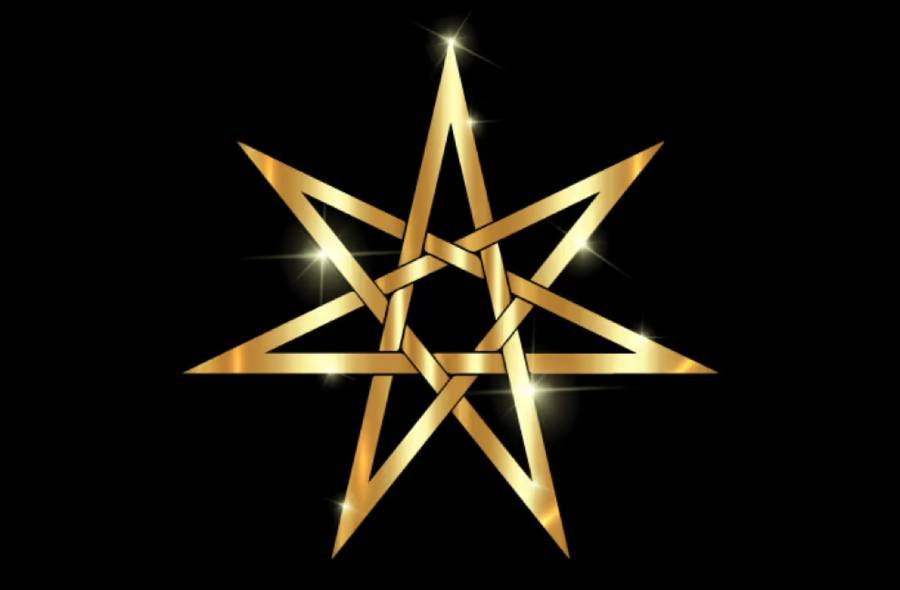
The heptagram, or seven-pointed star, spiritually symbolizes completeness, spiritual order, transformation, and the connection between different aspects of existence. Its symbolism comes primarily from the number seven, a number associated with complete cycles and structured spiritual systems across several religious, esoteric, and modern spiritual traditions. The seven points can therefore represent different sets of seven, including the seven classical planets, seven days, or other seven-part systems, depending on the tradition in which the symbol appears.
The heptagram does not have one universal spiritual meaning. Its interpretation changes according to its religious, magical, esoteric, or personal context. Some traditions use the seven-point star to represent cosmic order and spiritual wholeness, while others connect it with planetary forces, magical correspondences, or particular spiritual paths. Modern practitioners may also interpret the symbol through personal systems of spiritual growth.
Understanding the spiritual meaning of a heptagram therefore requires examining both its seven-point structure and the tradition using it. This article explains what the heptagram means spiritually, what its seven points can represent, how the number seven shapes its symbolism, and how interpretations differ across spiritual traditions.
What Does a Heptagram Mean Spiritually?
A heptagram spiritually represents completeness, spiritual integration, sacred order, and the relationship between seven distinct forces or aspects of existence. The symbol consists of seven points arranged as a star, making the number seven its defining symbolic feature. Its spiritual meaning therefore comes from both its geometric structure and the symbolic importance assigned to seven within a particular tradition.
Completeness is one of the central ideas associated with the heptagram because seven frequently represents a completed sequence or organized system. Examples include the seven days of the week and the seven classical planets used in historical astrological systems. When these correspondences are applied to a heptagram, each point can represent one component while the complete star represents their integration into a single symbolic structure.
The heptagram can also represent spiritual development and the integration of different aspects of experience. In this interpretation, the seven points are not seven unrelated symbols. They function as parts of a larger whole, while the connecting lines visually express relationships between them. This makes the seven-point star useful in spiritual systems that organize cosmological, planetary, or personal concepts into groups of seven.
However, the heptagram does not have one spiritual meaning that applies to every religion or esoteric system. Its meaning depends on the context in which it appears. A heptagram associated with planetary symbolism can carry a different meaning from a seven-point star used in a modern spiritual practice. Identifying the tradition and the system of correspondences is therefore necessary before assigning a specific meaning to the symbol.
What Does the Number Seven Symbolize in a Heptagram?
The number seven in a heptagram primarily symbolizes completeness, an ordered cycle, and the organization of multiple elements into one spiritual system. Because every heptagram contains seven points, interpretations of the star frequently draw from the symbolic significance already attached to seven.
One clear example is the seven-day week. Seven days form one complete weekly cycle, after which the sequence begins again. Historical planetary systems also connected the days of the week with seven classical celestial bodies: the Sun, Moon, Mars, Mercury, Jupiter, Venus, and Saturn. A spiritual or esoteric system using these planetary correspondences can consequently use seven positions to organize seven distinct forces within a unified symbolic structure.
Other spiritual frameworks also organize concepts into sets of seven. The seven-chakra model, for example, describes seven principal energy centers extending from the base of the spine to the crown in widely used modern presentations of the chakra system. This creates a numerical similarity with the heptagram and allows modern practitioners to build seven-part interpretations around the star.
Numerical similarity does not prove that every seven-part spiritual system historically originated from or was represented by the heptagram. The seven chakras, seven days, and seven classical planets come from different historical and cultural contexts. They should therefore be treated as examples of how the number seven can structure spiritual symbolism rather than as interchangeable meanings of the seven-point star.
Within heptagram symbolism, seven becomes most useful when the specific correspondence system is known. A planetary heptagram can organize seven celestial bodies, while another spiritual framework can assign seven different concepts to the same seven points. The number remains constant, but the meanings assigned to those points change with the tradition. This distinction explains why the heptagram can symbolize completeness at a general level while carrying more specific meanings in individual spiritual systems.
What Do the Seven Points of a Heptagram Represent?
The seven points of a heptagram represent seven interconnected elements within a complete symbolic system, but there is no universal meaning assigned to each individual point. The exact correspondences depend on the spiritual, religious, magical, or esoteric tradition using the seven-point star. This distinction is important because the heptagram provides a seven-part structure rather than one fixed list of seven meanings.
In planetary symbolism, the seven points can correspond to the seven classical celestial bodies: the Sun, Moon, Mercury, Venus, Mars, Jupiter, and Saturn. These bodies were historically visible without telescopes and became important components of astrological and esoteric systems. When arranged through a seven-point structure, they provide a way to represent several celestial influences as parts of one ordered system rather than as isolated forces.
The seven points can represent other seven-part concepts when the heptagram is adopted within a different spiritual framework. A modern practitioner, for example, might associate them with seven stages of spiritual development or use the star alongside a seven-part energy system. The interpretation comes from the correspondence assigned to the points, not simply from the geometry of the star itself.
This means that the complete heptagram is often more significant than any single point. Seven separate points establish differentiation, while their connection within one star represents integration. The resulting symbolism can express the idea that distinct spiritual forces, stages, or principles belong to a larger ordered whole.
A seven-point star should therefore be interpreted by identifying its context before defining its individual points. If the symbol appears in an astrological system, planetary correspondences are more relevant than unrelated modern interpretations. If it appears within a specific spiritual tradition, that tradition’s own symbolic framework should determine what the seven points represent.
What Does the Heptagram Mean in Different Spiritual Traditions?
The heptagram has different meanings across spiritual traditions because each tradition can assign its own correspondences to the symbol’s seven points. Its interpretations include planetary symbolism, magical or esoteric correspondences, Faery or Elven symbolism, religious associations with the number seven, and modern personal spirituality. These meanings overlap around the number seven but should not be treated as one universal tradition.
In Western esoteric and occult contexts, the heptagram can function as a structure for organizing sevenfold correspondences. The seven classical planets provide one important example because they create a complete group of seven celestial forces that can be mapped onto the seven points. Within such a system, the star becomes a symbolic framework for expressing relationships among planetary principles rather than merely representing the abstract number seven.
The seven-point star also appears under names such as the Faery Star or Elven Star in some modern magical and spiritual traditions. In these contexts, practitioners can associate the seven points with particular spiritual principles, directions, qualities, or stages. These assignments are tradition-dependent. A list of seven meanings used by one group should therefore not be presented as the definitive meaning of the Faery Star for every practitioner.
Christian interpretations are better understood through the broader symbolism of seven than through the claim that the heptagram is a universal Christian emblem. Seven has significant biblical associations with completion and sacred order. The seven days of the creation narrative provide a prominent example, while other biblical texts contain additional groups of seven. A seven-point star can consequently acquire Christian interpretations through this numerical symbolism, but the significance of the number seven and the historical use of the heptagram are separate questions.
Modern spiritual practices broaden the symbol further. A practitioner may interpret the heptagram as a representation of wholeness, spiritual development, interconnected forces, or a personal seven-part spiritual system. These interpretations can be meaningful within an individual’s practice without becoming historically established meanings of the symbol.
The most accurate way to understand these variations is to separate shared symbolism from tradition-specific symbolism. The seven-point structure is the shared feature. The meanings assigned to those seven points come from the spiritual framework surrounding it. This distinction prevents planetary, Christian, Faery, and modern interpretations from being incorrectly combined into a single historical meaning.
Does the Direction of a Heptagram Change Its Spiritual Meaning?
The direction of a heptagram can affect its spiritual interpretation when a specific tradition assigns meaning to its orientation, but an upward- or downward-pointing heptagram does not have one universal meaning. Orientation becomes significant through a symbolic system that defines it, not through the direction of the star alone.
This is particularly important when interpreting the heptagram through assumptions borrowed from other star symbols. The pentagram, for example, has developed recognizable orientation-based interpretations in several occult and religious contexts. Those associations should not automatically be transferred to a seven-point star. A heptagram has a different geometric structure, numerical basis, and history of symbolic use.
The construction of the heptagram can also influence how its direction is perceived. Different seven-point star forms connect their vertices in different sequences, producing distinct visual patterns. Consequently, identifying the specific form and the tradition using it provides more information than simply determining whether one point faces upward or downward.
For spiritual interpretation, context takes priority over orientation. An upward-facing heptagram should not automatically be labeled positive, and a downward-facing heptagram should not automatically be labeled negative. A specific meaning should only be assigned when the surrounding tradition, ritual system, artwork, or practitioner provides a symbolic framework that supports that interpretation.
Are There Different Types of Heptagrams?
There are different types of heptagrams because seven points can be connected in more than one geometric pattern. These forms share the same number of vertices but differ in how their lines move between the seven points. This distinction matters in spiritual symbolism because two seven-point stars can look similar while belonging to different symbolic or practical contexts.
A heptagram is created by arranging seven points around a circle and connecting them according to a repeating pattern. Changing the sequence in which those points are connected produces a different star polygon. As a result, identifying a symbol as a seven-point star does not provide enough information to determine its specific spiritual meaning.
The geometric form should also be separated from the interpretation assigned to it. A particular heptagram shape does not automatically carry one fixed spiritual meaning. Religious groups, esoteric systems, magical traditions, and individual practitioners can use similar geometric forms while assigning different correspondences to them. The surrounding context therefore determines whether differences in construction have symbolic importance.
What Is a Unicursal Heptagram?
A unicursal heptagram is a seven-point star designed so its complete figure can be traced in one continuous movement without lifting the drawing instrument from the surface. The term “unicursal” describes this continuous method of construction rather than a universal spiritual doctrine attached to the shape.
The continuous line can acquire additional symbolic significance when a spiritual system deliberately interprets it. For example, a practitioner may view an uninterrupted path through seven points as representing connection, progression, or unity among seven principles. This interpretation comes from the spiritual framework using the figure rather than from the geometric property alone.
The distinction prevents two separate ideas from being confused: what a heptagram is geometrically and what it means spiritually. Geometry establishes the form. A spiritual tradition establishes the symbolic correspondences associated with that form.
What Is the Difference Between a Heptagram and a Pentagram?
The main difference between a heptagram and a pentagram is the number of points: a heptagram has seven points, while a pentagram has five. This geometric difference creates different numerical foundations for their spiritual symbolism and means the two stars should not be interpreted interchangeably.
Heptagram symbolism centers on seven and on systems organized into seven parts. Depending on context, these associations can include the seven classical planets, complete cycles, spiritual order, or other sevenfold correspondences. A pentagram instead provides a five-part structure and has developed its own symbolic associations within religious, magical, and esoteric traditions.
The distinction becomes especially important when interpreting orientation. Meanings associated with an upright or inverted pentagram cannot automatically be transferred to a heptagram. Similar visual appearance does not establish identical symbolism because the number of points, historical contexts, and systems of correspondence differ.
The two symbols can still be studied together as examples of spiritual star symbolism. Understanding the pentagram spiritual meaning can help clarify why the number of points and the tradition using a star are more important than treating every star-shaped symbol as a variation of the same spiritual sign.
What Is the Difference Between a Heptagram and a Hexagram?
A heptagram is a seven-point star, whereas a hexagram is a six-point geometric figure, so their spiritual meanings arise from different numerical and traditional contexts. A heptagram is primarily interpreted through sevenfold symbolism, while a hexagram can belong to symbolic systems built around six points and its own historical forms.
This difference is visible before any spiritual interpretation is applied. Counting the outer points provides a direct way to distinguish the symbols: seven identifies a heptagram and six identifies a hexagram. Their construction can also differ, so identifying the number of points should come before assigning religious or esoteric meaning.
The hexagram has its own established religious and cultural associations, while the heptagram appears in different sevenfold spiritual and esoteric contexts. The presence of a star shape alone does not make their meanings equivalent. Their significance must be determined from the individual symbol, its numerical structure, and the tradition in which it appears.
For this reason, a seven-point star found in jewelry, artwork, ritual material, or spiritual imagery should first be identified as a heptagram before interpreting its meaning. This prevents the symbol from being confused with better-known five- or six-point stars and creates a more reliable basis for spiritual interpretation.
Read more: Spiritual Meanings of Pentagram or Five-Pointed Star
What Does Seeing a Seven-Point Star Mean Spiritually?
Seeing a seven-point star can spiritually represent completeness, integration, spiritual order, or attention to a seven-part symbolic system, but it does not carry one universal message for every person. The meaning depends on where the heptagram appears, which spiritual tradition surrounds it, and what symbolic associations the observer uses.
Context provides the strongest basis for interpretation. A heptagram appearing in an esoteric text may relate to planetary or magical correspondences, while the same seven-point form used within a Faery-oriented practice can carry a different set of meanings. A seven-point star appearing repeatedly in personal artwork, dreams, meditation, or daily life does not automatically establish that a specific spiritual event is occurring.
The number seven can provide a starting point for personal interpretation. Someone who already works with a seven-part spiritual framework may associate the star with completion, progression, or the integration of separate principles. For example, a practitioner using a system based on seven spiritual stages could view the seven points as a visual structure for those stages. This is a personal or tradition-specific correspondence rather than an inherent message contained in every heptagram.
Repeatedly seeing a heptagram should therefore be interpreted as a symbolic experience rather than proof of a predetermined spiritual message. Personal significance can still be meaningful, but it should be distinguished from historically established symbolism. The location of the symbol, the circumstances in which it appears, and the person’s existing spiritual framework provide more useful interpretive information than the star alone.
How Can You Interpret the Spiritual Meaning of a Heptagram?
You can interpret the spiritual meaning of a heptagram by examining 3 factors: its spiritual tradition, the seven-part system associated with it, and the personal context in which the symbol appears. Using these factors in order helps separate established symbolism from interpretations created by an individual practitioner.
First, identify the tradition or source of the heptagram. A seven-point star found in an occult text, religious artwork, modern spiritual practice, or Faery tradition should be interpreted within that context before meanings from other systems are considered. This prevents unrelated traditions from being combined simply because they use the same number or geometric shape.
Second, identify what the seven points represent within that context. A planetary system may connect the points with the Sun, Moon, Mercury, Venus, Mars, Jupiter, and Saturn. Another system may assign seven spiritual principles, stages, directions, or qualities. The correspondence system determines the specific meaning of the points, while the complete star can represent the relationship among them.
Third, consider personal context only after identifying established symbolic associations. A person may use the heptagram to represent spiritual wholeness, a seven-stage journey, interconnected aspects of life, or another personally meaningful structure. Personal interpretation does not need to match every historical use of the symbol, but it should be recognized as personal rather than presented as a universal meaning.
The most reliable interpretation of a heptagram comes from combining the symbol’s seven-point structure with the context in which it is used. At its broadest spiritual level, the heptagram can express completeness, order, integration, and relationships among seven distinct elements. Its more specific meaning emerges only when a spiritual tradition or practitioner defines what those seven elements represent.