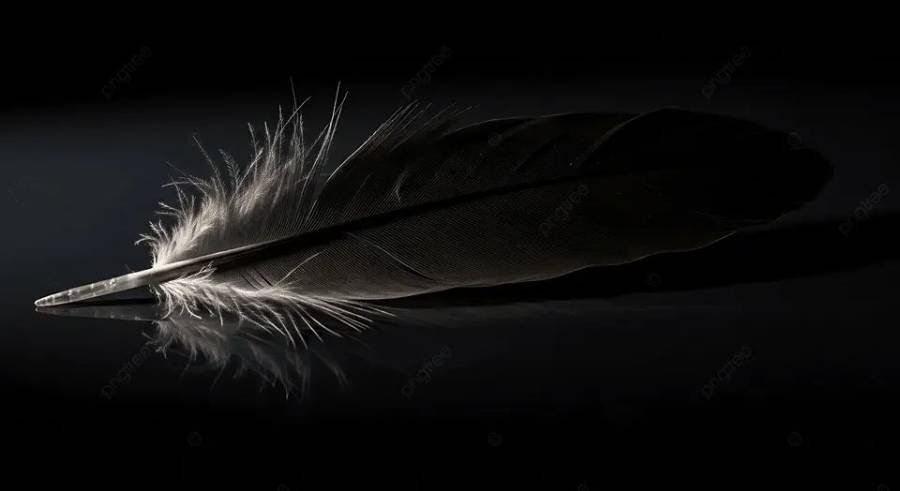
Finding a black feather is commonly interpreted as a spiritual symbol of protection, transformation, inner strength, guidance, and transition. In many spiritual belief systems, the color black represents mystery, the unknown, boundaries, and the ending of one phase, while a feather can represent freedom, spiritual awareness, or a connection with something beyond everyday experience. Together, these symbols give a black feather several possible meanings rather than one universal message.
The meaning of finding a black feather depends heavily on the circumstances surrounding the experience. Finding one while making an important decision may be interpreted differently from discovering one after a relationship ends, during grief, or at the beginning of a major life change. The location of the feather, your emotional response, and your personal spiritual beliefs also influence the interpretation.
There are 9 main spiritual meanings associated with finding a black feather, including protection, transformation, inner strength, caution, endings, new beginnings, intuition, spiritual guidance, and mystery. This article explains each meaning and shows how contexts such as love, loss, dreams, location, and repeatedly finding black feathers can change the interpretation. These meanings are spiritual and symbolic interpretations rather than scientific evidence that a supernatural event has occurred.
What Does Finding a Black Feather Mean Spiritually?
Finding a black feather spiritually means protection, transformation, inner strength, guidance, or a transition from one stage of life to another. The interpretation comes from combining the symbolism of a feather with the symbolism associated with the color black. Feathers are often connected with freedom, spiritual awareness, and messages, while black is associated with mystery, boundaries, endings, and the unknown. A black feather therefore tends to appear symbolically in interpretations involving change, protection, and periods when the next direction is not yet clear.
A black feather does not have one fixed spiritual meaning because the circumstances surrounding the discovery affect its interpretation. For example, finding one while facing a difficult decision may be interpreted as a reminder to trust your judgment and proceed carefully. Finding one after ending a relationship may instead represent closure and the transition into a new stage of life. The same symbol can therefore carry different meanings without those interpretations necessarily conflicting.
The emotional response to finding the feather provides another layer of context. A sense of calm may support an interpretation centered on protection or reassurance, while uneasiness may lead someone to view the feather as a reminder to examine a situation more carefully. Personal beliefs also matter because spiritual traditions and individuals do not assign identical meanings to feathers or to the color black.
For this reason, finding a black feather should be treated as a symbolic experience rather than a guaranteed prediction or supernatural message. Its spiritual significance comes from the relationship between the symbol, the circumstances in which it appears, and the meaning a person assigns to that experience.
What Are the 9 Spiritual Meanings of Finding a Black Feather?
There are 9 main spiritual meanings of finding a black feather: protection, transformation, inner strength, caution, endings, new beginnings, intuition, spiritual guidance, and mystery. These meanings overlap because they describe different stages or aspects of personal change. For example, an ending can create a transition, a transition can require inner strength, and uncertainty during that process can encourage greater reliance on intuition.
1. Spiritual protection. A black feather can symbolize protection and stronger personal boundaries. Black is frequently associated in spiritual symbolism with shielding, containment, and separation from unwanted influences. Finding a black feather during a stressful period may therefore be interpreted as a reminder to protect your emotional energy, establish clearer boundaries, or distance yourself from situations that repeatedly cause harm. For example, someone dealing with a draining relationship might associate the feather with the need to say no more firmly rather than viewing it as a prediction about what another person will do.
2. Transformation. A black feather can represent a period of significant personal transformation. Transformation involves leaving an established state and moving toward another, which makes the symbolism of darkness and uncertainty relevant: the old situation may be ending before the new one is fully visible. A person changing careers, leaving a long-term relationship, relocating, or reconsidering deeply held beliefs may interpret finding a black feather as reflecting that transitional period. In this context, the feather symbolizes the process of change rather than guaranteeing a particular outcome.
3. Inner strength. Finding a black feather can symbolize resilience when circumstances require emotional or mental strength. This interpretation focuses on the ability to continue through uncertainty instead of avoiding it. Difficult experiences such as rejection, failure, conflict, or an unexpected life change can force a person to recognize abilities that were less visible during stable periods. A black feather found during such a time may serve as a personal symbol of endurance and the capacity to move forward despite incomplete answers.
4. Caution or warning. A black feather can be interpreted as a symbolic reminder to slow down and examine a situation carefully. A spiritual warning does not mean that misfortune is certain to occur. Instead, this interpretation emphasizes awareness of decisions, relationships, habits, or circumstances that deserve closer attention. For example, finding a black feather while repeatedly ignoring concerns about a major decision might prompt reflection on those concerns before taking action. The useful element of this interpretation is increased awareness, not fear.
5. The end of a life chapter. A black feather can represent closure when a significant phase of life is coming to an end. An ending can involve a job, friendship, relationship, personal identity, habit, or long-term goal rather than physical death. Black symbolism is often connected with completion and the unknown that follows it, while the feather can represent movement away from what has finished. Someone who finds a black feather after finally leaving an unhealthy situation, for example, may interpret it as a personal symbol of closure.
6. New beginnings. A black feather can symbolize a new beginning because endings and beginnings are connected stages of the same transition. A person must often release an established situation before creating space for a different one. In this interpretation, the darkness associated with black represents a future that has not yet become clear rather than something inherently negative. Finding a black feather after accepting a new job, moving to another city, or making a major personal commitment may therefore be associated with entering an unfamiliar chapter.
7. Intuition. A black feather can represent the need to pay closer attention to intuition and internal judgment. This meaning is especially relevant when external information is incomplete and a person must examine their own reactions, values, and observations before deciding what to do. Intuition should not replace evidence in decisions involving health, safety, finances, or other high-impact matters, but reflection can help identify concerns that deserve investigation. Spiritually, the black feather can function as a prompt to notice what has been overlooked.
8. Spiritual guidance. In some spiritual belief systems, finding a black feather is interpreted as a form of guidance or reassurance during uncertainty. People may associate feathers with spirit guides, ancestors, angels, or other spiritual figures according to their own traditions. The interpretation is particularly common when a feather appears during grief, prayer, reflection, or an important life transition. However, finding a feather does not objectively establish that a supernatural being has sent it. The spiritual meaning belongs to the belief framework through which the experience is interpreted.
9. Mystery and the unknown. A black feather can symbolize uncertainty, hidden information, and aspects of life that have not yet been understood. Black naturally limits what can be seen and is therefore widely used symbolically to represent the unknown. This meaning does not automatically indicate danger. Instead, it can reflect a period when a person does not yet have enough information to know what comes next. For example, someone waiting for the outcome of a major life decision may associate a black feather with accepting temporary uncertainty rather than forcing an immediate answer.
These 9 meanings show why a black feather should not automatically be classified as either positive or negative. Its spiritual meaning depends on the interaction between the symbol and the context in which it is found. Protection and new beginnings can feel reassuring, while caution and endings may feel uncomfortable, but all four can belong to the same broader process of personal transition.
Is Finding a Black Feather a Good or Bad Sign?
Finding a black feather is not inherently a good or bad spiritual sign. Its meaning depends on the situation in which the feather appears, the person’s emotional response, and the spiritual belief system used to interpret it. Positive interpretations connect black feathers with protection, strength, and new beginnings, while cautionary interpretations connect them with endings, uncertainty, and the need to examine a situation more carefully.
A black feather can be considered a positive sign when it appears during a period that requires reassurance or resilience. For example, someone recovering from a difficult breakup may interpret the feather as a symbol of emotional protection and the beginning of a new chapter. A person preparing for a major change may associate it with the strength needed to move through uncertainty. In these situations, the color black represents protection or the unknown rather than danger.
The same feather can carry a cautionary meaning when it appears during conflict, uncertainty, or an important decision. In this context, the feather may serve as a personal reminder to reconsider a choice, establish stronger boundaries, or pay attention to information that has been ignored. Caution does not mean that something bad will happen. It means the symbolism is being used to encourage awareness before taking the next step.
The distinction between a good and bad sign therefore depends more on context than color. Black is sometimes associated with death, fear, or negativity, but spiritual symbolism also connects it with protection, mystery, strength, closure, and transformation. Interpreting every black feather as a bad omen ignores these other symbolic associations.
A practical way to interpret the experience is to consider four elements: the feather, the situation, your immediate emotional response, and your existing beliefs. A feather found during a peaceful walk after resolving a personal problem carries a different context from one noticed while worrying about a difficult decision. Neither interpretation predicts what will happen next; each reflects how the symbol relates to the circumstances surrounding its discovery.
Does the Place Where You Find a Black Feather Change Its Meaning?
The place where you find a black feather can change its spiritual interpretation because location provides context for the symbol. A feather found on a path may be associated with direction and life choices, while one found near a home may be interpreted through themes of protection, boundaries, family, or personal life. The physical location does not create a fixed spiritual message, but it can help determine which symbolic meaning feels most relevant.
Location matters because spiritual interpretation relies on associations. A doorway represents an entrance or boundary, a path represents movement and direction, and a home represents personal space and security. When a black feather appears in one of these places, the symbolic associations of the location combine with meanings commonly assigned to the feather.
What Does Finding a Black Feather on Your Path Mean?
Finding a black feather on your path can symbolize direction, transition, or the need to consider your next step carefully. A path naturally represents movement from one point to another, so the location reinforces the black feather’s association with change and uncertainty.
This interpretation is particularly relevant during a period involving an important choice. Someone deciding whether to change careers, relocate, begin a relationship, or leave an established situation may interpret a black feather on their path as a reminder to become more deliberate about the direction they are taking. The symbolism does not indicate which option is objectively correct. Instead, it encourages reflection on the decision itself.
The meaning can also be connected with progress through an uncertain period. A person does not always know the destination while moving through a transition. In this context, the black feather represents the unknown part of the journey, while its position on the path emphasizes continuing movement rather than remaining fixed in the previous stage.
What Does Finding a Black Feather at Your Door Mean?
Finding a black feather at your door can symbolize protection, boundaries, or a transition affecting your personal life. A door separates private space from the outside world, making boundaries the strongest contextual association with this location.
Under a protection interpretation, the feather can act as a personal reminder to consider what you allow into your physical or emotional space. This could involve relationships, recurring conflicts, responsibilities, or influences that affect your sense of security. For example, someone who has been struggling to establish limits with another person may connect a black feather at the door with the need for firmer boundaries.
A doorway also represents transition because people pass through it when entering or leaving a space. Finding a black feather there can therefore be interpreted as reflecting the movement between two stages of life. Starting a new relationship, moving home, changing family dynamics, or leaving an old routine can make this interpretation particularly relevant.
The feather itself does not indicate that the home is threatened or that something negative is about to enter it. Treating a black feather at the door as an automatic warning would turn symbolic interpretation into an unsupported prediction.
What Does Finding a Black Feather Inside Your House Mean?
Finding a black feather inside your house can symbolize personal reflection, emotional boundaries, family matters, or change within your private life. A house is commonly associated with security, identity, relationships, and the parts of life that are less visible to other people. The spiritual interpretation therefore tends to shift from external direction toward internal or personal concerns.
The specific area of the house can add another layer of context. A feather in a bedroom may be associated with private emotions, intimacy, relationships, or rest, while one near an entrance may relate more strongly to boundaries and transition. A feather found in a shared family space may lead someone to reflect on household relationships or changes affecting several people.
Finding a feather indoors also has straightforward physical explanations that should not be overlooked. A feather can enter through an open window, attach to clothing or an object, or be carried inside by a person or pet. Its natural route into the house does not prevent someone from assigning personal symbolism to the experience, but the physical explanation and spiritual interpretation should remain separate.
Location therefore helps narrow the possible meaning of a black feather rather than determine it absolutely. A path emphasizes direction, a door emphasizes boundaries and transition, and a house emphasizes personal or family life. The strongest interpretation is the one that fits both the location and the circumstances occurring in the person’s life at the time.
What Does Finding a Black Feather Mean in Love and Relationships?
Finding a black feather in the context of love and relationships can symbolize emotional protection, stronger boundaries, relationship transformation, closure, or the beginning of a new relationship phase. The meaning depends on what is currently happening in the relationship rather than the feather alone. Someone experiencing conflict may connect the feather with boundaries, while someone beginning or ending a relationship may interpret it through transformation and transition.
Emotional protection is one of the strongest interpretations when a black feather appears during relationship difficulties. Protection in this context means recognizing behaviors, situations, or emotional patterns that repeatedly cause distress and establishing appropriate boundaries around them. For example, a person who continually sacrifices personal needs to avoid conflict may interpret the feather as a reminder to protect their emotional well-being and communicate limits more clearly.
A black feather can also represent relationship transformation when an established dynamic is changing. Relationships change when partners make commitments, move in together, spend time apart, resolve long-term conflicts, or reconsider what they expect from each other. Because black feather symbolism is associated with endings and transitions, finding one during such a period may represent the movement from an old relationship pattern into a different one.
Closure becomes the more relevant interpretation when a relationship has ended or when someone is trying to release an attachment to a past partner. In this context, the black feather can symbolize accepting that one emotional chapter has finished and creating space for another to begin. The symbolism does not require reconciliation or a new romantic relationship. A new beginning can instead involve rebuilding independence, changing relationship patterns, or developing clearer expectations for future partners.
Finding a black feather should not be treated as proof that a breakup, reconciliation, marriage, or soulmate connection will occur. The feather cannot establish another person’s feelings or predict the future of a relationship. Its spiritual value is better understood as a symbolic prompt for examining boundaries, emotions, changes, and decisions that already exist within the person’s relationship context.
What Does Finding a Black Feather Mean After Someone Dies?
Finding a black feather after someone dies can symbolize remembrance, comfort, grief, transition, or an ongoing emotional connection with the person who died. In some spiritual belief systems, feathers are also interpreted as signs from ancestors, spirit guides, angels, or deceased loved ones. These interpretations can give personal meaning to an unexpected encounter with a feather during bereavement, but they remain spiritual beliefs rather than evidence that communication with the deceased has occurred.
Remembrance is one of the clearest ways to interpret the experience. Grief increases attention to objects, places, dates, songs, and other experiences associated with the person who died. A black feather discovered during this period may become a meaningful symbol because it appears at a moment when memories of that person are especially strong. For example, finding one while visiting a meaningful location or thinking about a deceased relative may create an association between the feather and remembrance.
The feather can also symbolize transition. Death creates a major change for surviving family members and friends, and grief involves adapting to life after that change. Within spiritual symbolism, black is associated with endings, mystery, and the unknown, while a feather can represent movement or release. Together, these associations allow a black feather to represent the difficult transition between a life shared with someone and a life in which that person’s physical presence is absent.
For people who believe in signs from deceased loved ones, finding a black feather may feel like reassurance or continuing connection. The interpretation becomes particularly significant when the feather appears on an anniversary, during reflection, after a dream about the person, or at a location connected with them. The timing can strengthen the individual’s personal association without establishing that the feather was deliberately sent.
A black feather found after a death should therefore not automatically be interpreted as a bad omen or another prediction of death. Black symbolism includes grief and endings, but it also includes protection, strength, transition, and the unknown. Interpreting the feather as a prediction of another loss can create unnecessary fear without providing reliable information.
The most appropriate spiritual interpretation depends on what the encounter represents to the grieving person. For one person, the feather may symbolize remembrance; for another, it may represent comfort, closure, or a continuing spiritual bond. The physical feather can have an ordinary natural origin while still becoming a meaningful personal symbol through the circumstances in which it was found.
What Does Seeing a Black Feather in a Dream Mean?
Seeing a black feather in a dream can symbolize transition, uncertainty, protection, hidden emotions, or unresolved concerns. Unlike physically finding a feather, a dream occurs within a person’s internal experience, so its meaning depends strongly on the events in the dream, the emotions felt during it, and the circumstances currently affecting the dreamer.
Transition is a relevant interpretation when the dream occurs during a major life change. Starting a new job, ending a relationship, moving to another place, or changing a long-established routine can create uncertainty about what comes next. A black feather appearing in this context may symbolically represent the movement between a familiar stage and an unfamiliar one. The black color emphasizes what is not yet known, while the feather represents movement away from the previous state.
Protection is another possible interpretation, particularly when the black feather creates a feeling of safety or calm within the dream. In spiritual symbolism, black can represent boundaries and shielding rather than negativity alone. A dream in which someone holds, receives, or discovers a black feather during a threatening situation may therefore be interpreted as reflecting a desire for security, stronger boundaries, or emotional protection.
A black feather can represent hidden or unresolved emotions when the dream feels uncomfortable. Fear, grief, resentment, uncertainty, or anxiety that has not been addressed directly may influence the symbolic content of a dream. For example, repeatedly dreaming about a black feather while avoiding a difficult conversation may make introspection more relevant than interpreting the feather as a warning about an external event.
The actions surrounding the feather also provide context. Finding a feather may emphasize discovery, receiving one may emphasize guidance or support, losing one may reflect concerns about security or direction, and watching one move away may symbolize release. These interpretations are symbolic frameworks rather than fixed rules because identical dream imagery can carry different personal associations for different people.
Seeing a black feather in a dream should therefore not be treated as a prediction of death, misfortune, or another future event. A more useful interpretation considers three elements together: what happened in the dream, how the dream felt, and what was happening in the dreamer’s life at the time. These details provide more context than the color of the feather alone.
What Does Finding a Black and White Feather Mean Spiritually?
Finding a black and white feather can spiritually symbolize balance, duality, transition, or the coexistence of opposing forces. The interpretation comes from the contrast between the two colors. Black is commonly associated in spiritual symbolism with mystery, introspection, endings, and the unknown, while white is often associated with clarity, peace, openness, and new beginnings. A feather containing both colors can therefore represent two different states existing together.
Balance is one of the strongest interpretations because black and white create a visible contrast without either color eliminating the other. Spiritually, this can represent the need to acknowledge both positive and difficult aspects of a situation. For example, accepting a new job may create excitement while also requiring someone to leave familiar colleagues and routines behind. Finding a black and white feather during that period may become a personal symbol of holding both experiences at the same time.
Duality is a related meaning but focuses on opposites rather than equilibrium. Certainty and uncertainty, endings and beginnings, independence and connection, or action and reflection can exist simultaneously during important life changes. A black and white feather may symbolize this tension when a person is deciding between two directions or trying to reconcile conflicting emotions.
The feather can also represent transition when one stage is ending while another is beginning. Major changes rarely create an immediate separation between the past and future. A person moving to a new city, for example, may still feel attached to their previous home while becoming increasingly connected to the new environment. Black-and-white symbolism can represent this intermediate state in which closure and beginning occur together.
A black and white feather is therefore not automatically more positive than a completely black feather. Both symbols can represent protection, change, introspection, or transition depending on context. The additional white coloring mainly introduces themes such as contrast, balance, and clarity into the interpretation. The circumstances of finding the feather remain more useful for determining personal meaning than color symbolism by itself.
What Does It Mean If You Keep Finding Black Feathers?
Repeatedly finding black feathers can symbolize a recurring theme of protection, transformation, intuition, or unresolved change that has become personally significant. Repetition can make an experience feel more meaningful because the same symbol appears across multiple situations. However, repeatedly encountering black feathers does not prove that a supernatural source is sending a message.
The circumstances surrounding each encounter determine whether repetition adds useful symbolic meaning. Finding several black feathers during the same major life transition may reinforce themes of change and uncertainty. For example, someone who repeatedly notices black feathers while preparing to leave a long-term job may associate them with the transition from a familiar identity to an unknown professional direction. The repeated symbol becomes connected with an existing life experience rather than predicting its outcome.
Repeated black feathers can also be interpreted as a reminder to examine an issue that continues to demand attention. Protection may become relevant when the same boundary is repeatedly crossed, while intuition may become relevant when a person continues to ignore concerns about a decision. In this interpretation, repetition encourages reflection on a recurring pattern. The useful question is not simply “Why do black feathers keep appearing?” but “What situation keeps being present when I notice them?”
There is also a natural explanation for repeated encounters. Birds lose feathers through normal biological processes, including molting and everyday activity, so locations with regular bird activity can contain multiple feathers. A person who begins paying attention to black feathers may also notice them more frequently than before because the symbol has become personally important. Environmental repetition and personal spiritual significance can therefore exist at the same time.
The strongest interpretation comes from identifying a consistent connection between the encounters and the person’s circumstances. Repeated black feathers have greater personal symbolic relevance when the same emotional concern, transition, decision, or relationship pattern is present across several encounters. Repetition alone does not establish a fixed spiritual message.
How Can You Interpret the Meaning of a Black Feather You Found?
You can interpret the meaning of a black feather by examining 5 factors: location, timing, current life circumstances, emotional response, and personal spiritual beliefs. These factors narrow the possible interpretations and help distinguish a personally relevant meaning from a generic list of black feather symbolism.
1. Identify where you found the feather. Location establishes the immediate context of the encounter. A feather on a path can emphasize direction and transition, while one near a doorway can emphasize boundaries or changes involving home life. A feather found at a personally meaningful location may also carry associations connected with memories or relationships. Start with the physical setting before assigning a broader spiritual interpretation.
2. Consider when you found it. Timing can connect the feather with an event that is already occurring in your life. Finding one immediately after making an important decision may make guidance or transition feel relevant, while discovering one during a period of grief may create an association with remembrance. The timing does not prove that the two events are causally connected, but it explains why a particular symbolic meaning may feel significant.
3. Examine what is changing in your life. Current circumstances help determine which of the 9 main black feather meanings fits the experience. A relationship ending points more naturally toward closure and new beginnings than toward mystery. A difficult decision may make intuition or caution more relevant. Ongoing emotional pressure may bring protection and inner strength into focus. Matching the symbol to an existing situation produces a more coherent interpretation than selecting a meaning without context.
4. Recall your immediate emotional response. Your first reaction can reveal how you personally experienced the symbol. Feeling calm, reassured, curious, uncomfortable, or reflective creates different interpretive contexts. Calmness may align with protection or reassurance, while discomfort may encourage closer examination of a concern. An emotional response is information about your reaction to the experience; it is not evidence that the feather objectively carries the same meaning.
5. Compare the experience with your spiritual beliefs. Personal beliefs determine how much spiritual significance you assign to feathers. Someone who views feathers as meaningful spiritual symbols may connect the encounter with guidance, protection, or ancestors. Someone with a different belief system may regard the same feather primarily as a natural object while still using it as a personal reminder of change or resilience. Neither approach requires a universal interpretation.
These 5 factors can be combined into a simple framework: location + timing + life circumstances + emotional response + spiritual beliefs = personal interpretation. For example, finding a black feather on a path shortly after deciding to leave an unhealthy relationship may make transition, protection, and new beginnings the most contextually relevant meanings. Finding the same type of feather during an ordinary walk with no meaningful personal context may carry little or no spiritual significance for that person.
The goal is not to force every black feather into one of the 9 spiritual meanings. A useful interpretation should fit the circumstances without turning symbolism into a factual prediction. This approach allows the feather to have personal spiritual significance while preserving the distinction between symbolic meaning and objective evidence.
Read more: Spiritual Meanings of Heptagram or Seven-Point Star
What Should You Do After Finding a Black Feather?
After finding a black feather, observe where it appeared, consider what was happening in your life, record the experience if it feels meaningful, and decide whether the feather has personal spiritual significance. You do not need to perform a ritual or immediately interpret the feather as a supernatural message. Reflection provides more context than reacting to the symbol alone.
First, observe the feather without immediately assigning a meaning to it. Note its location, when you noticed it, what you were doing, and whether an important event occurred shortly before the encounter. These details help distinguish a contextually relevant interpretation from one selected simply because it sounds appealing. For example, protection may be relevant during a period of boundary-setting, while transformation may fit more closely when you are changing careers or ending a major chapter of your life.
Second, record your immediate thoughts and emotions. Writing a short journal entry can preserve details that become less clear over time, including whether the feather made you feel calm, curious, uneasy, hopeful, or reflective. If black feathers appear repeatedly, these records can also reveal whether the encounters share a consistent context. Several encounters occurring during the same transition may carry more personal symbolic relevance than unrelated encounters spread across different circumstances.
Third, use the feather as a prompt for reflection rather than as an instruction. A meaning such as caution can encourage you to examine a decision more carefully, but it should not determine the decision by itself. Similarly, interpreting a feather as spiritual guidance does not require you to make an immediate life change. The practical value of symbolism comes from the questions it encourages you to consider about your circumstances, priorities, relationships, and emotional state.
You can photograph the feather if you want to preserve the memory without taking it home. Keeping a physical feather is a separate decision because wildlife laws differ by country and species, and possession of feathers from protected birds may be restricted. Avoid assuming that every feather found outdoors is legal or appropriate to collect. Leaving it where you found it allows you to preserve the symbolic experience without needing to identify or possess the feather.
There is also no required spiritual ritual after finding a black feather. A person may choose to meditate, pray, journal, or simply acknowledge the experience according to their own beliefs. These actions give structure to personal reflection; they do not make one interpretation objectively more valid than another.
Can Finding a Black Feather Have a Natural Explanation?
Yes. Finding a black feather can have a completely natural explanation because birds routinely lose and replace feathers. A feather appearing on a path, near a house, or in another outdoor location does not require a supernatural cause. Natural origin and spiritual interpretation are separate questions: one explains how the feather arrived, while the other describes the personal meaning someone assigns to finding it.
Molting is one straightforward reason feathers appear in the environment. Birds periodically replace old or damaged feathers as part of maintaining functional plumage. Individual feathers can also become detached through ordinary movement, interactions with other birds, contact with vegetation, or other environmental activity. Wind can then move a loose feather away from the place where it was originally shed.
Location can make repeated encounters more likely. A garden, park, walking route, balcony, or neighborhood with regular bird activity provides more opportunities to encounter feathers than an area with few birds. Finding several black feathers in the same location may therefore reflect the presence of dark-feathered birds or environmental conditions that allow feathers to accumulate.
Attention also affects how frequently a person notices a symbol. After a black feather becomes personally meaningful, someone may begin noticing similar feathers that previously would have attracted little attention. This does not mean the encounters are imaginary. The physical feathers are present, but increased attention can make an existing feature of the environment appear more frequent or significant.
A natural explanation does not prevent a black feather from having personal spiritual meaning. Physical cause and symbolic meaning can coexist without being treated as the same claim. A bird may have naturally lost the feather, while finding it at a meaningful moment can still prompt someone to reflect on protection, change, closure, intuition, or another theme relevant to their life.
This distinction provides the clearest way to approach black feather symbolism. The physical presence of a feather can be explained through ordinary bird behavior and environmental processes, while its spiritual significance depends on personal beliefs and context. Finding a black feather therefore does not need to prove a supernatural event to become a meaningful symbol for the person who discovers it.