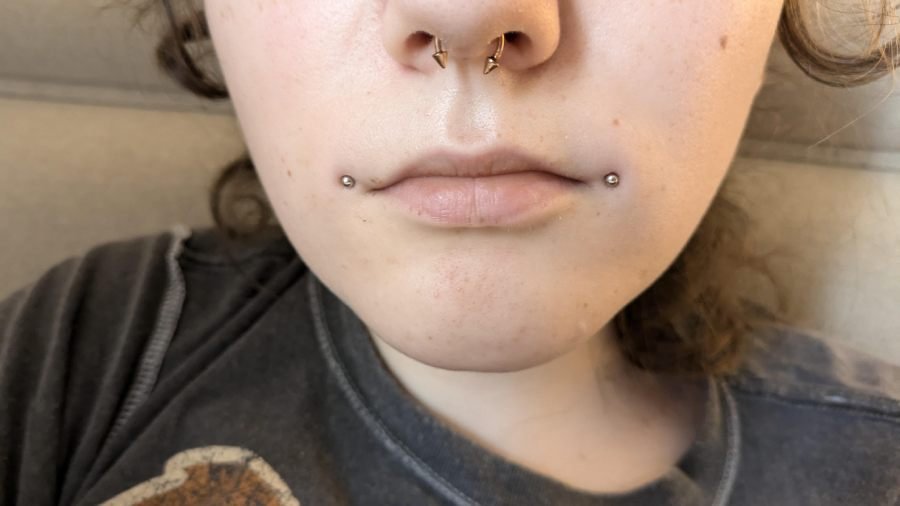
Dahlia piercings can spiritually represent individuality, self-expression, personal transformation, duality, balance, inner strength, confidence, empowerment, and unconventional beauty. These meanings are primarily modern symbolic and personal interpretations rather than universal spiritual beliefs attached to the piercing. Because spiritual symbolism depends heavily on personal intention, two people can wear the same Dahlia piercing while giving it entirely different meanings.
A Dahlia piercing, also known as a Dahlia bite, consists of paired piercings positioned near the corners of the mouth. Its symmetrical placement provides a natural basis for interpretations involving duality and balance, while its prominent position on the face connects it with identity and outward self-expression. For someone who chooses the piercing during a significant life transition, it may instead represent transformation, resilience, or taking greater ownership of their identity.
The name “Dahlia” also creates a possible symbolic connection with the dahlia flower. However, flower symbolism should not automatically be treated as the historical spiritual meaning of Dahlia piercings. Instead, it can provide an additional layer of meaning when the wearer intentionally identifies with the flower and its symbolism. The 9 spiritual meanings below explain the major ways a Dahlia piercing can be interpreted and what each symbolism can represent personally.
What Does a Dahlia Piercing Mean Spiritually?
A Dahlia piercing spiritually represents personal identity, transformation, duality, balance, and the freedom to express an unconventional version of yourself. Its meaning is not fixed by a single religious or spiritual tradition. Instead, the symbolism usually develops from three elements: the piercing’s symmetrical placement, the personal intention behind getting it, and the meaning the wearer associates with changing their physical appearance.
The paired placement is especially relevant to its spiritual interpretation. Dahlia piercings sit near opposite corners of the mouth, creating two corresponding points on the face. This visual structure can represent two sides of the self, such as strength and vulnerability, past and future, or the inner self and outward identity. When these opposing aspects are viewed as complementary rather than conflicting, duality develops into a symbolism of balance.
Personal intention creates another layer of meaning. A person who gets a Dahlia piercing after leaving an old stage of life may associate it with transformation or a new identity. Someone who chooses it because conventional forms of beauty do not reflect their personality may interpret the piercing as individuality, confidence, or empowerment. In both cases, the physical piercing becomes a visible symbol of an internal value or experience.
For this reason, there is no universal spiritual definition that applies to every Dahlia piercing. Its spiritual significance is better understood as personal symbolism expressed through body modification. The meaning becomes stronger when the wearer connects the piercing with a specific value, experience, transition, or aspect of identity rather than adopting a symbolic meaning simply because it is associated with the piercing online.
What Are the 9 Spiritual Meanings of a Dahlia Piercing?
The 9 main spiritual meanings associated with a Dahlia piercing are individuality, self-expression, personal transformation, duality, balance, inner strength, confidence, empowerment, and unconventional beauty. These interpretations overlap in some contexts, but each represents a different relationship between physical appearance, personal identity, and inner experience.
1. Individuality
A Dahlia piercing can symbolize individuality because it represents a deliberate choice to create an appearance that differs from conventional facial aesthetics. Individuality in this context means recognizing and expressing the characteristics that distinguish one person from others rather than adjusting personal appearance solely to meet external expectations.
This symbolism becomes particularly relevant when the wearer chooses the piercing as an expression of an identity they have consciously accepted. The piercing then functions as a visible marker of personal distinctiveness. For example, someone who previously avoided unconventional clothing, hairstyles, or body modifications because of social expectations may associate getting Dahlia piercings with finally becoming comfortable expressing an individual aesthetic.
2. Self-Expression
A Dahlia piercing can represent self-expression by turning personal identity into a visible form of body modification. While individuality concerns being distinct, self-expression concerns communicating that distinct identity outwardly. The face is highly visible during social interaction, so altering its appearance provides a direct way to communicate aesthetic preferences and personal values.
The symbolism does not require the wearer to communicate a specific message to everyone who sees the piercing. Instead, the act of choosing how the body appears can itself become expressive. For example, a wearer may view Dahlia piercings as an external representation of an alternative identity that was previously expressed only through private interests, beliefs, or creative activities.
3. Personal Transformation
A Dahlia piercing can symbolize personal transformation when the wearer connects it with a deliberate transition from one stage of life to another. Physical changes are sometimes used as markers of internal change because they create a visible distinction between a previous identity and a new one.
The transformation does not come from the piercing itself. Its meaning comes from the event, decision, or personal development attached to it. Someone might get Dahlia piercings after achieving independence, ending an important chapter of life, or deciding to change how they present themselves. In this context, the jewelry can serve as a personal reminder of the point at which that transition became meaningful.
4. Duality
A Dahlia piercing can represent duality because the two piercings create corresponding points on opposite sides of the mouth. Duality describes the coexistence of two different or contrasting aspects within one whole. The paired structure makes this interpretation especially relevant to Dahlia piercings.
A wearer can use the two sides to symbolize qualities such as softness and strength, logic and emotion, darkness and light, or the person they were and the person they are becoming. These pairs do not need to represent a conflict. The spiritual interpretation centers on acknowledging that apparently opposing characteristics can exist within the same identity.
5. Balance
A Dahlia piercing can symbolize balance when its symmetrical placement represents harmony between different parts of the self. Balance differs from duality because duality recognizes two sides, while balance concerns the relationship between those sides.
For example, a person may associate one side with ambition and the other with emotional well-being. The paired piercings can then serve as a reminder that pursuing one does not require abandoning the other. The visual symmetry provides the symbolic mechanism: two separate points appear balanced because neither visually dominates the other.
6. Inner Strength
A Dahlia piercing can represent inner strength when the wearer uses it as a reminder of resilience, endurance, or a challenge they have overcome. Inner strength refers to the ability to maintain personal values and continue moving forward through difficult experiences rather than physical strength alone.
This meaning is highly personal because the same piercing cannot reveal what another person has experienced. For someone who associates a Dahlia piercing with recovering from a difficult period, however, seeing the jewelry can reinforce the memory of having moved beyond that stage. The piercing becomes a personal symbol attached to resilience rather than the source of that resilience.
7. Confidence
A Dahlia piercing can symbolize confidence through the willingness to visibly present a distinctive personal aesthetic. Facial piercings are difficult to separate from everyday appearance, so choosing a prominent modification can carry personal meaning for someone who previously felt uncomfortable showing an unconventional side of themselves.
Confidence here does not mean seeking attention or approval. It means becoming more comfortable with presenting an appearance that reflects personal preference. For example, someone who spent years suppressing an alternative aesthetic may view getting Dahlia piercings as a marker of becoming more secure in how they want to look.
8. Empowerment
A Dahlia piercing can represent empowerment because choosing a body modification can symbolize personal agency and ownership over one’s appearance. Empowerment differs from confidence: confidence concerns self-assurance, while empowerment concerns having and exercising the ability to make choices for oneself.
This interpretation is strongest when the piercing represents a consciously chosen act of autonomy. A wearer who previously allowed family expectations, beauty standards, or social pressure to determine their appearance may connect Dahlia piercings with reclaiming control over personal presentation. The spiritual value lies in the decision and the agency behind it rather than in the jewelry itself.
9. Unconventional Beauty
A Dahlia piercing can symbolize unconventional beauty by representing the acceptance of aesthetics outside traditional beauty standards. The piercing deliberately draws attention to the corners of the mouth and changes the visual composition of the face rather than attempting to preserve an unmodified appearance.
For some wearers, this can represent a broader belief that beauty does not need to depend on conformity. Choosing an unusual facial piercing may therefore become a way of accepting features, styles, and forms of expression that fall outside conventional expectations. In this interpretation, the Dahlia piercing represents not the rejection of beauty, but the decision to define beauty according to personal values.
Why Is a Dahlia Piercing Associated With Duality and Balance?
A Dahlia piercing is associated with duality and balance because its paired placement creates two visually corresponding points on opposite sides of the mouth. This physical symmetry provides a clear basis for interpreting the piercing as a symbol of two different aspects existing within one person. Duality represents the presence of those two sides, while balance represents the ability to acknowledge and integrate them.
Duality does not necessarily mean conflict between opposites. In a spiritual context, it can represent complementary qualities such as strength and vulnerability, independence and connection, reason and emotion, or the inner self and outward identity. A person does not need to eliminate one quality to embody the other. Instead, the two Dahlia piercings can serve as a personal symbol that both qualities belong to the same identity.
Balance adds a second layer to this interpretation. Because Dahlia piercings are normally positioned as a pair, their visual effect depends on the relationship between the left and right sides. A wearer may interpret this symmetry as a reminder to maintain equilibrium between competing priorities. For example, one side might personally represent ambition while the other represents emotional well-being, making the pair a symbol of pursuing goals without neglecting inner stability.
This connection should be understood as modern symbolic interpretation rather than a universal spiritual doctrine attached to Dahlia piercings. The placement provides the symbolic mechanism, but the wearer determines what the two sides represent. For one person, they may symbolize past and future; for another, they may represent vulnerability and resilience. The spiritual meaning becomes personal when those two concepts correspond to an actual experience, value, or internal relationship.
Does a Dahlia Piercing Symbolize Transformation and Personal Growth?
A Dahlia piercing can symbolize transformation and personal growth when the wearer intentionally connects the physical change with a meaningful change in identity, circumstances, or personal values. The piercing does not create transformation by itself. Instead, it can function as a visible marker of a transition that has already occurred or a commitment to a new direction.
Transformation involves moving from one state or stage into another, which makes intentional changes to appearance useful personal symbols for significant transitions. A person may choose Dahlia piercings after becoming independent, leaving an important period of life behind, changing how they perceive themselves, or deciding to express an identity they previously concealed. The permanent or semi-permanent physical change can then distinguish a new stage from the one that preceded it.
Personal growth gives this symbolism a more specific direction. Growth involves developing qualities, perspectives, or behaviors rather than simply experiencing change. For example, someone who has learned to establish stronger personal boundaries may associate the piercing with self-respect, while someone who has become more comfortable expressing an unconventional identity may connect it with self-acceptance. In both cases, the Dahlia piercing serves as a reminder of a specific development rather than a vague symbol of becoming a “new person.”
The meaning is strongest when it corresponds to a clearly defined experience. Getting a Dahlia piercing after a major personal milestone, for example, can create an association between the jewelry and that point of transition. Seeing the piercing afterward may remind the wearer of why the change mattered and what they chose to carry forward from it. This makes transformation a personally assigned spiritual meaning, not an inherent property of the piercing.
What Does a Dahlia Piercing Mean for Self-Expression and Identity?
A Dahlia piercing can represent self-expression and identity because it allows a person to make an intentional and highly visible change to their appearance. Identity describes how someone understands and defines themselves, while self-expression describes how elements of that identity are communicated outwardly. Dahlia piercings can connect the two by turning an internal sense of individuality into a visible aesthetic choice.
The location of the piercing strengthens this relationship. Dahlia piercings appear near the corners of the mouth, placing them on an area of the body that remains visible during conversation and facial expression. Unlike a body modification normally covered by clothing, facial jewelry becomes part of how the wearer presents themselves in everyday interactions. This visibility can make the piercing especially meaningful to someone who sees appearance as an extension of personal identity.
Self-expression does not require a Dahlia piercing to communicate one standardized message. One wearer might choose it to express an alternative aesthetic, while another might associate it with creativity, independence, or freedom from conventional beauty expectations. For example, a person who previously avoided facial piercings because they feared social judgment may interpret finally choosing Dahlia piercings as an expression of greater self-acceptance.
Identity, individuality, confidence, and empowerment therefore remain related but distinct meanings. Identity concerns who the wearer understands themselves to be; individuality emphasizes what makes that identity distinct; self-expression communicates it outwardly; confidence reflects comfort in presenting it; and empowerment emphasizes the agency to make that choice. Keeping these concepts separate gives each interpretation a specific spiritual function instead of treating several similar ideas as interchangeable meanings.
Is Dahlia Piercing Symbolism Connected to the Dahlia Flower?
Dahlia piercing symbolism can be connected to the dahlia flower as a personal interpretation, but the flower’s symbolism should not automatically be treated as the established spiritual meaning of the piercing. Sharing the name “Dahlia” creates an intuitive symbolic connection, yet a meaningful distinction exists between symbolism historically associated with a flower and meanings that a modern wearer chooses to associate with body jewelry.
This distinction matters because symbolic associations can develop after an object, practice, or style receives its name. A person may find that the meanings associated with dahlias reflect the reason they chose their piercing and intentionally combine the two. In that situation, the flower provides an additional interpretive layer. It does not prove that Dahlia piercings were originally created to represent those meanings.
For spiritual interpretation, the strongest connection therefore comes from personal intention. Someone who already identifies the dahlia flower with qualities they value may incorporate those qualities into the meaning of their piercing. Another wearer may have no interest in flower symbolism and instead associate the same piercing with individuality, balance, or transformation. Both approaches demonstrate why Dahlia piercing symbolism is better treated as personal rather than universal.
What Does the Dahlia Flower Symbolize?
The dahlia flower is commonly interpreted through themes such as inner strength, commitment, creativity, change, and distinctive beauty, but specific meanings depend on the symbolic tradition or source being used. These themes overlap with several interpretations that a person might independently associate with a Dahlia piercing, particularly transformation, inner strength, and unconventional beauty.
Inner strength creates one of the clearest symbolic parallels. A wearer who chooses Dahlia piercings after overcoming a difficult stage of life might identify with both the flower and the piercing as reminders of resilience. Change offers another possible connection when the body modification marks a transition, such as becoming independent or adopting a more authentic form of self-expression.
The overlap does not make the two symbol systems identical. Flower symbolism develops within cultural, historical, and interpretive contexts, while the spiritual significance of an individual piercing can come directly from the wearer. Dahlia flower symbolism is therefore most useful as supplementary meaning rather than evidence that every Dahlia piercing carries the same spiritual message.
Do Dahlia Flower Meanings Apply to Dahlia Piercings?
Dahlia flower meanings do not automatically apply to Dahlia piercings. A wearer can intentionally use flower symbolism to give the piercing additional personal significance, but the shared name alone does not establish that every symbolic meaning attributed to dahlias also belongs to the piercing.
For example, someone who associates dahlias with inner strength may choose that meaning because their piercing commemorates overcoming a difficult experience. Another person might focus on transformation because the piercing marks a major transition. In these cases, the relationship follows a clear sequence: the wearer identifies with a symbolic quality, recognizes that quality in dahlia symbolism, and consciously assigns it to the piercing.
This distinction prevents personal interpretation from being presented as historical fact. Without evidence establishing that a particular flower meaning formed part of the original symbolism of Dahlia piercings, the more accurate description is that dahlia flower symbolism can inspire the spiritual meaning a wearer personally gives to the piercing.
Does the Placement of a Dahlia Piercing Affect Its Spiritual Meaning?
The placement of a Dahlia piercing can influence its spiritual interpretation because the two piercings sit near opposite corners of the mouth, creating visibility, symmetry, and a paired visual structure. These physical characteristics provide symbolic cues that can support meanings such as self-expression, duality, and balance. Placement influences interpretation, but it does not create a fixed spiritual meaning.
Facial visibility strengthens the connection with identity and self-expression. The face plays a central role in how people present themselves during everyday interactions, and jewelry around the mouth becomes part of that visible presentation. A wearer who deliberately chooses an unconventional facial modification may therefore connect the placement with authenticity, individuality, or greater confidence in showing their preferred identity.
The paired positioning supports a different set of meanings. Two corresponding piercings can visually represent two parts of a whole, providing a straightforward mechanism for interpretations involving duality. A wearer might assign the two sides meanings such as past and future, strength and vulnerability, independence and connection, or inner identity and outward expression.
Symmetry can extend duality into balance. When the two sides are perceived as visually equal, the piercing can become a personal reminder that contrasting parts of life or identity do not need to eliminate one another. For example, a wearer might use the pair to represent maintaining personal independence while remaining emotionally connected to other people.
The mouth area can also carry personal associations with communication and expression, but these interpretations should remain clearly identified as symbolic rather than inherent properties of the piercing location. The strongest spiritual meaning comes from combining the physical characteristics of Dahlia piercings with an intention that genuinely matters to the wearer.
Does a Dahlia Piercing Have a Universal Spiritual Meaning?
No, a Dahlia piercing does not have one universal spiritual meaning that applies to every wearer. Meanings such as transformation, duality, balance, individuality, and empowerment are best understood as symbolic interpretations unless a specific historical, cultural, or religious source establishes otherwise. The appearance of a meaning in modern spiritual discussions does not by itself make that meaning an established tradition.
Three levels of meaning should be distinguished: historical or cultural symbolism, modern symbolic interpretation, and personal meaning. Historical or cultural symbolism requires evidence connecting a symbol with a particular tradition, community, or period. Modern interpretation develops when people associate the characteristics of an object with broader symbolic concepts. Personal meaning develops when an individual connects that symbolism with a specific experience, value, or intention.
For Dahlia piercings, the second and third levels provide the clearest framework for spiritual interpretation. Their paired placement can inspire associations with duality and balance, while choosing a distinctive facial modification can represent individuality or self-expression. A person who gets the piercing during an important life transition may instead give it a meaning centered on transformation or personal growth. These interpretations are meaningful because of the relationship between the piercing and the wearer’s intention, not because every Dahlia piercing carries them automatically.
This distinction also explains why two people can choose identical Dahlia piercings for entirely different spiritual reasons. One person may see the pair as a reminder to balance different areas of life. Another may associate it with taking ownership of their appearance after years of conforming to other people’s expectations. Neither interpretation needs to become the universal definition of the piercing to hold personal significance.
Read more: Spiritual Meanings of Jestrum Piercing
How Can You Choose a Personal Spiritual Meaning for a Dahlia Piercing?
Choose a personal spiritual meaning for a Dahlia piercing by connecting it with one specific experience, value, transition, or part of your identity that you want the piercing to represent. Starting with personal intention produces a clearer meaning than selecting several symbolic associations simply because they appear in descriptions of Dahlia piercings.
There are 4 useful factors to consider: personal experience, life transitions, values and identity, and symbolism that genuinely resonates with you. Personal experience works well when the piercing commemorates something you have overcome. A life transition makes transformation relevant when the piercing marks the end of one stage and the beginning of another. Values and identity support meanings such as individuality or empowerment when the decision reflects how you want to define yourself. Existing symbolism, including interpretations associated with the dahlia flower, can add another layer when it matches that intention.
For example, someone who gets Dahlia piercings after becoming independent may choose empowerment as the primary meaning because the modification represents greater control over personal choices. Someone who chooses the piercing after a major period of emotional or personal development may prefer transformation. A wearer interested in its paired symmetry may instead choose balance, using the two sides as reminders of two priorities they want to keep in equilibrium.
Selecting one primary meaning does not prevent the piercing from carrying secondary associations. A piercing centered on transformation can also represent confidence or inner strength. However, establishing a primary meaning creates a stronger symbolic relationship because the wearer can explain exactly what the piercing represents and why that interpretation matters.
What Should You Consider Before Giving a Dahlia Piercing a Spiritual Meaning?
Consider 3 factors before assigning a spiritual meaning to a Dahlia piercing: historical evidence, personal intention, and symbolic consistency. These factors help separate meanings supported by an identifiable context from modern interpretations and purely personal associations.
Historical evidence matters when a spiritual claim is presented as traditional, cultural, or universally recognized. A symbolic interpretation should not be described as an ancient belief or established spiritual tradition without evidence supporting that connection. This is especially important when discussing Dahlia flower symbolism alongside Dahlia piercings. Similar themes do not prove that the piercing historically inherited the symbolic meanings associated with the flower.
Personal intention determines whether a symbolic meaning is relevant to the individual wearer. Transformation has greater significance when the piercing marks an actual transition. Empowerment becomes more specific when choosing the piercing represents personal agency. Balance becomes meaningful when the wearer can identify the two priorities, qualities, or parts of the self that the paired jewelry represents. A clearly defined intention turns an abstract concept into personal symbolism.
Symbolic consistency concerns whether the interpretation has a logical connection with the piercing or the wearer’s experience. The paired placement provides a clear symbolic basis for duality and balance, while the visibility of facial jewelry supports interpretations involving identity and self-expression. Dahlia flower symbolism can provide another layer when the wearer deliberately identifies with it. The most meaningful spiritual interpretation of a Dahlia piercing is therefore not the one with the largest number of symbolic associations, but the one that most clearly connects the piercing with the wearer’s values, experiences, and intentions.