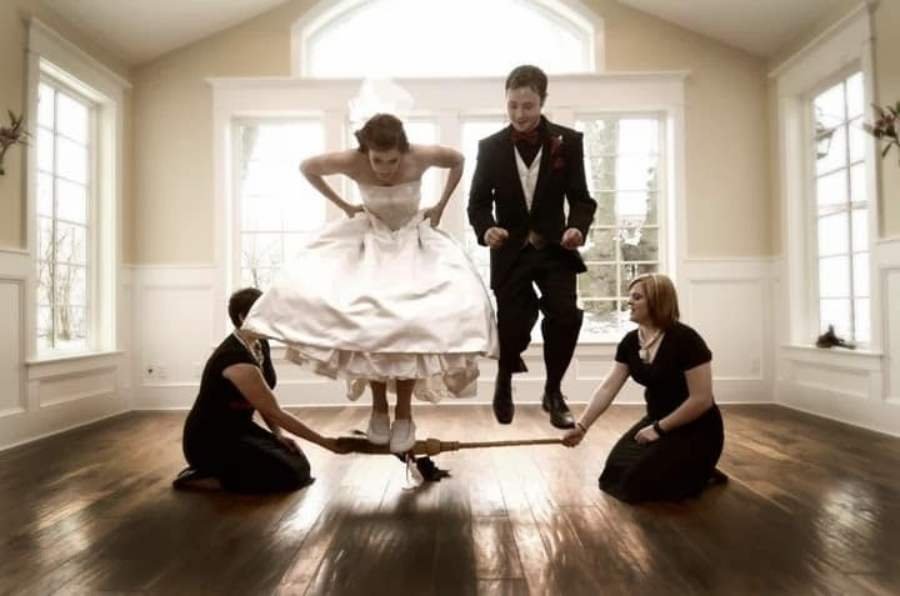
Jumping the broom spiritually symbolizes crossing a threshold into a new stage of life, leaving the past behind, and intentionally entering a committed union. The broom itself can represent cleansing and clearing away old patterns, while the act of jumping over it represents movement from one state of life into another. In a wedding, these symbols come together to express a couple’s transition into marriage and the beginning of a shared path.
The ritual can also carry meanings connected to commitment, family heritage, remembrance, and ancestral connection. These meanings are not universal, however. The significance of jumping the broom depends on the couple’s cultural background, family traditions, and spiritual intentions. Historical associations with African American weddings also need to be distinguished from modern spiritual interpretations rather than treated as evidence that every symbolic meaning has the same historical origin.
The spiritual meaning of jumping the broom is therefore best understood through its individual symbolic elements: the broom represents cleansing and preparation, the jump represents transition, and crossing the broom represents entering a new beginning. Within marriage, these elements can express the conscious decision to leave one chapter behind and begin another together.
What Is the Spiritual Meaning of Jumping the Broom?
The spiritual meaning of jumping the broom centers on transition, cleansing, new beginnings, commitment, and the intentional crossing from one stage of life into another. In a wedding ceremony, the couple physically jumps over a broom to represent leaving their previous state behind and entering married life together. The action creates a visible boundary between what came before the marriage and what begins after the commitment.
There are 5 main spiritual meanings associated with jumping the broom: transition, cleansing, new beginnings, union, and ancestral connection. Transition comes from the act of crossing over an object rather than remaining on the same side. Cleansing comes from the broom’s traditional function of sweeping away what is no longer wanted. A new beginning follows this symbolic clearing, while union reflects two people making the transition together. Ancestral connection can become another layer of meaning when a couple uses the ritual to acknowledge family heritage or a cultural tradition connected to their community.
The ritual can therefore function as a symbolic threshold. A threshold separates one space or condition from another, and crossing it represents a change in status. Before the jump, the two participants stand as individuals approaching a commitment; after crossing together, they symbolically enter a shared stage of life. The spiritual significance comes not from the physical height or direction of the jump but from the intention attached to crossing that boundary.
These meanings should not be treated as one fixed spiritual doctrine. Jumping the broom has been practiced and interpreted in different historical, cultural, and personal contexts, so a modern couple may emphasize one meaning more strongly than another. One couple may view the jump primarily as a symbol of commitment, while another may use it to represent family continuity or leaving old patterns behind. The common spiritual theme is intentional transition: something is being left behind while a new stage is consciously entered.
What Does the Broom Symbolize Spiritually?
The broom spiritually symbolizes cleansing, removal, preparation, and the clearing of space for something new. Its symbolism develops naturally from its physical function: a broom removes dirt and unwanted material from a space. In spiritual interpretation, that physical action becomes a metaphor for removing old patterns, unresolved influences, or aspects of life that a person does not want to carry into a new chapter.
Within jumping the broom, cleansing does not require the broom to literally remove something from the couple. Instead, the object represents the intention to clear the path before crossing into married life. The symbolic sequence is straightforward: the old is swept away, the boundary is approached, and the couple crosses into a new stage. This gives the broom a specific function within the ritual rather than making it merely a decorative wedding object.
The broom can also symbolize leaving the past behind. This does not mean rejecting a person’s history, family, or previous experiences. It represents choosing what will and will not be carried forward. For example, a couple might associate the broom with leaving behind harmful relationship patterns while carrying forward family values, memories, and traditions that support their marriage. The distinction makes cleansing a process of intentional preparation rather than erasure of the past.
The symbolism of the broom also complements the symbolism of the jump. The broom represents what is being cleared or prepared, while the jump represents the act of moving forward. Together, these two elements create a complete symbolic movement: cleansing precedes transition, and transition leads into a new beginning. This relationship explains why the broom has greater spiritual significance within the ceremony than an ordinary object placed on the ground.
What Does Jumping Over the Broom Symbolize?
Jumping over the broom symbolizes crossing a boundary and intentionally moving from an old state into a new one. The broom establishes the symbolic line, while the jump creates the act of crossing it. In the context of a wedding, the movement can represent the transition from life before the marital commitment to a shared life after that commitment.
Crossing is important to this symbolism because transitions are frequently understood through boundaries. A doorway separates two rooms, a threshold marks the point of entry, and a ceremonial boundary can distinguish one status from another. Jumping over the broom turns this abstract idea into a physical action. The couple does not simply state that a transition is occurring; they enact that transition by crossing the symbolic threshold together.
The act of jumping also introduces intention. Walking past an object can happen without attention, whereas deliberately positioning a broom and crossing it during a ceremony makes the movement purposeful. The spiritual meaning comes from the intention assigned to the action rather than from the physical jump itself. For example, a couple might cross the broom while intending to mark their commitment to approach future challenges as partners rather than as separate individuals.
Jumping and broom symbolism therefore perform different but connected roles. The broom represents cleansing and preparation; the jump represents movement and transition. When combined within a marriage ceremony, they form a symbolic sequence of clearing the old, crossing the threshold, and entering the new together.
Why Does Jumping the Broom Symbolize a New Beginning?
Jumping the broom symbolizes a new beginning because crossing the broom marks the transition from one chapter of life into another. In a wedding context, the boundary represents the point at which the couple leaves their previous relationship status behind and consciously enters a shared marital commitment.
A new beginning does not imply that everything before the ceremony disappears. Instead, the symbolism focuses on a change in direction and responsibility. Experiences, family relationships, and personal histories remain part of each person, but marriage introduces a new shared context for future decisions. The jump provides a physical representation of that change: both people cross the same boundary and continue forward on the same side.
The broom strengthens this interpretation because cleansing comes before renewal within the symbolic sequence. Clearing what no longer serves the relationship creates space for new intentions, habits, and commitments. For example, a couple may associate the ritual with leaving behind patterns of handling problems independently and beginning a marriage in which major challenges are approached together. In this interpretation, the new beginning is connected to a concrete change in how the couple intends to live.
The central symbolism is therefore not simply “starting over.” It is beginning deliberately after a symbolic act of preparation and transition. Cleansing represents readiness, crossing represents change, and arriving on the other side represents entry into the next stage. This sequence gives the idea of a new beginning its spiritual meaning within the jumping-the-broom ritual.
What Does Jumping the Broom Mean for Marriage?
Jumping the broom in marriage symbolizes commitment, union, and the couple’s decision to enter a shared life together. While the broom represents preparation and the jump represents transition, performing the action as a couple adds another layer of meaning: two people cross the same symbolic boundary and begin the next stage of their relationship together.
There are 3 central marriage meanings within the ritual: commitment, union, and a shared future. Commitment is represented by deliberately taking part in the ceremony rather than crossing the broom accidentally. Union comes from the couple completing the symbolic transition together. A shared future is represented by both partners arriving on the other side of the boundary and continuing forward from the same point. These meanings make jumping the broom especially relevant to a wedding, where a change in relationship status is already taking place.
The ritual can also represent the movement from individual intention to mutual responsibility. Marriage does not eliminate either partner’s individual identity, but it creates commitments that involve both people. Jumping together provides a physical expression of that change. For example, a couple may use the moment to symbolize a promise that decisions about their home, family, finances, or future will be approached as partners rather than as two entirely separate lives.
The spiritual significance of the marriage symbolism comes from choosing to cross the threshold together. The broom establishes a boundary between two stages, but both partners participate in moving beyond it. In this sense, the ceremony represents more than simply beginning something new. It represents beginning that new stage through a consciously chosen union.
This symbolism also explains why the ritual can remain meaningful even when a couple interprets it differently from another couple. One pair may emphasize commitment, another may emphasize building a household, and another may connect the marriage to family heritage. The specific intention can change while the underlying structure remains consistent: two people make a deliberate transition into a shared chapter of life.
Does Jumping the Broom Have an Ancestral Meaning?
Jumping the broom can have an ancestral meaning when the couple intentionally uses the ritual to honor family heritage, remember previous generations, or maintain a cultural connection. Ancestral connection is not a universal spiritual meaning of jumping the broom, however. Its significance depends on the historical, cultural, familial, and personal context surrounding the people performing the ceremony.
There are 3 distinct ways ancestral meaning can appear in the ritual: remembrance, continuity, and connection to heritage. Remembrance involves acknowledging family members or previous generations who came before the couple. Continuity means carrying a meaningful tradition into another generation. Connection to heritage involves using the ceremony as an expression of cultural identity and recognizing the history associated with the practice.
For example, an African American couple may choose jumping the broom partly because they understand the practice through the history and traditions of their community. In that context, the ceremony can function as more than a general symbol of a new beginning. It may also create a symbolic relationship between the present marriage, family memory, and previous generations. The meaning comes from the couple’s relationship with that heritage rather than from an automatic spiritual property of the broom itself.
Honoring ancestors and communicating with ancestors are not the same claim. A couple can honor previous generations through remembrance, ritual, family objects, or inherited traditions without claiming that jumping the broom literally establishes supernatural contact with them. This distinction is important because spiritual interpretations vary considerably between individuals and traditions.
Ancestral symbolism should also be separated from historical origin. A modern ceremony can acquire ancestral significance because of family or cultural continuity even when every detail of its distant origin is not known with certainty. Historical evidence addresses where and how a practice developed; ancestral meaning addresses what that practice represents to the people performing it today. Treating these as separate questions prevents spiritual interpretation from being presented as historical fact.
For couples who attach ancestral significance to the ritual, jumping the broom can therefore connect past, present, and future within one ceremonial action. The past is represented through family memory and heritage, the present through the couple making the commitment, and the future through the new family chapter that begins after the symbolic crossing.
Where Did the Tradition of Jumping the Broom Come From?
The exact origin of jumping the broom is complex, and the tradition should not be attributed to a single culture without historical qualification. The practice is strongly associated today with African American wedding traditions, particularly through its connection with enslaved African Americans, but broom-jumping customs have also been documented in Britain and among other communities. This makes it important to separate the documented history of the ritual from the spiritual meanings later attached to it.
For enslaved African Americans, marriage existed within a system that denied enslaved people legal autonomy and left their families vulnerable to separation. Jumping the broom became associated with marriage ceremonies conducted outside the legal protections available to free couples. Within this context, the ritual could publicly recognize a union even when the surrounding legal system did not provide the couple with the same marital rights and security.
The tradition later acquired additional meanings through cultural memory. For some African American couples today, jumping the broom can acknowledge the marriages, families, and resilience of previous generations. This creates an important distinction between historical function and contemporary symbolism. A ritual practiced under one set of historical circumstances can later become a way of remembering those circumstances and honoring the people connected to them.
Its modern spiritual meaning therefore cannot be understood solely by asking where the custom originated. The more precise question is how historical experience, cultural memory, and present-day intention interact. A couple may jump the broom today to symbolize marriage and transition while simultaneously recognizing a tradition that carries a deeper historical significance within African American culture.
What Does Jumping the Broom Mean in African American History?
In African American history, jumping the broom is associated with marriage among enslaved people and has subsequently become a symbol of cultural memory, family continuity, and heritage. Because enslaved people lived under laws that restricted their freedom and did not provide their relationships with the same legal security as recognized marriages, community and ceremonial practices could carry significance beyond formal legal recognition.
This historical context gives the broom ceremony a different dimension from its general symbolism of cleansing or new beginnings. When contemporary African American couples incorporate jumping the broom into a wedding, the act can acknowledge people whose relationships existed under radically different social and legal conditions. The ritual can therefore connect a present marriage with the memory of previous generations.
The renewed visibility of jumping the broom in modern African American weddings has also strengthened its association with heritage. In this context, the act can simultaneously represent a present commitment and remembrance of the past. The couple crosses into their own marriage while acknowledging a historical tradition associated with earlier African American families.
This history should not be reduced to the claim that enslaved people had one universal wedding ceremony. Experiences differed across time, place, families, and communities. Jumping the broom is better understood as one historically associated practice rather than a ceremony performed identically by every enslaved couple.
Is Jumping the Broom Originally an African Tradition?
It is not historically precise to state as an uncontested fact that jumping the broom originated directly from one specific African wedding tradition. African ancestry is central to the history and identity of African Americans, but that fact alone does not establish the geographic origin of every practice that developed or was preserved within African American communities.
Different explanations have connected broom-jumping with African traditions, European customs, British folk practices, and the specific conditions experienced by enslaved African Americans. These explanations need different levels of historical evidence. Similar symbolism in two cultures does not by itself prove that one ritual directly descended from the other.
The distinction matters especially in spiritual writing. Ideas such as cleansing, crossing a threshold, honoring ancestors, and beginning a new life can provide meaningful interpretations of the ceremony, but symbolic similarity is not evidence of historical origin. A spiritual interpretation can be meaningful without being presented as an established historical fact.
For this reason, the strongest interpretation recognizes two dimensions at once: jumping the broom has an important place in African American cultural and wedding history, while claims about its ultimate origin require greater historical qualification. This approach preserves the ritual’s cultural significance without turning uncertain origin stories into certainty.
Is Jumping the Broom a Religious or Spiritual Ritual?
Jumping the broom is better understood as a cultural and ceremonial practice that can carry spiritual meaning rather than as a universal religious requirement. The act does not have one theological meaning shared across religions, and participating in it does not automatically identify a couple with a particular faith.
There are 3 useful distinctions: religious practice, cultural tradition, and personal spiritual ritual. A religious practice derives its significance from the teachings, requirements, or established customs of a faith tradition. A cultural tradition receives meaning through the history and practices of a community. A personal spiritual ritual receives significance from the intentions and beliefs that individuals attach to it. Jumping the broom can overlap with the latter two without necessarily functioning as the first.
A couple can therefore include the ritual within a religious wedding while giving it additional cultural or spiritual significance. For example, a wedding may contain prayers or other practices belonging to the couple’s faith, followed by jumping the broom as a symbol of transition, heritage, or commitment. The presence of both within the same ceremony does not make them equivalent religious acts.
The spiritual meaning ultimately depends on the intention attached to the ritual. A couple may see the broom as representing cleansing, the jump as crossing a threshold, and the landing as entering married life together. Another couple may place greater emphasis on heritage and family continuity. A third may regard the practice primarily as a cultural tradition without assigning it a supernatural meaning.
This distinction allows jumping the broom to retain spiritual significance without making unsupported claims about religious doctrine. Its meaning can arise from symbolism, intention, cultural memory, and the couple’s understanding of marriage, while its historical and religious classifications remain separate questions.
What Does Jumping the Broom Mean in Modern Weddings?
In modern weddings, jumping the broom can symbolize heritage, remembrance, commitment, and the beginning of married life. The physical action remains simple, but couples can attach different meanings to it according to their cultural background, family history, and spiritual beliefs. This flexibility explains why the ritual can carry both collective cultural significance and deeply personal meaning.
There are 4 main meanings associated with jumping the broom in modern weddings: honoring heritage, remembering previous generations, affirming commitment, and marking a new beginning. Heritage connects the ceremony with a cultural or family tradition. Remembrance acknowledges people and experiences that came before the couple. Commitment focuses on the decision to enter marriage together. A new beginning represents the transition from the couple’s previous stage of life into a shared marital future.
For couples with a meaningful connection to African American heritage, the ritual can carry particular historical and cultural weight. Performing it during a contemporary wedding may connect a legally recognized marriage with the memory of earlier generations whose relationships existed under very different circumstances. The ceremony can therefore operate on two levels at once: it celebrates the present union while acknowledging the past.
Other couples may focus primarily on the symbolic structure of the ritual. They may interpret the broom as clearing away old patterns and the jump as crossing into a new chapter. In this context, the meaning comes from the intention expressed during the ceremony rather than from the assumption that the ritual automatically carries one spiritual message for everyone.
Modern meaning does not replace historical meaning. Instead, contemporary couples can add personal intentions to a ritual that already carries cultural and historical associations. Keeping these layers distinct allows the ceremony to be interpreted spiritually without erasing the context that gives jumping the broom particular significance for specific communities.
Can You Jump the Broom If It Is Not Part of Your Heritage?
A couple can give a broom-crossing ritual personal meaning, but using jumping the broom without a connection to its cultural heritage requires awareness of the tradition’s historical significance. The question is not only whether someone is technically able to perform the action. It is also whether the couple understands what the established tradition represents to communities for whom it carries cultural and historical meaning.
There are 3 factors to consider: knowledge, intention, and representation. Knowledge means learning about the historical and cultural context instead of treating the ritual as an unexplained wedding trend. Intention means identifying why the couple wants to include it. Representation means avoiding claims that inaccurately describe the ritual’s history, religious status, or relationship to a culture.
For example, a couple attracted specifically to the symbolism of cleansing and transition may recognize that these symbolic ideas are meaningful to them without claiming a cultural connection they do not have. They can also consider whether another threshold or transition ritual drawn from their own family, spiritual practice, or cultural background would communicate the intended meaning more appropriately.
Respectful engagement also requires distinguishing appreciation from ownership. Learning about a tradition, recognizing its importance, and treating it respectfully is different from presenting oneself as an authority or inheritor of a cultural experience one does not share. This distinction becomes especially relevant when the ceremony is explained to wedding guests or described publicly.
The appropriate choice therefore depends on context rather than a universal yes-or-no rule. Couples should understand the tradition first, determine what they intend to express, and consider how their use of the ritual relates to its cultural significance before incorporating it into their ceremony.
How Can You Give Jumping the Broom a Personal Spiritual Meaning?
You can give jumping the broom personal spiritual meaning by defining what you intend to leave behind, what threshold you are crossing, and what commitment you want to carry into the next stage of your relationship. The symbolism becomes more specific when the couple connects each part of the ritual with a clear intention instead of treating the jump as an isolated ceremonial action.
There are 4 spiritual intentions that fit naturally with the structure of the ritual: cleansing, transition, commitment, and remembrance. Cleansing can represent releasing relationship patterns that no longer serve the couple. Transition can represent moving consciously into married life. Commitment can represent the responsibilities both partners choose to share. Remembrance can acknowledge family members, ancestors, or traditions that have influenced the couple when that connection is personally and culturally appropriate.
A couple focusing on cleansing, for example, might understand the broom as a symbol of leaving resentment, destructive habits, or previous relationship patterns behind. The jump then represents a decision not to carry those patterns across the symbolic threshold. The spiritual value comes from connecting an abstract intention with a visible ceremonial action.
A couple focusing on commitment may interpret the same ritual differently. For them, the most important element is crossing together. Both partners approach the boundary, make the movement, and arrive on the other side as a pair. The ritual therefore becomes a physical representation of choosing a shared direction rather than merely celebrating an individual transformation.
Remembrance adds another dimension when family or ancestral connection is relevant. A family broom, meaningful decoration, names, photographs, or a spoken acknowledgment can connect the present ceremony with previous generations. These elements should reflect the couple’s actual family or cultural relationship rather than being added simply to make the ritual appear more spiritual.
Personal spiritual meaning works best when it complements rather than rewrites the tradition’s cultural history. A couple can understand the broom as cleansing, the jump as transition, and the crossing as commitment while still recognizing that jumping the broom has historical meanings beyond their individual interpretation. Holding these meanings together allows the ritual to remain personal without treating personal symbolism as universal historical fact.
What Should You Remember About the Spiritual Meaning of Jumping the Broom?
The spiritual meaning of jumping the broom is primarily connected with transition, cleansing, new beginnings, commitment, and, in appropriate contexts, ancestral or cultural connection. The broom can symbolize clearing away what belongs to an earlier stage of life, while jumping over it can represent consciously crossing a threshold into a new one. Within a wedding, that transition becomes specifically connected to marriage and a shared future.
The ritual does not have one universal spiritual interpretation. Historical context, cultural heritage, family tradition, and personal intention all affect what the ceremony means to the people performing it. An African American couple honoring cultural memory may therefore experience the ritual differently from a couple focusing primarily on the spiritual symbolism of crossing a threshold.
The most useful distinction is between symbolism, history, and personal belief. Symbolism explains what the broom and crossing can represent. History examines how the practice developed and was used by particular communities. Personal belief determines what spiritual significance an individual couple assigns to the ceremony. Keeping these three layers distinct makes it possible to appreciate jumping the broom without turning interpretation into historical fact.
Ultimately, jumping the broom can make an invisible transition visible. The couple approaches a boundary, crosses it together, and begins the next stage on the other side. That movement captures the central spiritual idea behind the ritual: consciously leaving one chapter, committing to another, and moving forward together.