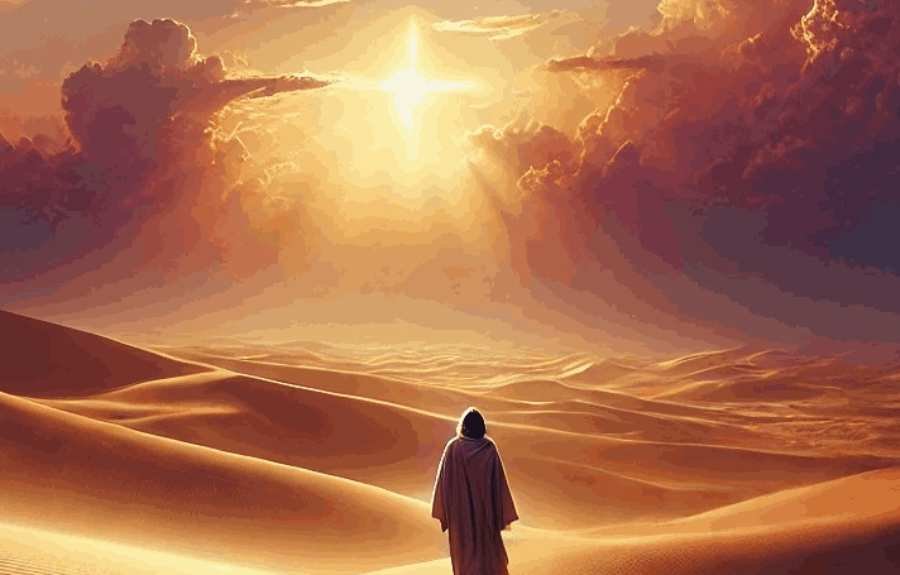
Spiritually, a desert symbolizes solitude, emptiness, testing, purification, transformation, and renewal. Its barren landscape represents a place where familiar comforts and distractions disappear, leaving a person to confront their beliefs, fears, desires, and sense of purpose. For this reason, the desert frequently represents an important transitional stage in a spiritual journey rather than simply a place of isolation or hardship.
The physical characteristics of a desert help explain its spiritual symbolism. Its vast open spaces represent solitude and inner reflection, while scarce water and harsh conditions represent endurance, faith, and spiritual testing. Silence removes external distractions, creating space for contemplation and greater self-awareness. Crossing or leaving the desert can therefore represent transformation, renewed clarity, or the beginning of a new spiritual stage.
The desert also carries significant meanings across different spiritual contexts. Biblical wilderness narratives connect it with testing, preparation, and encounters with God, while desert spirituality associates isolation with contemplation and spiritual discipline. Desert dreams can carry additional meanings depending on whether a person is lost, alone, crossing the landscape, or finding water. Understanding these contexts reveals why the desert can represent both spiritual difficulty and profound inner transformation.
What Does a Desert Mean Spiritually?
A desert spiritually represents a period of solitude, testing, purification, and inner transformation. The absence of water, vegetation, shelter, and familiar surroundings makes the desert a natural symbol of having external comforts stripped away. In spiritual terms, this emptiness creates a setting where attention shifts from the external world toward beliefs, fears, attachments, and deeper questions about meaning.
The desert also represents transition because it is commonly understood as a place to pass through rather than a permanent destination. Entering the desert can symbolize leaving a familiar spiritual state, while crossing it represents enduring uncertainty without immediate answers. Emerging from the desert can then symbolize renewed clarity, resilience, or a changed perspective. The complete pattern is separation → testing → transformation → renewal.
This symbolism explains why a desert does not have an exclusively negative spiritual meaning. Hardship and isolation form one side of the symbol, but discovery and transformation form the other. A person experiencing a symbolic desert may feel that familiar sources of certainty have disappeared, yet that absence can create the conditions for deeper self-examination. The spiritual meaning therefore depends not only on the emptiness of the desert but also on what happens within and after that emptiness.
What Does a Desert Symbolize Spiritually?
A desert symbolizes 6 primary spiritual themes: solitude, emptiness, testing, purification, transformation, and renewal. These meanings are interconnected because each reflects a different stage or characteristic of experiencing a place where ordinary sources of comfort and distraction are limited.
Solitude represents separation from external distractions. A desert contains few of the social and environmental stimuli associated with ordinary life, making it a natural symbol of withdrawal and introspection. Spiritually, this separation creates an opportunity to observe thoughts, beliefs, fears, and desires that may be harder to recognize in a constantly stimulating environment.
Emptiness represents the removal of what is familiar. The barren appearance of a desert visually expresses absence, scarcity, and simplicity. Spiritual emptiness can similarly describe a period when previous sources of certainty, motivation, or meaning no longer feel available. This does not automatically mean that something has gone wrong; emptiness can function as a transitional space between an old spiritual state and a new one.
Testing represents endurance under difficult conditions. Physical survival in a desert depends on dealing with heat, scarcity, distance, and uncertainty. As a spiritual symbol, these conditions become metaphors for maintaining faith, patience, discipline, or direction when immediate reassurance is unavailable.
Purification represents stripping away unnecessary attachments and distractions. A desert reduces life to basic needs, which makes it an effective symbol for simplifying one’s inner world. Spiritual purification in this context means identifying what remains important when familiar comforts, expectations, and external validation are removed.
Transformation represents the change produced by passing through difficulty. A desert journey has a beginning, a period of exposure or testing, and an eventual exit. Spiritually, the same pattern can represent leaving an established identity, confronting uncertainty, gaining insight, and emerging with a different understanding of oneself or one’s path.
Renewal represents what becomes possible after the desert experience. Water, vegetation, shelter, or the end of a desert journey carry greater significance after prolonged scarcity. Spiritually, renewal can therefore represent restored purpose, clarity, faith, or direction following a difficult transitional period.
Why Does the Desert Symbolize Solitude and Emptiness?
The desert symbolizes solitude and emptiness because its physical landscape removes many of the people, objects, sounds, and resources associated with ordinary life. Spiritually, this absence represents a reduction of external distractions and a corresponding increase in attention to the inner world. Silence becomes more noticeable when noise disappears, just as thoughts and unresolved questions can become more noticeable when everyday distractions are removed.
Solitude in desert symbolism is different from loneliness. Solitude describes being apart, while loneliness describes the distress that can result from feeling disconnected. A desert can represent either experience depending on context. Voluntary withdrawal may symbolize contemplation and self-examination, whereas being abandoned or trapped in a desert may represent isolation, disconnection, or uncertainty.
Emptiness also has a dual meaning. A barren landscape can represent loss because it appears to contain little nourishment or protection. However, the same openness can represent possibility because there is less competing for attention. In a spiritual journey, emptiness can therefore symbolize the interval between releasing an established belief, identity, or direction and discovering what will replace it.
This relationship can be expressed as external emptiness → inner attention → self-examination → spiritual clarity. The desert does not create clarity automatically. Instead, its symbolic lack of distraction represents the conditions in which a person has fewer ways to avoid difficult questions about identity, values, faith, attachment, and purpose.
Why Does the Desert Symbolize Spiritual Testing?
The desert symbolizes spiritual testing because survival in a harsh and scarce environment requires endurance without continuous comfort or certainty. Heat, limited water, long distances, and exposure make the physical desert an effective metaphor for periods when a person must continue without receiving immediate reassurance that the journey will become easier.
Three relationships explain this symbolism: scarcity tests dependence, hardship tests endurance, and uncertainty tests faith or conviction. When familiar resources disappear, a person must determine what they rely on. When difficult conditions continue, patience and resilience become more important. When the destination cannot be clearly seen, continuing the journey requires commitment without complete certainty.
Spiritual testing does not necessarily mean that suffering has been deliberately sent as a punishment or supernatural test. The symbolism describes how hardship can expose existing beliefs, attachments, fears, and priorities. A comfortable environment may allow these elements to remain unnoticed, while a symbolic desert makes them harder to avoid.
The desert therefore represents a test primarily because it reveals what remains when comfort is reduced. What a person trusts, values, fears, or refuses to release becomes more visible under conditions of scarcity and uncertainty. This is why desert symbolism frequently connects hardship with the later stages of purification and transformation rather than treating suffering as the final meaning of the journey.
Why Does the Desert Symbolize Purification?
The desert symbolizes purification because it represents the removal of distractions, attachments, and comforts that can obscure inner awareness. Its physical simplicity provides the foundation for this symbolism: there are fewer resources, fewer places of refuge, and fewer distractions from immediate reality. In a spiritual context, entering the desert can therefore represent stripping life back to what is essential.
Spiritual purification in desert symbolism does not necessarily mean becoming morally perfect or physically cleansed. It refers more directly to a process of recognizing and releasing what no longer serves a spiritual path. These elements can include excessive attachment to comfort, dependence on external validation, rigid expectations, or habits that prevent honest self-examination. The desert represents an environment where these attachments become easier to identify because many of the usual distractions are absent.
The mechanism behind this symbolism follows a clear sequence: removal → exposure → recognition → release. Removing familiar comforts exposes reactions that may otherwise remain hidden. Exposure makes fears, dependencies, and priorities easier to recognize. Recognition then creates an opportunity to decide what should be retained and what should be released. Purification is therefore represented by what is stripped away during the desert experience rather than by the hardship itself.
This meaning also explains why emptiness and purification are closely connected but are not identical. Emptiness describes the absence created when something familiar disappears. Purification describes the process of determining what should remain after that absence occurs. A spiritual desert can consequently symbolize a period in which old beliefs, expectations, or attachments lose their previous importance, creating space for a clearer sense of purpose.
Why Does the Desert Symbolize Transformation?
The desert symbolizes transformation because crossing it represents moving from one state of being to another through a period of uncertainty and difficulty. A desert journey has a recognizable structure: a person enters an unfamiliar environment, encounters scarcity or exposure, adapts to those conditions, and eventually emerges from them. Spiritually, this pattern mirrors the process through which an established identity or worldview is challenged and reorganized.
There are 5 stages in this symbolic transformation: departure, stripping away, testing, realization, and renewal. Departure separates a person from what is familiar. Stripping away reduces previous sources of comfort or certainty. Testing reveals beliefs, fears, and attachments under pressure. Realization develops when the person recognizes what the experience has exposed. Renewal begins when those insights influence how the person approaches the next stage of life.
Transformation is different from simple change. Change means that circumstances have become different, while spiritual transformation involves a deeper shift in perspective, identity, values, or purpose. A person can enter a symbolic desert seeking certainty and leave with greater acceptance of uncertainty. Another person may enter strongly attached to external approval and leave with a clearer understanding of internally held values. In both cases, the desert represents the transitional process rather than the final outcome.
The desert also symbolizes transformation because it occupies the space between departure and arrival. It is a threshold rather than a destination. This makes the landscape particularly suitable as a symbol for periods when an old way of understanding life no longer works but a new one has not fully formed. The discomfort of this intermediate state is part of the symbolism: transformation frequently requires remaining within uncertainty long enough for a different perspective to emerge.
Renewal completes this pattern. Finding water, reaching fertile land, seeing vegetation, or simply leaving the desert can symbolize the return of direction and vitality after scarcity. These images become meaningful precisely because they contrast with the barrenness that came before them. In spiritual terms, renewal can represent restored purpose, stronger conviction, greater self-awareness, or a new relationship with one’s beliefs.
What Does the Desert Represent in a Spiritual Journey?
The desert represents a transitional stage in a spiritual journey where familiar certainty is reduced and deeper beliefs are tested, examined, or transformed. It can occur symbolically when a person leaves an established spiritual identity, questions previously accepted beliefs, experiences a loss of direction, or deliberately withdraws from external distractions to pursue greater clarity.
A desert stage is not necessarily evidence that a spiritual journey has failed. Its significance comes from being an intermediate state. The previous path may no longer provide sufficient meaning, while the next direction remains unclear. This creates a period in which a person has to continue without the same degree of certainty, comfort, or reassurance that existed before.
Four stages describe the symbolic desert journey: entry → testing → transformation → renewal. Entry represents separation from a familiar state. Testing exposes the person’s responses to uncertainty and scarcity. Transformation occurs as those experiences alter priorities or understanding. Renewal represents the emergence of a clearer direction after the transitional period. Not every spiritual experience follows these stages exactly, but the sequence explains why desert imagery is strongly associated with journeys of inner change.
The meaning also depends on what happens within the desert. Walking through it can represent perseverance. Remaining still can represent contemplation or waiting. Searching for a path can represent the pursuit of spiritual direction. Finding water can represent renewal, insight, or the discovery of something sustaining. The desert therefore provides the context, while the person’s condition and actions determine the more specific interpretation.
What Does Being Lost in the Desert Mean Spiritually?
Being lost in a desert spiritually symbolizes uncertainty, disorientation, or the absence of a clear path forward. The key element is not simply the desert but the inability to determine direction within it. This creates a symbolic connection between physical navigation and spiritual direction.
Feeling spiritually lost can occur when established beliefs no longer provide the same certainty but an alternative has not yet emerged. The resulting experience can involve questioning values, purpose, identity, or one’s relationship with a spiritual tradition. The desert intensifies this symbolism because landmarks and sources of guidance appear limited, mirroring the feeling of having no obvious direction to follow.
Being lost does not automatically predict a negative outcome. Disorientation can represent a transitional condition rather than a permanent state. Losing an established path may force a person to examine why that path was followed in the first place. In this interpretation, uncertainty becomes the mechanism that encourages discernment rather than proof that the spiritual journey has ended.
Context determines whether the symbolism leans toward distress or discovery. Panic, exhaustion, or endless wandering can emphasize isolation and lack of direction. Calmly searching for a route can instead emphasize patience and perseverance. Finding a path, shelter, another person, or water can shift the symbolism toward guidance, support, and renewal.
What Does Leaving the Desert Mean Spiritually?
Leaving the desert spiritually symbolizes the completion of a difficult transition and movement toward renewal, clarity, or a new sense of direction. The meaning comes from contrast: scarcity is followed by abundance, uncertainty by direction, isolation by reconnection, or testing by greater understanding.
Leaving the desert does not mean returning unchanged to the condition that existed before entering it. Within transformation symbolism, the journey matters because the person carries something out of the desert that was developed within it. This may be greater resilience, a changed belief, clearer priorities, stronger self-awareness, or greater acceptance of uncertainty.
The sequence can therefore be expressed as desert → confrontation → insight → emergence. The desert creates the conditions for confrontation with difficult questions or attachments. That confrontation produces insight when the experience is consciously examined. Emergence represents applying that insight beyond the transitional period.
For this reason, leaving the desert is closely associated with renewal rather than simple escape. Escape focuses on ending discomfort; renewal focuses on what becomes possible afterward. Spiritually, the end of a desert period can signify that uncertainty has served its transitional purpose and that a person is ready to move forward with a clearer understanding of what they value, believe, or seek.
What Is a Spiritual Desert?
A spiritual desert is a period of inner emptiness, uncertainty, or disconnection in which familiar sources of spiritual meaning no longer provide the same sense of direction or reassurance. Unlike a physical desert, it is not a geographical place. It is a metaphor for an internal experience in which a person feels spiritually dry, distant, directionless, or unable to access the clarity they previously relied on.
The metaphor comes from the defining characteristics of a physical desert: scarcity, silence, exposure, and limited signs of life. Spiritual dryness corresponds to scarcity because meaning or inspiration can feel difficult to access. Silence corresponds to the absence of expected answers or reassurance. Exposure represents confronting thoughts and fears without familiar distractions. The desert landscape therefore provides a concrete image for an experience that is otherwise difficult to describe.
A spiritual desert can also emerge during a transition between two ways of understanding oneself or one’s spiritual path. Previous beliefs, practices, or assumptions may no longer feel sufficient, while a new framework has not yet developed. This creates an intermediate state characterized by uncertainty. The person has left one familiar position without fully arriving at another.
Several experiences can characterize this period, including spiritual emptiness, lack of direction, inner silence, questioning of existing beliefs, reduced connection with spiritual practices, and a stronger search for meaning. These experiences do not all need to occur simultaneously. Their shared characteristic is the loss of something that previously provided spiritual orientation.
A spiritual desert should also be distinguished from a prediction or punishment. Experiencing uncertainty does not prove that a supernatural force has deliberately removed guidance, nor does spiritual dryness automatically indicate personal failure. The desert metaphor is useful because it describes the structure of the experience: familiar resources become scarce, uncertainty increases, and the person must determine how to respond.
The eventual meaning of a spiritual desert depends partly on that response. Constantly attempting to recreate an earlier spiritual state can make the period feel like nothing more than loss. Examining what has changed can instead reveal whether old beliefs, habits, expectations, or attachments still serve their original purpose. In this sense, the spiritual desert can function as a transitional space where previous assumptions are examined before a new direction becomes clear.
What Can a Spiritual Desert Teach You?
A spiritual desert can teach 6 primary lessons: patience, surrender, self-awareness, resilience, discernment, and detachment. These lessons develop through the central condition represented by the desert: continuing through a period when certainty, comfort, or immediate answers are limited.
Patience develops when clarity cannot be forced. A spiritual desert represents a period in which the next direction may not become obvious immediately. Attempts to demand an instant answer can conflict with the nature of the experience because uncertainty is one of its defining characteristics. Patience means remaining attentive while allowing understanding to develop rather than treating every unanswered question as evidence of failure.
Surrender develops through recognizing the limits of control. The desert is difficult to dominate because its conditions exceed individual preferences. Symbolically, this represents circumstances in which a person cannot control every outcome, maintain every previous certainty, or determine exactly when clarity will return. Surrender in this context does not mean abandoning responsibility. It means distinguishing between what can be consciously changed and what must temporarily remain unresolved.
Self-awareness develops when external distractions become less effective. Silence and emptiness create fewer places to redirect attention, which can expose fears, expectations, attachments, and unresolved questions. A person who previously relied heavily on approval, routine, or certainty may recognize that dependence more clearly when those sources of reassurance become unavailable. The lesson comes from observing what becomes visible when familiar supports are removed.
Resilience develops through continuing despite uncertainty. The symbolic desert does not promise immediate relief, making perseverance part of its meaning. Resilience is not the absence of difficulty; it is the capacity to maintain direction or continue searching when conditions are difficult. Just as crossing a physical desert requires adaptation to changing conditions, moving through a spiritual desert can require adjusting expectations without abandoning the search for meaning.
Discernment develops by separating what is essential from what is merely familiar. A belief or practice can feel important simply because it has existed for a long time. A period of spiritual uncertainty can challenge that familiarity and create a reason to examine what still carries genuine meaning. Discernment therefore asks a more specific question than whether something feels comfortable: does it remain aligned with the values and spiritual direction the person intends to follow?
Detachment develops when identity becomes less dependent on external conditions. The desert represents the reduction of possessions, distractions, validation, and comfort to their minimum. Spiritually, this can symbolize loosening attachment to things that have become overly important to one’s sense of security or identity. Detachment does not require rejecting relationships, possessions, achievements, or traditions. It means reducing the degree to which they determine inner stability.
These 6 lessons are connected through a common mechanism: scarcity reveals dependence, silence reveals inner activity, uncertainty reveals the need for patience, and difficulty reveals the capacity for resilience. The spiritual value of the desert therefore lies less in suffering itself than in what becomes visible when familiar forms of comfort and certainty are reduced.
A spiritual desert can consequently become a period of preparation for renewal. Patience creates room for new understanding, surrender reduces the struggle to control uncertainty, self-awareness identifies what needs attention, discernment clarifies what should remain, detachment makes release possible, and resilience supports movement forward. The desert becomes transformative when these insights influence how a person lives after the period of uncertainty has ended.
What Does the Desert Symbolize in the Bible?
In the Bible, the desert and wilderness symbolize testing, preparation, dependence on God, and encounters with the divine. Biblical figures and communities repeatedly enter wilderness settings during periods of transition. The physical conditions of these places, including scarcity, isolation, and exposure, reinforce the spiritual themes of depending on God when ordinary sources of security are limited.
Moses provides one important example of this pattern. After leaving Egypt, he lived in the wilderness of Midian before encountering God at the burning bush and returning to Egypt with a new purpose. The wilderness therefore functions as more than a place of isolation in his story. It stands between his former life in Egypt and his later role leading the Israelites, connecting the desert with preparation, encounter, and transition.
The Israelites’ journey through the wilderness adds the themes of testing and dependence. After leaving Egypt, they traveled through the wilderness before reaching the Promised Land. Scarcity of food and water repeatedly placed them in situations where survival and trust became central concerns. Symbolically, their journey follows the pattern of departure → wilderness → testing → destination, making the desert an intermediate space between liberation from an old condition and arrival at a new one.
Jesus’ time in the wilderness strengthens the connection between the desert and spiritual testing. The Gospel narratives describe Jesus fasting for 40 days in the wilderness and facing temptation before beginning his public ministry. In this context, the wilderness combines physical deprivation with a direct test of commitment and identity. It also precedes a new stage of action, reinforcing the desert’s broader symbolism as a place of preparation before transition.
These biblical examples share a common structure even though their circumstances differ. Moses encounters calling, the Israelites experience dependence and testing, and Jesus faces temptation and preparation. In each case, the wilderness removes ordinary security and creates a setting in which spiritual commitments become more visible.
The biblical desert should therefore not be reduced to a symbol of punishment or suffering. It can represent hardship, but hardship is only one part of the pattern. The wilderness can also represent preparation for a new responsibility, dependence during uncertainty, separation from a previous life, and an encounter that changes the direction of a spiritual journey.
Why Did Spiritual Seekers Go Into the Desert?
Spiritual seekers went into the desert to pursue solitude, prayer, contemplation, discipline, and separation from worldly distractions. The physical isolation of the desert created an environment where ordinary social demands and material comforts were reduced, allowing spiritual practice to become a more concentrated part of daily life.
The Desert Fathers provide a prominent historical example within early Christianity. Beginning especially in the third and fourth centuries, Christian ascetics withdrew into the deserts of Egypt and surrounding regions to pursue lives centered on prayer, simplicity, fasting, contemplation, and spiritual discipline. Figures associated with this tradition include Anthony the Great, whose withdrawal into the Egyptian desert became influential in the development of Christian monasticism.
For these ascetics, physical withdrawal served a spiritual purpose. Reducing external distractions created more space for sustained attention to prayer and inner discipline. The desert’s scarcity also limited material comfort, making simplicity part of the practice rather than merely an abstract ideal. Solitude consequently functioned as a method of confronting thoughts, desires, fears, and attachments without many of the distractions available in ordinary social life.
Desert solitude was not identical to rejecting other people. Early desert spirituality eventually included communities, teachers, disciples, and collections of spiritual sayings. Withdrawal could therefore serve as a period or method of spiritual formation rather than a permanent rejection of human relationships. The central principle was reducing unnecessary distraction so that attention could be directed toward spiritual practice.
The environment itself strengthened this symbolism. Silence supported contemplation, scarcity encouraged simplicity, isolation reduced social distraction, and difficult conditions required discipline. These relationships create the pattern desert → withdrawal → solitude → contemplation → spiritual discipline. The physical characteristics of the landscape became closely connected with the practices performed within it.
This historical use of the desert also helps explain why desert symbolism continues to represent inner withdrawal even when no physical desert is involved. A person can create a symbolic form of desert solitude by temporarily reducing noise, stimulation, or unnecessary activity for reflection. The essential spiritual principle is not the sand or heat but the deliberate removal of distraction.
The desert therefore carries both symbolic and practical significance in spiritual traditions. As a symbol, it represents the stripping away of comfort and distraction; as a spiritual setting, it has provided actual space for solitude, contemplation, and disciplined practice. This combination helps explain why desert imagery remains strongly associated with spiritual seeking, self-examination, and transformation.
What Does Dreaming About a Desert Mean Spiritually?
Dreaming about a desert can spiritually symbolize isolation, uncertainty, inner emptiness, self-discovery, or a period of transition. The specific meaning depends on what happens in the dream and how the dreamer experiences the desert. A peaceful desert and a threatening desert contain the same central entity but create different symbolic contexts.
Being alone in a desert can represent solitude or isolation. The distinction depends on the emotional context of the dream. Feeling calm while alone can point toward a desire for silence, independence, contemplation, or distance from external distractions. Feeling abandoned or afraid can instead reflect disconnection, vulnerability, or difficulty finding support.
Being lost in a desert can symbolize uncertainty about direction. The absence of recognizable paths or landmarks mirrors an internal experience in which the next decision, belief, or purpose is unclear. In a spiritual context, this imagery can correspond to questioning an established path or moving through a transitional period without knowing what comes next.
Walking across a desert can represent perseverance through a prolonged transition. The movement matters because the dreamer is continuing despite difficult surroundings. A clear destination can emphasize purpose, while endless wandering can emphasize uncertainty. Reaching the edge of the desert can symbolize completing a difficult stage and entering a period of greater clarity.
Finding water in a desert carries a contrasting symbolism because water introduces life and abundance into a landscape defined by scarcity. Spiritually, finding water can represent renewal, relief, insight, hope, or the discovery of something that restores a sense of direction. An oasis can carry a similar meaning because it provides rest and nourishment within an otherwise barren environment.
Desert dreams should not be treated as fixed predictions. Dream symbolism is interpretive, and the same image can carry different meanings according to personal associations, emotions, beliefs, and events within the dream. The most useful interpretation therefore comes from examining the condition of the desert, the dreamer’s actions, the emotions experienced, and what changes before the dream ends.
Is Seeing a Desert a Positive or Negative Spiritual Sign?
A desert is not inherently a positive or negative spiritual sign; its meaning depends on the context in which it appears. The same landscape can symbolize painful isolation and uncertainty in one experience while representing purification, contemplation, transformation, and renewal in another.
A desert carries a more difficult meaning when its central features are experienced as threats. Being trapped can represent stagnation, being lost can represent lack of direction, extreme thirst can represent an unmet need, and endless emptiness can represent disconnection. These interpretations share one mechanism: scarcity is experienced without a visible path toward renewal.
The symbolism becomes more constructive when the desert functions as a place of movement or discovery. Crossing the landscape can represent endurance, choosing solitude can represent contemplation, releasing unnecessary possessions can represent detachment, and finding water can represent renewal. In these contexts, scarcity becomes part of a transitional process rather than its final outcome.
The person’s relationship with the desert is therefore more informative than the desert alone. Fear emphasizes threat, stillness can emphasize contemplation, purposeful movement emphasizes perseverance, and emergence emphasizes transformation. Examining these details produces a more precise interpretation than assigning one universal meaning to every desert experience.
This dual symbolism is one reason the desert is such a powerful spiritual image. It contains apparent opposites: emptiness and possibility, hardship and growth, isolation and contemplation, scarcity and renewal. The desert can represent what has been lost while simultaneously creating space for what has not yet emerged.
What Should You Reflect on During a Spiritual Desert?
During a spiritual desert, reflect on what has disappeared, what the absence reveals, what still remains meaningful, and what direction may be emerging. Reflection is useful because the defining feature of a spiritual desert is reduced certainty. Instead of immediately trying to eliminate that uncertainty, examining it can reveal why a previous source of meaning or direction no longer functions in the same way.
Start by asking what feels absent or empty. The missing element may be motivation, certainty, connection, purpose, inspiration, or confidence in an established belief. Naming the absence makes the experience more specific. A vague sense of spiritual emptiness is difficult to examine, while recognizing that an old practice no longer creates the same sense of connection provides a clearer subject for reflection.
Next, consider what the absence has exposed. When familiar comforts or distractions lose their effectiveness, previously hidden concerns can become easier to recognize. These may include dependence on external approval, fear of uncertainty, attachment to a particular outcome, or beliefs maintained primarily through habit. The desert metaphor becomes useful here because scarcity reveals what a person previously depended on.
A third question is what remains meaningful without the familiar comforts. This separates essential values from habits or expectations that simply feel familiar. A spiritual practice, relationship, belief, or principle that continues to matter during uncertainty may represent something more deeply integrated into the person’s values. Conversely, something that loses all significance once external reinforcement disappears may need to be reconsidered.
Finally, reflect on what renewal would actually look like. Renewal does not necessarily mean restoring the exact spiritual state that existed before the desert period began. Transformation can produce a different relationship with faith, purpose, contemplation, community, or personal values. Returning to the previous state may therefore be less meaningful than identifying what the experience has changed.
The central question of a spiritual desert is not simply, “How do I get out?” A more useful question is, “What is becoming visible because the familiar path is no longer available?” The spiritual symbolism of the desert reaches its fullest meaning at this point: emptiness creates space for examination, testing exposes what matters, purification removes what no longer serves, and transformation creates the possibility of renewal.