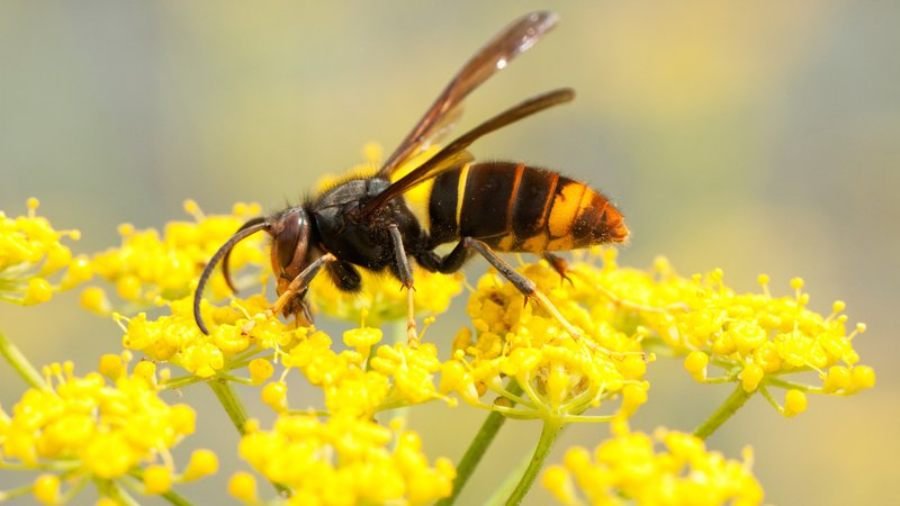
Yellow jackets are associated with 8 main spiritual meanings: protection, personal boundaries, courage, persistence, action, community, personal power, and warning. These meanings reflect the insect’s recognizable behaviors, especially its determination to defend its nest, persistent activity, social colony structure, and strong response to perceived threats.
The spiritual meaning of a yellow jacket depends on the context of the encounter. Seeing one during a period of conflict may draw attention to personal boundaries or self-protection, while repeatedly encountering yellow jackets may be interpreted as a reminder to address an issue that requires decisive action. A sting carries a different symbolic association from simply seeing a yellow jacket, just as finding one inside your home creates a different context from encountering one outdoors.
Yellow jacket symbolism is a spiritual interpretation rather than a scientifically established message or prediction. Its value comes from connecting the insect’s characteristics with themes that may be relevant to your current circumstances. This guide explores the major spiritual meanings of yellow jackets, specific encounters, stings, dreams, spirit animal symbolism, and the difference between positive and warning interpretations.
What Does a Yellow Jacket Mean Spiritually?
A yellow jacket spiritually represents protection, personal boundaries, courage, persistence, action, community, personal power, and warning. These 8 meanings are symbolic associations rather than fixed messages. They largely come from observable yellow jacket characteristics, including defending a nest, living within an organized colony, remaining highly active, and responding forcefully when threatened.
The central theme behind yellow jacket symbolism is active self-protection. A yellow jacket does not rely only on avoidance when its nest or territory is threatened. This behavior creates a natural symbolic connection with defending personal boundaries and responding to situations that demand attention. For someone dealing with repeated boundary violations, for example, an encounter may serve as a symbolic prompt to identify what needs to be protected and communicate limits more clearly.
Yellow jackets also carry a strong social dimension because they live and work within colonies. This characteristic connects the insect with community, cooperation, shared responsibility, and protecting collective interests. As a result, yellow jacket symbolism contains both an individual message about personal power and a collective message about knowing when to contribute to or defend a group.
Context determines which meaning is most relevant. A yellow jacket appearing during an unresolved conflict may be interpreted through the themes of boundaries and warning, whereas an encounter during a demanding project may resonate more strongly with persistence and action. The encounter itself does not establish that a supernatural message has occurred; spiritual symbolism provides a framework for reflecting on the experience.
What Are the Spiritual Meanings of a Yellow Jacket?
There are 8 main spiritual meanings of a yellow jacket: protection, personal boundaries, courage, persistence, action, community, personal power, and warning. Each meaning emphasizes a different characteristic of the insect, so the most relevant interpretation depends on what happened during the encounter and what is occurring in your life.
1. Protection. Yellow jackets symbolize protection because they actively defend their nest and colony against perceived threats. Spiritually, this defensive characteristic can represent the need to protect something valuable, such as your emotional well-being, family, personal space, beliefs, or commitments. The message is not necessarily to become aggressive. Instead, protection symbolism asks whether something important currently lacks an adequate defense.
For example, a person who continually sacrifices personal time to meet other people’s demands may connect an unexpected yellow jacket encounter with the need to protect time and energy. In this interpretation, the yellow jacket represents active protection rather than passive withdrawal.
2. Personal boundaries. Yellow jackets are strongly associated with personal boundaries because territorial defense is one of their most recognizable characteristics. In spiritual symbolism, a boundary defines what you accept, what you refuse, and where another person’s influence should stop. The yellow jacket therefore represents the distinction between maintaining healthy limits and allowing repeated intrusion.
This meaning becomes particularly relevant when an encounter coincides with situations involving excessive demands, unwanted interference, or unresolved interpersonal tension. For example, someone who repeatedly agrees to responsibilities they do not have time for might interpret the yellow jacket as a reminder to communicate a clear limit. The symbolic lesson is to establish the boundary before frustration turns into conflict.
3. Courage. A yellow jacket can symbolize courage because it responds assertively when it perceives a threat to itself or its colony. Spiritually, courage in this context means facing a necessary challenge despite discomfort rather than avoiding every difficult situation. The symbolism therefore emphasizes deliberate confrontation with a problem, not reckless aggression.
A difficult conversation illustrates this distinction. Avoiding the conversation may preserve short-term comfort while allowing the underlying problem to continue. Yellow jacket symbolism can represent the courage required to address the issue clearly while maintaining control over the response.
4. Persistence. Persistence is another central yellow jacket spiritual meaning. The insect’s sustained activity creates a symbolic association with continuing purposeful effort when a goal requires repeated action. This meaning is especially relevant to situations where progress depends on consistency rather than a single dramatic decision.
For example, completing a long-term project requires repeated work even when immediate results are limited. In this context, yellow jacket symbolism points toward maintaining focused effort instead of abandoning the objective because progress feels slow. Persistence differs from stubbornness: persistence continues toward a worthwhile goal, while stubbornness can continue after the original goal has stopped being useful.
5. Action. Yellow jackets symbolize action because their behavior is active, responsive, and purposeful. Spiritually, this characteristic represents situations in which thinking, planning, or waiting has reached its limit and a concrete decision is required. The symbolism asks what specific action will move the situation forward.
This interpretation can apply when someone already understands a problem but continues postponing the response. A person who knows a commitment is unsustainable, for instance, gains little from repeatedly analyzing the same situation. Under an action-based interpretation, the yellow jacket symbolizes the point at which awareness needs to become a decision.
6. Community. Yellow jackets can represent community because they live within colonies in which individual insects perform roles that contribute to the survival of the group. This social structure creates symbolic associations with cooperation, shared responsibility, belonging, and collective protection.
Community symbolism does not require sacrificing individuality. Instead, it raises questions about how personal effort contributes to a larger group. A person working within a family, team, or community may use this symbolism to consider whether responsibilities are distributed fairly and whether cooperation is supporting a shared objective.
7. Personal power. Yellow jacket symbolism connects personal power with the ability to assert yourself and respond when something important is threatened. Personal power in this context is not dominance over other people. It is the capacity to recognize your needs, make decisions, communicate limits, and act without surrendering responsibility for the consequences.
For example, declining an unreasonable request can represent personal power when the decision protects an existing commitment. The yellow jacket becomes a symbolic reminder that strength includes knowing when to say no, particularly when constant accommodation damages priorities or personal boundaries.
8. Warning. A yellow jacket can represent a spiritual warning because its defensive behavior and sting naturally communicate that a limit has been reached. Symbolically, this meaning directs attention toward conflicts, neglected boundaries, escalating tension, or problems that require action before they become harder to manage.
A warning interpretation should not be treated as a prediction that something bad will happen. It functions more effectively as a prompt for awareness. If the same disagreement continues resurfacing, for example, yellow jacket symbolism may encourage examination of the unresolved cause rather than fear of a future event.
Together, these 8 meanings create a consistent symbolic pattern: yellow jackets represent knowing what deserves protection, establishing limits, acting with purpose, and responding consciously when a situation demands attention. The specific meaning becomes clearer when the behavior and location of the yellow jacket are considered alongside the circumstances surrounding the encounter.
What Does Seeing a Yellow Jacket Mean Spiritually?
Seeing a yellow jacket spiritually can represent a need to notice your boundaries, protect something important, act on an unresolved issue, or remain persistent with a current goal. The sighting does not have one fixed meaning because the interpretation changes according to the yellow jacket’s behavior, the location of the encounter, whether the experience repeats, and what is happening in your life at that time.
The yellow jacket’s behavior provides the first interpretive clue. A yellow jacket calmly moving through an outdoor space creates a different symbolic context from one behaving defensively near its nest. The first encounter may align more closely with activity, persistence, or purposeful action, while the second has a stronger connection with protection and boundaries. This distinction matters because spiritual interpretation becomes more specific when it reflects what actually occurred instead of assigning the same message to every sighting.
Location provides a second layer of context. Seeing a yellow jacket while working on an important project may resonate with persistence or decisive action, whereas encountering one during a period of interpersonal tension may draw attention to boundaries and self-protection. Your emotional response also matters. Fear, curiosity, irritation, or calmness can reveal which aspect of the encounter feels personally significant.
A single sighting does not establish that a spiritual message has occurred. Yellow jackets are insects whose movements have natural explanations. Within spiritual symbolism, however, the encounter can function as a reflective prompt. The useful question is not simply, “Why did a yellow jacket appear?” but “Which characteristic of this encounter reflects something I am currently experiencing?”
What Does It Mean When a Yellow Jacket Lands on You?
A yellow jacket landing on you can spiritually symbolize attention, awareness, and the need to remain composed while dealing with a sensitive situation. Because the insect has entered your immediate personal space, the encounter also has a strong symbolic connection with boundaries.
Remaining calm is an important part of this interpretation. A close encounter can create an immediate impulse to react, yet impulsive reactions can intensify difficult situations. Symbolically, the experience can therefore represent a circumstance that requires awareness before action. The lesson is not passivity; it is controlled response.
For example, consider an ongoing disagreement in which another person makes a provocative comment. Responding immediately from anger may escalate the conflict, while recognizing the boundary violation and choosing a deliberate response preserves greater control. A yellow jacket landing on you can be interpreted through the same symbolic pattern: notice what has entered your space, assess it, and respond intentionally.
The practical explanation remains separate from the spiritual interpretation. A yellow jacket may land on a person because of environmental factors rather than because it carries a supernatural message. The spiritual meaning comes from how the encounter is used for reflection, not from assuming that the insect deliberately delivered a message.
What Does It Mean When Yellow Jackets Keep Appearing Around You?
Yellow jackets repeatedly appearing around you can spiritually represent a recurring issue, boundary, responsibility, or decision that continues to demand attention. Repetition makes the encounter symbolically different from seeing one yellow jacket once because it naturally draws greater attention to a pattern.
The first step is to determine whether the repeated sightings have an ordinary environmental explanation. A nearby nest, food source, seasonal activity, or suitable habitat can explain why yellow jackets repeatedly appear in the same location. Recognizing these practical causes does not prevent someone from using the experience symbolically, but it keeps spiritual interpretation separate from biological cause.
From a symbolic perspective, repeated encounters can be compared with repeated circumstances in your own life. If you keep facing the same interpersonal conflict, the boundary meaning may be most relevant. If you repeatedly postpone a necessary decision, action may be the stronger interpretation. If you are progressing slowly through a demanding goal, persistence may provide the better symbolic connection.
The repeated appearance therefore does not automatically predict an event. It can instead serve as a prompt to identify what else is repeating. The most relevant spiritual meaning is usually the one that connects the yellow jacket’s symbolic characteristic with a recognizable pattern in your current circumstances.
What Does a Yellow Jacket in Your House Mean Spiritually?
A yellow jacket in your house can spiritually symbolize personal boundaries, protection, safety, family matters, or an issue entering your private space. The house changes the symbolic context because a home commonly represents a person’s private environment rather than the public world outside it.
Boundaries are the strongest interpretation when the encounter involves an unwanted intrusion. Yellow jackets are associated with territorial defense, while a home represents a physical boundary separating private and external spaces. Combining these two ideas creates a symbolic question: is something or someone currently entering an area of your life where clearer limits are needed?
For example, the relevant issue could involve a family member interfering with a personal decision, work repeatedly entering time reserved for home life, or another responsibility consuming space intended for rest. In these circumstances, the yellow jacket does not prove that the situation has spiritual significance. Instead, its presence can provide a symbolic framework for recognizing where private boundaries have become unclear.
The exact location inside the home can add another interpretive layer. A yellow jacket in a bedroom may be associated with privacy, rest, vulnerability, or intimate boundaries because a bedroom is a highly personal space. One appearing near a window or doorway may carry a symbolic association with the boundary between private and external life. These interpretations derive from the symbolic meaning assigned to the location rather than from different biological meanings of the insect.
A yellow jacket nest near the home creates a stronger connection with territory, protection, community, and shared space. A nest houses a colony and represents a place that yellow jackets actively defend. Spiritually, someone may associate this situation with protecting a household, reconsidering family responsibilities, or examining how security and boundaries operate within the home.
Practical safety takes priority when yellow jackets or a nest are physically present around a house. Spiritual symbolism should not replace an appropriate response to an active nest or the risk of stings. The symbolic interpretation answers what the encounter may represent to you; the practical response addresses the actual insect and its environment.
What Does a Yellow Jacket Sting Mean Spiritually?
A yellow jacket sting can spiritually symbolize a warning, crossed boundary, unresolved conflict, painful realization, or consequence that requires immediate attention. Among yellow jacket encounters, a sting carries stronger warning symbolism because it changes the experience from observing the insect to experiencing a direct physical consequence.
The strongest symbolic theme is a boundary that has already been crossed. Yellow jackets use their sting defensively when they perceive a threat, creating a connection between the physical event and the spiritual concept of protecting limits. In personal interpretation, the sting can prompt you to examine whether you have ignored a boundary, allowed someone to repeatedly cross one, or entered a conflict that requires a different response.
For example, consider a relationship in which you repeatedly accept behavior that makes you uncomfortable because you want to avoid confrontation. The discomfort continues until the situation becomes impossible to ignore. Within yellow jacket symbolism, a sting can represent that turning point: the problem has moved beyond a subtle warning and now requires recognition and action.
A second interpretation involves unresolved conflict. A sting is sudden, painful, and difficult to overlook, so it can symbolically resemble a disagreement or problem that has escalated after being neglected. This interpretation does not mean the sting predicts further conflict. Instead, it provides a framework for asking whether a current problem has reached the stage where postponing action creates greater consequences.
The sting can also represent a painful realization. Some personal lessons become clear only after a decision produces an unwanted result. A failed commitment, broken trust, or poorly defined boundary can reveal information that was previously ignored. In this context, yellow jacket sting symbolism emphasizes learning from the consequence rather than remaining focused only on the pain that exposed it.
Your response to the sting adds another layer to the interpretation. Anger may point toward an existing conflict, fear may highlight vulnerability, and immediate awareness may connect with a problem that already felt urgent. The most relevant meaning is the interpretation that matches both the nature of the encounter and a specific circumstance in your life.
A yellow jacket sting still has a physical cause and should first be treated as a real insect sting rather than a supernatural event. Spiritual interpretation does not establish that the yellow jacket intentionally delivered a message. Its symbolic value comes from using the experience to examine boundaries, conflicts, warnings, and consequences that already have relevance in your circumstances.
What Does a Dead Yellow Jacket Mean Spiritually?
A dead yellow jacket can spiritually symbolize the end of a conflict, release from a threat, transition, weakened defenses, or completion of a difficult cycle. The meaning differs from encountering a living yellow jacket because death changes the central symbolism from active protection and confrontation to cessation, change, or release.
The end of conflict is one of the clearest interpretations. A living yellow jacket carries associations with defense, boundaries, and readiness to respond, while a dead yellow jacket no longer presents the same active threat. Symbolically, this contrast can represent a dispute losing its power, a stressful period reaching its end, or a problem that no longer requires the same level of defensive energy.
For example, someone who has recently resolved a prolonged disagreement may interpret finding a dead yellow jacket as a symbol of closure. The insect does not cause or confirm that closure. Instead, the contrast between its former defensive power and its current stillness can mirror the transition from ongoing conflict to resolution.
Release is a related meaning. Constantly defending yourself, maintaining a conflict, or remaining alert to a perceived threat consumes attention and energy. A dead yellow jacket can therefore symbolize the point at which protection is no longer necessary and defensive habits can be released. This interpretation is particularly relevant when an external problem has ended but the emotional response to it remains.
A dead yellow jacket can also represent transition. Death symbolism across spiritual interpretations commonly points toward the ending of one state and movement into another rather than literal death. Applied to a yellow jacket, the transition may concern how you use personal power. A period defined by confrontation, for instance, may be giving way to one that requires cooperation, rebuilding, or a different set of boundaries.
The opposite interpretation is also possible: weakened protection. Because yellow jackets symbolize defense, encountering one dead may prompt reflection on whether an important boundary has become too weak. This interpretation is more relevant when you currently feel unable to defend your time, values, responsibilities, or personal space. Context determines whether the dead yellow jacket represents releasing unnecessary defenses or recognizing that necessary defenses have been neglected.
Finding a dead yellow jacket is not inherently a bad omen. Its presence does not scientifically predict loss, danger, or death. Within spiritual symbolism, it is more useful to interpret the encounter through the themes already associated with the insect—protection, boundaries, conflict, and personal power—and then ask how the absence of those active qualities relates to your present circumstances.
The central question is therefore what has ended or changed? If a conflict has recently been resolved, closure may be the strongest interpretation. If you have moved beyond a stressful situation, release may fit better. If your boundaries have deteriorated, weakened protection may be more relevant. The surrounding context determines which symbolic meaning carries the greatest personal value.
What Does a Yellow Jacket Spirit Animal Represent?
A yellow jacket spirit animal represents assertiveness, protection, persistence, decisive action, and cooperation. Within spiritual symbolism, these qualities reflect the yellow jacket’s defensive behavior, sustained activity, and colony-based social structure. The central lesson is to protect what matters while directing your energy toward purposeful action.
Assertiveness is one of the strongest qualities associated with the yellow jacket spirit animal. Assertiveness means expressing a position or protecting a boundary clearly without seeking unnecessary conflict. Yellow jackets create this symbolic association through their readiness to defend themselves and their colony when they perceive a threat. Applied to personal circumstances, the symbolism can encourage a clearer response when silence or excessive accommodation allows a problem to continue.
For example, someone who consistently accepts additional responsibilities despite having no available time may identify with this aspect of yellow jacket symbolism. The relevant lesson is not aggression toward the person making the request. It is recognizing the limit, communicating it clearly, and protecting existing priorities.
Protection adds another dimension to the yellow jacket spirit animal. The insect’s defensive behavior creates a symbolic connection with safeguarding personal space, relationships, responsibilities, and values. This interpretation can be especially relevant during periods when protecting something important requires active participation rather than waiting for circumstances to resolve themselves.
Persistence and decisive action represent the more goal-oriented side of the symbolism. Yellow jackets are active insects, so their symbolic meaning emphasizes sustained effort and response. A person who identifies with the yellow jacket spirit animal may use this association as a reminder to continue working toward a meaningful objective while recognizing when planning needs to become action.
The yellow jacket also represents cooperation because its life is connected to a colony. This creates a balance between individual strength and collective responsibility. Personal power does not have to operate in isolation; it can be used to support a family, team, community, or shared purpose. Someone who takes responsibility for an individual role while contributing to a larger objective reflects this aspect of the symbolism.
A yellow jacket totem carries closely related themes. Within spiritual practices that use animal symbolism, it can represent a recurring symbolic association with determination, protection, productivity, social responsibility, and assertiveness. Someone drawn to this symbolism may use these characteristics as themes for reflection rather than treating them as fixed personality traits.
The terms “spirit animal” and “totem” should not automatically be treated as interchangeable across every spiritual or cultural tradition. Their meanings depend on the belief system in which they are used. In a general spiritual interpretation of yellow jackets, the most useful approach is to focus on the symbolic qualities represented by the animal rather than claiming a universal definition.
What Does Dreaming About Yellow Jackets Mean?
Dreaming about yellow jackets can symbolize conflict, boundaries, pressure, persistent concerns, defensive behavior, or a situation that requires attention. The specific interpretation depends on what the yellow jacket does in the dream, how you respond, how many yellow jackets appear, and where the interaction occurs.
A peaceful yellow jacket dream carries a different symbolic context from a dream involving pursuit or attack. Simply observing a yellow jacket may connect with persistence, activity, or awareness. Being chased by one creates a stronger association with avoidance, pressure, or an unresolved issue. Seeing a nest can shift the focus toward territory, family, community, and protected space.
Your emotional response provides another interpretive clue. Fear may connect the dream with a perceived threat or vulnerability. Anger may correspond with conflict or frustration. Calm observation may point toward awareness rather than danger. Because the same dream image can produce different emotions in different people, the emotional context helps narrow the possible symbolic meaning.
For example, dreaming that a yellow jacket repeatedly follows you while you try to escape may symbolically resemble a responsibility or disagreement that you continue avoiding while it remains unresolved. This interpretation comes from the pattern within the dream—pursuit and avoidance—rather than from the yellow jacket functioning as a universal prediction.
What Does Dreaming About a Yellow Jacket Sting Mean?
Dreaming about a yellow jacket sting can symbolize a painful conflict, crossed boundary, criticism, consequence, or realization that has become difficult to ignore. The sting intensifies the warning theme because the dream moves from the presence of a potential threat to direct contact with it.
The person or location involved in the dream can clarify the interpretation. Being stung during an argument may connect more strongly with interpersonal conflict, while being stung after approaching a nest may symbolize entering a sensitive situation despite recognizable boundaries. A sting that occurs without an obvious threat may instead reflect a feeling of being unexpectedly hurt or criticized.
Consider a person who has recently received harsh feedback after overlooking problems in an important project. A dream about being stung could symbolically reflect the emotional impact of that experience. The dream does not establish that the yellow jacket predicted the event; its imagery provides a metaphor for a painful consequence that demands attention.
What Does Dreaming About a Swarm of Yellow Jackets Mean?
Dreaming about a swarm of yellow jackets can symbolize overwhelming pressure, multiple conflicts, social tension, or several demands competing for your attention at the same time. The number of insects changes the symbolic scale: one yellow jacket can represent a specific concern, while a swarm can represent accumulated pressures that feel difficult to manage individually.
The behavior of the swarm matters. A distant swarm may symbolize awareness of developing pressure, whereas being surrounded or chased can reflect a stronger sense of losing control. If the swarm gathers around a nest, family, community, workplace, or group dynamics may become more relevant because yellow jacket colonies naturally reinforce themes of collective behavior.
For example, someone managing several deadlines while also dealing with family conflict may dream of being surrounded by yellow jackets. The symbolic connection lies in the experience of multiple simultaneous pressures rather than in a prediction that something harmful will occur.
Other yellow jacket dream scenarios can be interpreted through the same framework. Killing a yellow jacket may symbolize confronting a perceived threat, ending a conflict, or attempting to regain control. The meaning changes if killing it produces guilt rather than relief, because that emotional response may suggest discomfort with how a conflict was handled.
Dreaming about a yellow jacket nest can symbolize territory, community, family responsibilities, protected space, or a sensitive situation that should be approached carefully. Damaging the nest may reflect conflict with a group or disruption of an established boundary, while observing it from a distance may represent awareness of a situation without direct involvement.
No single yellow jacket dream has a universal spiritual meaning. A stronger interpretation considers the insect’s behavior, your actions, your emotions, the setting, and a current situation that follows a similar pattern. These elements connect dream symbolism with personal context without treating the dream as scientific evidence of a future event or supernatural message.
Are Yellow Jackets a Good or Bad Spiritual Sign?
Yellow jackets are not inherently a good or bad spiritual sign. Their symbolism contains both positive qualities, such as protection, courage, persistence, community, and personal power, and warning qualities, such as aggression, conflict, crossed boundaries, and threats. The meaning depends on the circumstances of the encounter rather than the insect carrying a universally positive or negative message.
A yellow jacket can be interpreted as a positive spiritual sign when its symbolism reflects qualities that support constructive action. Protection represents safeguarding something valuable. Courage represents facing a necessary challenge. Persistence represents continuing purposeful effort despite difficulty. Community represents contributing to a shared goal. Personal power represents asserting needs and making decisions without surrendering responsibility to others.
For example, seeing a yellow jacket while considering whether to defend an important personal boundary may resonate with protection and courage. In this context, the positive interpretation does not mean that the insect guarantees a favorable outcome. The symbolic value comes from recognizing a characteristic of the yellow jacket that reflects a useful response to the situation.
Yellow jackets can carry warning symbolism when an encounter reflects conflict, excessive defensiveness, ignored boundaries, or escalating tension. Their ability to defend themselves through stinging creates a natural symbolic association with consequences that occur when a limit is crossed. A warning interpretation therefore encourages awareness rather than fear.
For example, repeatedly encountering yellow jacket imagery while dealing with an unresolved disagreement could prompt reflection on whether the conflict is becoming unnecessarily aggressive. The relevant lesson may be to establish a clearer boundary, address the underlying problem, or change how you respond before the situation escalates further.
The same symbolic quality can also have both constructive and destructive expressions. Protection can become excessive defensiveness, courage can become recklessness, persistence can become stubbornness, and personal power can become domination. This duality explains why labeling yellow jackets exclusively as a good omen or bad omen oversimplifies their spiritual symbolism.
The encounter itself provides the strongest clue. A yellow jacket peacefully moving through its environment may align more closely with persistence, activity, and purpose. One defending a nest may emphasize protection and boundaries. Being stung creates a stronger association with warning and consequences. Finding a dead yellow jacket can shift the interpretation toward closure, transition, or weakened protection.
Yellow jacket symbolism is therefore better understood as context-dependent guidance rather than a prediction of good or bad fortune. Instead of asking only whether the encounter is positive or negative, identify which characteristic of the yellow jacket most closely reflects the situation you are currently experiencing.
Read more: Brown Cardinal Spiritual Meaning
How Can You Interpret a Yellow Jacket Encounter in Your Own Life?
You can interpret a yellow jacket encounter by examining 4 elements: the yellow jacket’s behavior, the location of the encounter, your emotional response, and the current situation that shares the same symbolic theme. This method creates a more specific interpretation than selecting a spiritual meaning without considering context.
1. Identify what the yellow jacket was doing. Behavior establishes the first layer of meaning. A yellow jacket defending its nest has a stronger connection with protection and boundaries, while one repeatedly moving around an area may resonate more with persistence or activity. A sting strengthens themes of warning and consequences because the interaction has progressed from observation to direct physical contact.
Describe the behavior before assigning a spiritual meaning. For example, “a yellow jacket repeatedly approached while I was near its nest” provides more interpretive information than simply “I saw a yellow jacket.” The first description contains clear themes of territory, proximity, and defense.
2. Consider where the encounter happened. Location changes the symbolic context. A yellow jacket inside your home can connect with private space, family, security, or personal boundaries. One encountered while working may resonate with persistence, productivity, or collective responsibility. A nest near your home strengthens associations with territory, community, and protection.
The location should narrow the interpretation rather than create an entirely unrelated meaning. A yellow jacket in a bedroom, for example, still carries the central themes of yellow jacket symbolism, but privacy and vulnerability become more relevant because of the setting.
3. Examine your emotional response. Your reaction helps identify which symbolic theme has personal relevance. Fear can highlight vulnerability or perceived danger. Anger can point toward conflict or violated boundaries. Curiosity can indicate that the encounter primarily drew your attention rather than creating a sense of threat. Calmness may shift the interpretation toward observation, persistence, or purposeful activity.
The emotion alone does not determine the meaning. Instead, combine it with the insect’s behavior. Feeling afraid while a yellow jacket aggressively defends a nearby nest creates a stronger protection-and-boundaries interpretation than feeling curious while observing one from a distance.
4. Connect the encounter with a current situation. The final step is identifying a specific circumstance that follows a similar symbolic pattern. Look for an existing issue involving protection, boundaries, courage, persistence, action, community, personal power, or warning rather than searching for an unrelated future prediction.
For example, imagine that a yellow jacket repeatedly appears near you during a period when a colleague continues assigning responsibilities outside your agreed role. The insect’s association with territorial defense connects with boundaries, while the repeated encounter draws attention to a recurring pattern. The relevant reflection is whether you need to communicate the limit more clearly.
A different situation produces a different interpretation. Imagine seeing a yellow jacket while considering abandoning a long-term project because progress has been slow. If no conflict or boundary issue exists, persistence may provide a stronger symbolic connection than warning. The same central entity therefore produces different interpretations because the surrounding context changes.
A useful interpretation should create specific reflection rather than generalized fear. Ask what needs protection, which boundary needs clarification, where persistent effort remains valuable, or what unresolved issue requires action. These questions translate yellow jacket symbolism into themes that can be examined within real circumstances.
Natural explanations should remain part of the interpretation process. Yellow jackets may appear because of food, habitat, seasonal activity, weather, or a nearby nest. Recognizing an environmental cause does not prevent an encounter from having personal symbolic value. It simply separates the physical reason the insect appeared from the spiritual meaning a person chooses to draw from the experience.
The strongest personal interpretation therefore follows a simple sequence: observe the encounter, identify the relevant yellow jacket characteristic, connect that characteristic with its symbolic meaning, and compare the meaning with a specific situation in your life. This approach keeps the interpretation grounded in context while allowing yellow jacket symbolism to function as a tool for reflection.
What Is the Difference Between Yellow Jacket, Wasp, and Bee Spiritual Meanings?
The main difference between yellow jacket, wasp, and bee spiritual meanings lies in which symbolic qualities receive the strongest emphasis. Yellow jackets are most closely associated with boundaries, protection, persistence, and decisive action. General wasp symbolism places greater emphasis on independence, defense, action, and transformation, while bee symbolism centers more strongly on cooperation, productivity, community, and abundance.
Yellow jacket symbolism emphasizes protection and boundaries. Yellow jackets are strongly associated with defending their colony and responding when their territory is threatened. These characteristics create symbolic connections with protecting personal space, recognizing crossed boundaries, confronting unresolved problems, and using personal power deliberately. Persistence and community remain important meanings, but the defensive aspect distinguishes yellow jacket symbolism from the softer associations commonly attributed to bees.
For example, someone dealing with repeated boundary violations may find yellow jacket symbolism more relevant than bee symbolism. The central symbolic question is not simply how to cooperate with others, but how to participate in relationships or groups without allowing personal limits to disappear.
Wasp symbolism emphasizes action, independence, defense, and transformation. Yellow jackets belong within the broader group commonly identified as wasps, so their symbolic associations naturally overlap. Both can represent assertiveness, purposeful action, self-defense, and the need to respond to challenges instead of remaining passive.
The distinction is primarily one of emphasis rather than complete separation. General wasp symbolism can cover a wider range of themes, while yellow jacket symbolism places stronger attention on territorial boundaries, collective defense, persistence, and warning. A spiritual interpretation should therefore remain centered on the specific insect encountered rather than automatically treating every wasp-related meaning as a yellow jacket meaning.
Bee symbolism emphasizes cooperation, productivity, community, and abundance. Bees are commonly associated with coordinated work and the production of resources within a colony. This creates a strong symbolic connection with productive effort, shared goals, contribution, and the results created through sustained cooperation.
Yellow jackets share the community theme because they also live socially, but the symbolic emphasis differs. Bee symbolism asks how individual effort contributes to collective productivity, while yellow jacket symbolism places greater emphasis on how individuals and groups protect what they value. Both can represent teamwork, but they approach the theme through different symbolic characteristics.
These distinctions can be summarized through their dominant themes: yellow jacket symbolism centers on boundaries and protection, wasp symbolism centers on assertive action and defense, and bee symbolism centers on productive cooperation and abundance. The categories overlap because the insects share behavioral characteristics, so these meanings should not be treated as rigid spiritual rules.
Identifying the insect accurately can therefore create a more precise interpretation. If you encountered a yellow jacket specifically, begin with protection, boundaries, persistence, action, community, personal power, and warning. Related wasp or bee symbolism can provide additional context, but it should not replace the characteristics of the central symbol.
Ultimately, the spiritual meaning of a yellow jacket is most useful when it directs attention toward a recognizable situation rather than predicting an external event. Across encounters, dreams, stings, and recurring appearances, the same central pattern remains: protect what matters, recognize your boundaries, persist where effort has value, cooperate without surrendering personal power, and act when a problem genuinely requires attention.