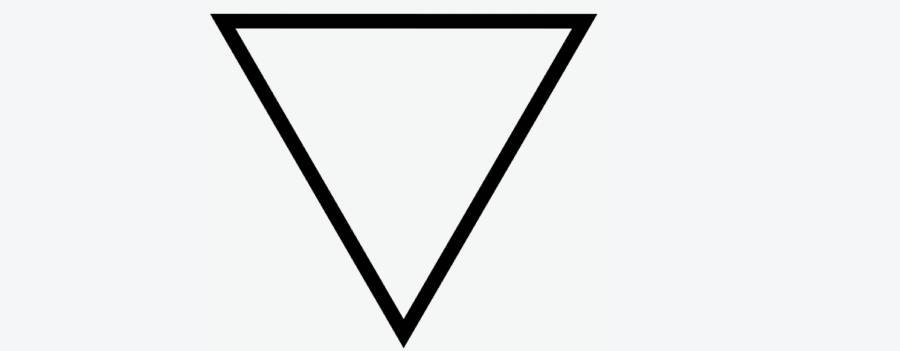
An upside down triangle spiritually symbolizes feminine energy, receptivity, intuition, water, earth, and the movement of energy toward the physical or inner realm, depending on the spiritual tradition and the exact form of the symbol. Its meaning is not universal because different religious, esoteric, and alchemical systems assign distinct attributes to a downward-pointing triangle.
One of the most important distinctions is between a plain downward triangle and a downward triangle crossed by a horizontal line. In Western alchemical symbolism, the plain downward-pointing triangle (▽) represents water, while the downward triangle with a horizontal line represents earth. In other spiritual contexts, the downward orientation is associated with feminine principles, receptivity, creation, and the descent of spiritual energy into material existence.
The symbol also appears within broader systems of sacred geometry and religious symbolism. In Hindu and Tantric contexts, for example, downward-pointing triangular forms can be associated with Shakti and the feminine principle, while their relationship with upward-pointing triangles introduces ideas of complementary forces and union. Understanding an upside down triangle therefore requires looking at its shape, surrounding symbols, and spiritual tradition rather than assigning one fixed meaning to every appearance.
What Does an Upside Down Triangle Mean Spiritually?
An upside down triangle spiritually represents receptive or feminine energy, water, earth, intuition, creation, and the movement of energy downward, but its exact meaning depends on the symbolic system in which it appears. The downward orientation is the defining feature: instead of pointing upward, the triangle directs attention toward what is below, inward, receptive, or material. This orientation explains why spiritual traditions and modern symbolic interpretations frequently connect the shape with qualities that contrast with an upward-pointing triangle.
There are several major interpretations of the downward triangle rather than one universal spiritual definition. Feminine symbolism connects it with receptivity, creation, and the divine feminine. Western alchemical symbolism uses a plain downward triangle for water, while a downward triangle crossed by a horizontal line represents earth. Hindu and Tantric symbolism provides another context in which downward-pointing triangular forms are associated with Shakti and feminine creative power. These meanings overlap around themes such as receptivity and creation, but they come from different symbolic frameworks and should not be treated as interchangeable definitions.
The direction of the triangle also contributes to interpretations involving inward movement and manifestation. A downward-pointing form can visually suggest movement from above to below, which lends itself to spiritual interpretations involving energy entering the physical world, consciousness moving inward, or an abstract principle becoming embodied. These interpretations are especially common when the triangle is discussed through a spiritual or sacred-geometric lens rather than strictly as an elemental sign.
Context ultimately determines which spiritual meaning applies. A plain ▽ used in an alchemical chart has a more specific elemental meaning than the same geometric shape appearing in contemporary spiritual artwork. A downward triangle incorporated into a Hindu sacred symbol must likewise be interpreted through that tradition rather than through Western alchemy. The surrounding symbols, horizontal lines, orientation, cultural tradition, and purpose of the image provide the information needed to interpret an upside down triangle accurately.
Why Does an Upside Down Triangle Represent Feminine Energy?
An upside down triangle represents feminine energy because the downward-pointing form has been associated with receptivity, the feminine principle, and creative power within specific spiritual and esoteric traditions. In this symbolic relationship, feminine energy does not simply mean biological sex or women. It refers to a principle characterized by receiving, containing, nurturing, creating, and bringing potential into form.
Receptivity is central to this interpretation. The downward triangle can be viewed as an open or receiving form, which contrasts symbolically with the outward or upward direction of an upright triangle. This contrast allows the two orientations to represent complementary principles rather than opposing values. The downward form can therefore signify receptive energy, while an upward form can signify an active or ascending principle within systems that use this polarity.
The connection becomes more specific in Hindu and Tantric symbolism. Downward-pointing triangular forms can represent Shakti, the feminine principle of dynamic creative power. The triangle can also carry associations with the yoni in appropriate Tantric contexts, reinforcing themes of generation, creation, and feminine power. These associations belong to particular religious and philosophical traditions, so they should not be presented as proof that every inverted triangle encountered in art, jewelry, tattoos, or other spiritual practices represents Shakti or the divine feminine.
Modern spiritual interpretations expand this feminine symbolism to qualities such as intuition, emotional awareness, nurturing, openness, and inward reflection. These associations provide a contemporary interpretive layer rather than a single historical definition of the symbol. For someone using an upside down triangle as a personal spiritual symbol, feminine energy may therefore represent cultivating receptivity, connecting with intuition, or balancing receptive and active aspects of the self. The intended meaning still depends on the tradition and context in which the triangle is being used.
What Elements Does an Upside Down Triangle Represent?
An upside down triangle represents water when it appears without a horizontal line and earth when a horizontal line crosses the triangle in Western alchemical elemental symbolism. The distinction between these two forms is essential because changing one visual feature changes the element represented. A plain downward triangle and a downward triangle with a line should therefore not be interpreted as the same symbol.
The four classical elements are commonly represented through combinations of upward and downward triangles. Water and earth use downward-pointing forms, while fire and air use upward-pointing forms. This creates a visual distinction between the two orientations and allows closely related geometric shapes to communicate different elemental concepts. When interpreting an upside down triangle spiritually, identifying whether a horizontal line is present should come before assigning an elemental meaning.
Elemental symbolism can also influence modern spiritual interpretations of the triangle. Water is commonly connected with qualities such as fluidity, emotion, intuition, and receptivity, while earth is associated with stability, materiality, grounding, and the physical realm. These broader associations help explain why an upside down triangle may carry different meanings in spiritual practices even when the underlying geometric form looks nearly identical.
Why Does a Downward Triangle Represent Water?
A plain downward-pointing triangle (▽) represents water in Western alchemical elemental symbolism. The symbol belongs to a larger system in which geometric orientation and additional lines distinguish water from the other classical elements. Its meaning is therefore more specific than the broad claim that every downward triangle encountered in a spiritual setting represents water.
Water symbolism adds several related spiritual qualities to interpretations of the downward triangle. Water moves, adapts to its container, and flows according to its environment, making it a natural symbolic reference for fluidity and receptivity. Spiritual interpretations also connect water with emotion, intuition, purification, and the inner world. When a downward triangle is intentionally used as the water symbol, these associations can provide additional layers of meaning beyond the element itself.
The downward direction can reinforce this interpretation visually. Water naturally moves toward lower points under gravity, so the downward orientation corresponds intuitively with descent and flow. This visual relationship also distinguishes the water triangle from the upward-pointing fire triangle. The two forms create a clear symbolic contrast between downward and upward movement within the elemental system.
A water interpretation is strongest when context supports it. For example, a plain downward triangle placed alongside symbols for fire, air, and earth is clearly functioning as an elemental sign. The same triangle used alone in jewelry, a tattoo, meditation artwork, or a contemporary spiritual illustration does not automatically prove a connection with water. Its intended meaning must still be established from the surrounding context.
Why Does a Downward Triangle With a Line Represent Earth?
A downward-pointing triangle crossed by a horizontal line represents earth in Western alchemical elemental symbolism. The horizontal line is the feature that separates the earth symbol from the plain downward triangle for water. Ignoring this line can result in assigning the wrong elemental meaning to the symbol.
Earth symbolism centers on the physical and stable aspects of existence. In spiritual interpretation, the element is associated with grounding, structure, stability, material reality, and embodiment. A person using the earth triangle in a contemporary spiritual practice may therefore use it to represent staying grounded, connecting with the physical world, or creating stability. These are interpretations derived from the symbolic qualities of earth rather than properties shared by every upside down triangle.
The relationship between earth and the downward orientation also fits the broader idea of energy moving toward physical form. Earth is the most tangible of the classical elements in many esoteric interpretations, so downward movement can be understood symbolically as movement toward materiality and embodiment. The horizontal bar further differentiates earth from water within the elemental symbol set.
The visual difference provides a simple rule for interpretation: ▽ indicates water, while a downward triangle crossed by a horizontal line indicates earth in the Western alchemical elemental system. This distinction becomes especially important when interpreting spiritual artwork, tattoos, jewelry, or diagrams containing triangle symbols. Checking the complete form of the symbol prevents a water meaning from being incorrectly assigned to an earth symbol, or vice versa.
What Does an Upside Down Triangle Mean in Sacred Geometry?
An upside down triangle in sacred geometry can represent a receptive or descending principle, especially when it is paired with an upward-pointing triangle to express complementary forces. Its precise meaning depends on the spiritual system using the geometry. Sacred geometry is not a single symbolic tradition with one fixed dictionary of meanings, so the downward triangle should be interpreted according to the larger symbol in which it appears.
Direction provides an important part of this symbolism. A triangle pointing upward creates an ascending visual movement, while a triangle pointing downward creates a descending movement. In spiritual interpretations, descent can represent movement from the spiritual toward the material, from an outward state toward an inward state, or from active expression toward receptivity. These associations explain why the downward triangle is sometimes connected with embodiment, manifestation, feminine principles, and receptive energy.
The meaning changes when the downward triangle interacts with another geometric form. An upward and a downward triangle can create a six-pointed figure, allowing the two orientations to function as complementary parts of one structure. Within traditions that assign polarity to these orientations, their combination can represent the relationship between complementary principles rather than either triangle functioning independently. The complete geometric arrangement therefore carries information that cannot be determined from the downward triangle alone.
Context remains necessary when interpreting sacred geometry. A downward triangle used as an elemental water symbol has a defined meaning within that symbolic system, while a downward triangle incorporated into a larger sacred diagram can serve a different function. Identifying the complete design, the tradition behind it, and the symbols surrounding the triangle provides a stronger interpretation than assuming every upside down triangle has the same sacred-geometric meaning.
What Does an Upside Down Triangle Mean in Hindu Symbolism?
In Hindu and Tantric symbolic contexts, a downward-pointing triangle can represent Shakti, the feminine principle and creative power, while its meaning becomes more specific according to the sacred diagram or tradition in which it appears. This association provides one of the clearest religious contexts for interpreting the downward triangle as feminine, but it should not be generalized to every inverted triangle used outside these traditions.
Shakti refers to divine power or energy and is closely associated with the feminine principle in Hindu traditions. Within relevant Tantric geometric symbolism, the downward triangle can express this creative feminine power. Its form is also associated with the yoni in specific contexts, connecting the triangle with generation and creation. These meanings explain why modern discussions of spiritual symbols frequently associate an inverted triangle with feminine energy, although the historical religious context is more specific than the broader modern interpretation.
The downward triangle also gains meaning through its relationship with an upward-pointing triangle. In symbolic compositions where the two orientations interact, the downward form can represent the feminine principle while the upward form represents its complementary masculine principle. Their relationship expresses a union of complementary forces rather than establishing one orientation as spiritually superior to the other.
The Shatkona demonstrates this relationship through two interlocking triangles, one pointing upward and one pointing downward. Within Hindu symbolism, the combined form can represent the union of complementary divine principles. The downward-pointing triangle contributes the Shakti or feminine aspect, while the upward-pointing triangle contributes the complementary principle. The spiritual meaning comes from both the individual orientations and their relationship within the complete symbol.
This context also shows why an upside down triangle cannot be assigned a universal religious meaning. A plain downward triangle in Western alchemy can indicate water, while a downward triangular form in a Hindu or Tantric sacred diagram can communicate a feminine or Shakti-related principle. The geometry may look similar, but the symbolic systems provide different meanings. The tradition surrounding the symbol determines its interpretation more reliably than its shape alone.
What Is the Difference Between an Upward and Downward Triangle Spiritually?
The spiritual difference between an upward and downward triangle is primarily their symbolic direction: an upward triangle can express ascending or active principles, while a downward triangle can express descending or receptive principles within traditions that assign meaning to orientation. The contrast can extend to masculine and feminine principles or different classical elements, but these associations depend on the symbolic system being used.
In Western alchemical elemental symbolism, orientation helps distinguish the four classical elements. A plain upward-pointing triangle represents fire, while a plain downward-pointing triangle represents water. Adding a horizontal line changes the elemental meaning: an upward triangle with a line represents air, while a downward triangle with a line represents earth. This system demonstrates why orientation is important but cannot determine meaning by itself. The presence of another geometric feature can change the symbol completely.
Spiritual interpretations can extend this directional contrast to complementary principles. An upward orientation visually suggests ascent and outward or rising movement, whereas a downward orientation suggests descent and receptive or inward movement. Within contexts that associate the two orientations with polarity, the upward triangle may represent an active or masculine principle and the downward triangle a receptive or feminine principle. These qualities function as complementary symbolic categories rather than a hierarchy in which one orientation is spiritually better than the other.
The most accurate comparison therefore requires both shape and context. △ and ▽ can communicate opposite directions, but their meanings change across alchemical, Hindu, Tantric, sacred-geometric, and contemporary spiritual contexts. A downward triangle should not automatically be interpreted as feminine whenever it appears, just as an upward triangle should not automatically be interpreted as masculine. The surrounding design and symbolic tradition determine which contrast is intended.
What Do Two Interlocking Triangles Mean Spiritually?
Two interlocking triangles can spiritually symbolize the union and balance of complementary principles when a tradition assigns opposing or complementary qualities to the upward and downward forms. One triangle points upward and the other downward, creating a single geometric structure in which the two orientations remain distinct while becoming interconnected.
The spiritual significance comes from this relationship. If the upward triangle represents an active or ascending principle and the downward triangle represents a receptive or descending principle, interlocking them can express integration rather than separation. The resulting form can therefore communicate concepts such as balance, union, complementarity, and the interaction between different forces. The exact pair of forces represented must still be identified from the tradition using the symbol.
Hindu symbolism provides a specific example through the Shatkona. Its upward and downward triangles can represent complementary divine principles, with the downward form associated with Shakti and the feminine principle in the relevant context. Their interlocking arrangement expresses their relationship as a unified form. This meaning should be understood within its Hindu context rather than treated as a universal explanation for every six-pointed figure.
Two interlocking triangles can also resemble symbols belonging to other religious and cultural traditions, where the complete figure has meanings and histories of its own. Visual similarity alone does not establish identical spiritual symbolism. The identity of the symbol, its cultural setting, accompanying imagery, and intended use must be considered before assigning a meaning.
For interpreting an upside down triangle, the key distinction is whether it appears independently or as one component of a larger symbol. An isolated downward triangle can carry its own elemental or spiritual association, while an interlocking downward triangle derives additional meaning from its relationship with the upward triangle. This relationship shifts the interpretation from a single principle toward the interaction of complementary principles.
Read more: 9 Spiritual Meanings of Seeing a Grey Cat
Does an Upside Down Triangle Always Have the Same Spiritual Meaning?
An upside down triangle does not always have the same spiritual meaning because its interpretation depends on the symbolic tradition, orientation, additional markings, surrounding symbols, and context in which it appears. The same basic triangular shape can represent water in Western alchemical symbolism, feminine creative power in specific Hindu and Tantric contexts, or broader ideas such as receptivity and inward movement in contemporary spiritual interpretations.
The exact design is the first factor to examine. A plain downward-pointing triangle and a downward triangle crossed by a horizontal line are visually similar but represent different elements in Western alchemical symbolism. The plain form represents water, while the crossed form represents earth. Likewise, an isolated downward triangle differs from one interlocked with an upward triangle because the second configuration introduces a relationship between complementary forms. Small visual differences can therefore change the symbolic identity of the triangle.
The tradition behind the symbol is the second factor. A downward triangle appearing in an alchemical elemental diagram should be interpreted according to the elemental system rather than automatically through Hindu symbolism. Conversely, a downward-pointing triangular form within an appropriate Hindu or Tantric sacred diagram should not be reduced to the Western alchemical symbol for water. Identifying the cultural and spiritual framework prevents meanings from separate traditions from being incorrectly combined.
Surrounding symbols provide a third source of information. Fire, air, earth, or other elemental signs can indicate an alchemical context, while placement within a larger sacred diagram can point toward a different interpretation. Jewelry, tattoos, artwork, and modern spiritual designs require additional caution because creators can combine symbols from several traditions or assign personal meanings to them.
For this reason, the most reliable way to interpret an upside down triangle is to identify its complete form and symbolic context before assigning a spiritual meaning. Orientation provides an initial clue, but it does not establish a universal definition. Water, earth, feminine energy, Shakti, receptivity, and descent are context-dependent interpretations rather than meanings that apply simultaneously to every downward triangle.
What Does It Mean If You Keep Seeing an Upside Down Triangle?
Repeatedly seeing an upside down triangle does not establish one fixed spiritual message; its personal meaning depends on where the symbol appears, what form it takes, and which symbolic tradition is relevant to you. Historical and religious symbolism can provide a framework for reflection, but the frequency with which someone notices a symbol does not by itself prove that the symbol is delivering a supernatural message.
Start by identifying the exact triangle you are seeing. A plain downward triangle can point toward water symbolism in an alchemical context, while a downward triangle with a horizontal line corresponds to earth in the same system. A triangle appearing within a larger sacred diagram may instead need to be understood through that diagram. Recording where the symbol appears and what accompanies it can therefore reveal whether repeated sightings share an actual symbolic context.
If the triangle is being used as a personal spiritual symbol, its established associations can serve as prompts for reflection. Water symbolism may direct attention toward emotion, fluidity, intuition, or receptivity. Earth symbolism may encourage reflection on grounding, stability, embodiment, or material concerns. A feminine interpretation may focus on receptivity, creative power, or the relationship between active and receptive aspects of experience. These are interpretive frameworks rather than predictions about what will happen next.
Personal association also matters because a symbol can acquire meaning through experience. Someone who encounters a downward triangle during meditation, in a piece of jewelry, and later in spiritual artwork may associate the form with a particular period of reflection or change. That personal meaning can be significant without being presented as a universal meaning shared by everyone who sees the same shape.
The clearest approach is therefore to combine symbolic context with personal reflection. Determine whether the triangle belongs to an identifiable spiritual, religious, or esoteric system first, then consider what that established symbolism means within your own circumstances. This method preserves the historical context of the upside down triangle while still allowing the symbol to function as a meaningful part of an individual spiritual practice.