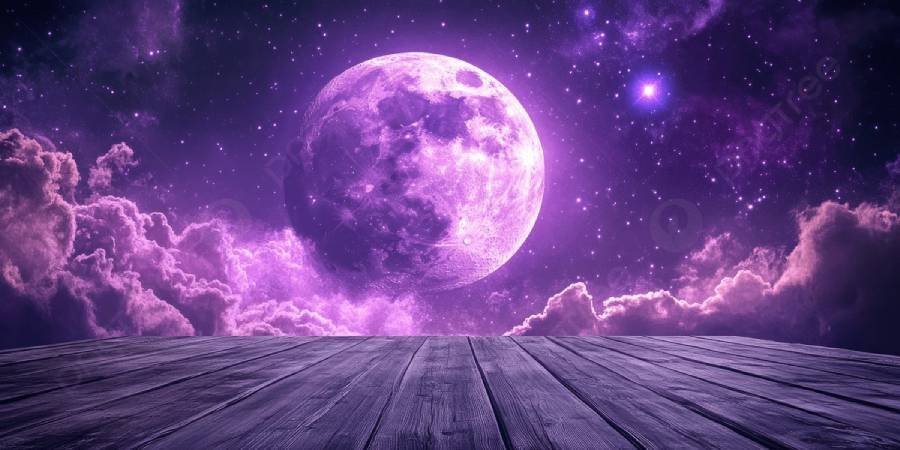
A purple moon spiritually symbolizes heightened intuition, personal transformation, inner wisdom, and a deeper awareness of your spiritual life. The meaning comes from combining two established forms of spiritual symbolism: purple is associated with intuition, wisdom, mystery, and higher awareness, while the moon represents cycles, reflection, emotions, and change. Together, they create a symbol commonly interpreted as a period of inner transition or increased spiritual awareness.
Seeing a purple moon does not have one universal spiritual meaning. The interpretation depends on where it appears and what is happening in your life. A purple moon seen in a dream, for example, may represent something different from a purple-colored moon observed in the sky or an image that repeatedly appears during meditation. Your emotional response also changes the interpretation; feelings of peace may point toward acceptance and spiritual growth, while fear or uncertainty may reflect an unresolved transition.
There are several ways to interpret purple moon symbolism. Its meaning can relate to spiritual awakening, intuition, emotional healing, life-cycle changes, dreams, chakra symbolism, or manifestation practices. Understanding these associations provides a framework for determining which meaning best matches your experience.
What Does a Purple Moon Mean Spiritually?
A purple moon spiritually represents intuition, transformation, inner wisdom, spiritual awareness, and the transition from one personal cycle to another. These meanings come from the symbolic relationship between the color purple and the moon rather than from the moon having one universally accepted spiritual meaning. In spiritual traditions and practices, purple is commonly associated with higher awareness, mystery, wisdom, and introspection. The moon is associated with cycles, emotions, reflection, and change. Combining these symbols makes the purple moon a useful representation of internal transformation.
The symbolism of purple gives the purple moon much of its spiritual character. Purple sits between the stability commonly associated with blue and the intensity associated with red, which has contributed to its symbolic connection with balance, contemplation, and deeper awareness. In spiritual contexts, purple is also frequently connected with practices involving intuition and consciousness. For this reason, a purple moon may be interpreted as a reminder to pay closer attention to internal perceptions rather than relying only on external circumstances.
The moon adds the concepts of cycles and transition to this interpretation. Its visible phases continually move from new moon to waxing moon, full moon, and waning moon before the cycle begins again. Spiritual symbolism frequently uses this changing appearance as a metaphor for beginnings, growth, completion, release, and renewal. A purple moon therefore combines the moon’s cyclical symbolism with purple’s associations with intuition and spiritual awareness.
Context determines which interpretation is most relevant. Someone encountering purple moon imagery while facing a major life transition may associate it with transformation or the end of an old cycle. Someone encountering the same symbol during meditation may connect it more strongly with intuition or inner awareness. The symbol provides a framework for reflection, but the surrounding experience determines its personal meaning.
What Are the Main Spiritual Meanings of a Purple Moon?
There are 7 main spiritual meanings associated with a purple moon: spiritual awakening, transformation, stronger intuition, inner wisdom, the completion of a life cycle, emotional healing, and deeper spiritual connection. These meanings overlap because each describes a different aspect of internal change. The most relevant interpretation depends on your current circumstances, emotional response, and the context in which the purple moon appears.
1. Spiritual awakening
A purple moon can symbolize a period of increased spiritual awareness. Spiritual awakening in this context refers to becoming more attentive to your beliefs, values, inner experiences, and sense of purpose. The purple symbolism emphasizes awareness and introspection, while the moon represents a changing internal cycle. For example, someone reconsidering long-held beliefs or becoming more reflective about their direction in life may interpret a purple moon as representing that shift in awareness.
2. Personal transformation
A purple moon can represent movement from one stage of life into another. Transformation differs from a temporary change because it involves a deeper shift in identity, priorities, beliefs, or behavior. The moon’s phases provide a natural symbolic model for this process: one phase ends before another becomes visible. A purple moon encountered during a career change, relationship transition, or period of personal development may therefore symbolize leaving an established pattern and entering a new stage.
3. Stronger intuition
Purple moon symbolism is frequently connected with paying closer attention to intuition. Intuition refers to an immediate internal perception or judgment that arises without deliberate step-by-step reasoning. In a spiritual interpretation, seeing a purple moon may encourage greater awareness of these internal signals. This does not mean every instinct predicts an external event; rather, the symbol can function as a prompt to examine thoughts and feelings that have previously been ignored.
4. Inner wisdom
A purple moon can symbolize knowledge developed through experience, reflection, and self-awareness. Inner wisdom is different from intuition because it draws more heavily on what a person has already learned about themselves and their circumstances. For example, someone repeatedly encountering the same unhealthy relationship pattern may already understand what needs to change even before taking action. Purple moon symbolism can represent recognizing and acting on that existing understanding.
5. Completion of a life cycle
The moon’s repeating phases make completion and renewal central parts of lunar symbolism. A purple moon may therefore represent the closing of a personal cycle, such as the end of a relationship, a change in identity, the completion of a long-term goal, or the release of an old belief. Completion does not necessarily imply loss. In this interpretation, an ending creates the conditions for a different phase to begin.
6. Emotional healing.
A purple moon can symbolize a period of processing emotions and developing a different relationship with past experiences. Emotional healing does not require forgetting difficult events; it involves recognizing their effects and reducing the extent to which they control present choices. The reflective symbolism of the moon makes this interpretation especially relevant when purple moon imagery appears during periods of grief, forgiveness, self-reflection, or emotional recovery.
7. Deeper spiritual connection
A purple moon can represent increased attention to spiritual practices or a stronger sense of connection with something beyond everyday concerns. Depending on a person’s beliefs, this may involve meditation, prayer, contemplation, nature, or another spiritual practice. The interpretation is personal rather than universal. A person who sees a purple moon during meditation, for example, may treat the image as a symbol that encourages deeper reflection without assuming that it carries an objectively fixed supernatural message.
These 7 meanings share one central theme: a purple moon represents an inward shift more often than an external prediction. Spiritual awakening concerns awareness, transformation concerns change, intuition concerns internal perception, and inner wisdom concerns accumulated understanding. Emotional healing and cycle completion describe processes of transition, while spiritual connection describes the broader context in which those changes may be understood. This distinction helps interpret purple moon symbolism without assigning the same meaning to every experience.
What Does Seeing a Purple Moon Mean Spiritually?
Seeing a purple moon spiritually can represent a period of heightened intuition, inner transformation, or increased attention to your spiritual life. The interpretation depends on whether you physically see a purple-colored moon, encounter one in a vision or meditation, or repeatedly notice purple moon imagery. These experiences have different causes and should not automatically be treated as the same type of spiritual sign.
A purple moon seen in the physical sky can first be understood as a visual experience rather than proof of a supernatural event. The moon’s apparent color can change because of atmospheric conditions, light scattering, haze, smoke, or the position of the moon near the horizon. A person may still attach personal spiritual meaning to that experience, but the physical cause and the symbolic interpretation are separate questions. This distinction allows spiritual symbolism to be explored without presenting a personal belief as an astronomical fact.
In a symbolic context, seeing a purple moon can draw attention to an internal transition. Consider what was changing in your thoughts, relationships, priorities, or personal direction when the experience occurred. For example, seeing a purple moon during a period when you are reconsidering a career, ending a relationship, or developing a new spiritual practice may make transformation the most relevant interpretation. The symbol becomes meaningful through its relationship with the circumstances surrounding it.
Your emotional response provides another important clue. Peace, curiosity, wonder, fear, and sadness can produce different interpretations of the same purple moon. A peaceful experience may correspond with acceptance or inner clarity, while an unsettling experience may reflect uncertainty about an ongoing change. Rather than assigning a predetermined message to the symbol, examine the emotion alongside the situation that produced it.
What Does It Mean If You Keep Seeing a Purple Moon?
Repeatedly seeing a purple moon can be interpreted as a recurring symbol that draws your attention to an unresolved thought, transition, emotion, or spiritual concern. Repetition makes the image more noticeable, but repetition alone does not establish that an external spiritual force is sending a message. The useful question is why the symbol continues to feel significant within your current circumstances.
There are 3 contexts to examine when purple moon imagery repeatedly appears: where you see it, how you feel when it appears, and what is repeatedly happening in your life at the same time. Seeing the image in several dreams, for example, creates a different context from repeatedly noticing purple moons in artwork, social media, or meditation. Recording these circumstances can reveal whether the experiences share a recognizable emotional or situational pattern.
Some spiritual traditions use the concept of synchronicity to interpret meaningful coincidences. From this perspective, repeatedly encountering the same symbol can encourage reflection on an issue that already carries personal significance. A purple moon might therefore become associated with transformation if it repeatedly appears while you are navigating major changes. This is a symbolic interpretation rather than evidence that the repeated appearances predict a particular future event.
The strongest interpretation comes from identifying the connection between the symbol and your experience. If purple moons consistently appear during moments of self-reflection, intuition may be the relevant theme. If they coincide with endings and new beginnings, transformation may be more appropriate. Repetition strengthens the personal significance of a symbol, but context determines what that symbol means.
What Does a Purple Moon Mean in a Dream?
A purple moon in a dream can symbolize intuition, emotional transition, spiritual curiosity, or an internal change that is becoming more noticeable to you. Dream interpretation is personal, so the purple moon does not carry one fixed meaning in every dream. Its appearance, your emotional reaction, and the events surrounding it provide the three main clues for interpreting the dream.
The appearance of the purple moon changes the emphasis of the symbolism. A bright purple moon dominating the sky may represent an issue, realization, or internal change that has become difficult to ignore. A dark or partially hidden purple moon may correspond with uncertainty, emotions that have not been fully processed, or a transition whose outcome is unclear. An unusually large purple moon can indicate that the idea represented by the moon feels especially important or emotionally prominent within the dream.
Your emotional reaction helps narrow the interpretation. Feeling calm while looking at a purple moon can suggest acceptance, curiosity, or readiness for change. Feeling afraid may indicate anxiety about uncertainty or a transition occurring in waking life. Feeling fascinated may point toward spiritual curiosity, intuition, or a desire to understand something about yourself more deeply. The same dream image can therefore produce different meanings depending on the emotion attached to it.
The events before and after the moon appears provide additional context. For example, dreaming about leaving a familiar place and then seeing a purple moon may connect the symbol with transition or a new personal cycle. Seeing one after meeting a particular person may make relationships or emotions more relevant. A purple moon appearing during meditation within a dream may instead emphasize introspection or spiritual awareness.
For a more useful interpretation, record the dream soon after waking and identify 4 details: the moon’s appearance, your strongest emotion, the surrounding events, and any current situation that resembles the dream’s theme. Comparing these details is more informative than relying on a universal dream definition because dream symbolism is shaped by personal associations as well as broader cultural and spiritual meanings.
Is a Purple Moon Connected to the Crown or Third Eye Chakra?
A purple moon can be symbolically connected to the crown and third eye chakras because purple and violet are commonly used in modern chakra symbolism to represent spiritual awareness, intuition, and higher consciousness. The association is symbolic rather than evidence that seeing a purple moon directly activates either chakra. Within spiritual practice, the image can instead function as a visual representation of qualities associated with these energy centers.
The crown chakra is associated with spiritual awareness, higher consciousness, and a sense of connection beyond the individual self. Purple or violet is frequently used to represent this chakra in contemporary spiritual practices. A purple moon can therefore symbolize a period in which questions about purpose, beliefs, consciousness, or spiritual direction become more prominent. Someone beginning a deeper meditation practice, for example, might interpret purple moon imagery as reflecting increased attention to these areas.
The third eye chakra has a different emphasis. It is commonly associated with intuition, perception, insight, and the ability to look beyond immediate surface impressions. Purple moon symbolism connects naturally with these ideas because both the moon and the color purple already carry associations with introspection and intuition. In this context, a purple moon can represent the need to observe your thoughts and internal perceptions more carefully before making an important decision.
The distinction between the two chakras helps prevent the symbolism from becoming too broad. The crown chakra emphasizes spiritual connection and consciousness, while the third eye emphasizes intuition and inner perception. If a purple moon experience makes you reflect primarily on spiritual purpose, the crown chakra association may be more relevant. If it draws attention to instincts, perception, or an unresolved decision, the third eye association may provide a more appropriate symbolic framework.
What Does a Purple Moon Mean for Manifestation?
A purple moon in manifestation can symbolize setting intentions around transformation, intuition, spiritual growth, and the release of outdated personal patterns. It does not need to be treated as a source of supernatural power for the symbolism to have practical value. Instead, the image can provide a specific focus for identifying what you want to change and why that change matters.
There are 4 manifestation themes that fit purple moon symbolism particularly well: personal transformation, stronger self-awareness, release of old patterns, and alignment with meaningful goals. For example, someone changing careers might use the symbol to focus on releasing fear associated with an old professional identity while defining the values they want their next stage of work to reflect. In this case, the purple moon represents the transition rather than causing the desired outcome.
Specific intentions make this practice more useful. An intention such as “I want positive change” is difficult to evaluate because neither the change nor the desired behavior is defined. A clearer intention identifies an outcome and an action, such as developing a daily reflection practice for 15 minutes or setting a boundary in a relationship that repeatedly creates emotional stress. Purple moon symbolism can then serve as a reminder of the intention rather than replacing the actions required to pursue it.
Manifestation also fits the cyclical symbolism of the moon. A person can use the idea of an ending and a beginning to separate what they want to release from what they want to develop. This creates two distinct questions: What pattern am I ready to leave behind, and what behavior do I want to establish in its place? Answering both prevents manifestation from focusing only on desired outcomes without addressing the habits and decisions connected to them.
How Can You Use Purple Moon Symbolism During Meditation?
Use purple moon symbolism during meditation by visualizing the image while focusing on one clearly defined intention, emotion, or transition. Keeping the meditation centered on one subject makes it easier to observe thoughts and emotional reactions without turning the practice into a collection of unrelated spiritual goals.
A simple purple moon meditation can follow 4 steps. First, choose one issue you want to reflect on, such as a relationship transition, career decision, or recurring emotional pattern. Second, visualize a purple moon and use it as the central point of attention. Third, observe the thoughts and emotions that emerge without immediately treating them as predictions or instructions. Fourth, write down the most relevant insight after the meditation and identify whether it suggests a practical action.
For example, a person uncertain about ending an unhealthy pattern might visualize the waning or disappearance of a purple moon as a symbol of release. The purpose of the visualization is not to make the pattern disappear automatically. It creates a structured mental context for examining what needs to end, why the person continues the behavior, and which action could begin a different cycle.
Meditation can also help distinguish intuition from immediate emotional reactions. A strong feeling experienced once may reflect fear, excitement, or stress, while an insight that remains consistent across repeated periods of calm reflection may deserve closer examination. Purple moon meditation is most useful as a tool for focused self-reflection rather than as a method for predicting future events.
Does a Purple Moon Have a Meaning in Astrology?
A purple moon does not have one standardized meaning in astrology, but it can be interpreted symbolically by combining traditional lunar themes with the spiritual symbolism associated with purple. Astrology gives the Moon established associations with emotions, instincts, inner needs, habits, and personal cycles. Purple adds symbolic themes such as intuition, spiritual awareness, wisdom, and transformation. A purple moon can therefore function as a personal spiritual symbol without being treated as a distinct astrological event.
The Moon has a specific role in astrology that should be separated from the color it appears to have. In a natal chart, the Moon’s zodiac sign, house placement, and relationships with other planets are used to interpret emotional patterns and instinctive responses. Lunar phases are also interpreted in relation to cycles, beginnings, culmination, and release. None of these astrological factors requires the Moon to appear purple.
Purple moon symbolism becomes relevant when someone intentionally combines astrological and spiritual interpretations. For example, a person may encounter purple moon imagery during a period of emotional change and associate the Moon with their internal life while using purple to represent transformation or heightened intuition. The resulting interpretation is symbolic and personal rather than a fixed astrological rule.
This distinction matters because spiritual symbolism and astrological terminology are not interchangeable. A purple moon can carry an astrological interpretation without being a standardized astrological phenomenon. When interpreting one, begin with the Moon’s established symbolic role and then consider what the color purple adds to the experience. This approach creates a clearer interpretation than assigning a predetermined astrological prediction to the color alone.
Is a Purple Moon a Real Astronomical Event?
A “purple moon” is not generally the name of a standard astronomical event in the same sense as a lunar eclipse or a recognized lunar phase. A moon that appears purple in the physical sky and a purple moon encountered in a dream, meditation, artwork, or spiritual vision should therefore be treated as different experiences.
The Moon’s apparent color can vary because the light reaching an observer is affected by viewing conditions. Atmospheric particles, haze, smoke, and the Moon’s position in the sky can alter how its light is perceived. Cameras, filters, editing, screens, and surrounding colors can also change its apparent hue. A purple-looking Moon does not by itself establish that a unique astronomical event is occurring.
This physical explanation does not prevent someone from giving the experience personal spiritual meaning. Physical cause and spiritual interpretation answer two different questions. Astronomy addresses why the Moon looked unusual, while spiritual interpretation considers what the experience represented to the observer. Someone who sees an unusually colored Moon during a major personal transition, for example, may remember it as a symbol of that transition even when its color has an ordinary physical explanation.
The same distinction applies more strongly to dreams and meditation. A purple moon seen in a dream does not require an astronomical explanation because the image occurs within a dream experience. Its interpretation instead depends on factors such as emotions, personal associations, current life circumstances, and the other symbols appearing with it. Separating these contexts prevents literal observations and symbolic experiences from being given the same explanation.
Read more: 8 Spiritual Meanings of the Color Blue
How Can You Interpret the Spiritual Meaning of a Purple Moon?
Interpret the spiritual meaning of a purple moon by examining 6 factors: context, emotion, timing, repetition, personal associations, and spiritual practice. These factors provide more useful information than assigning every purple moon the same universal message. A symbol becomes personally meaningful through its relationship with the experience surrounding it.
1. Examine the context
First identify where the purple moon appeared. Seeing one in the physical sky, dreaming about one, visualizing one during meditation, and repeatedly encountering purple moon imagery are different contexts. A dream may emphasize subconscious or emotional themes, while meditation may connect more directly with an intention you were already exploring.
2. Identify your strongest emotion
Determine whether the experience produced peace, wonder, excitement, sadness, uncertainty, or fear. Emotion helps clarify how you relate to the symbol. Feeling peaceful while watching a purple moon may support an interpretation involving acceptance or spiritual connection, while anxiety may point toward uncertainty about an ongoing transition.
3. Consider the timing
Compare the experience with events occurring in your life at the same time. Look specifically at changes involving relationships, work, identity, beliefs, emotional recovery, or personal goals. A purple moon appearing during the end of a long relationship, for example, may carry stronger symbolism around completion and transformation than around manifestation.
4. Look for repetition
Determine whether the purple moon appeared once or has become a recurring image. Repeated dreams or meditation imagery can indicate that a particular subject continues to occupy your attention. Record each occurrence and compare the circumstances rather than assuming repetition automatically confirms a supernatural message.
5. Identify your personal associations
Ask what purple and the Moon already mean to you. Someone who associates purple with a deceased relative may interpret the image differently from someone who associates the color with meditation, creativity, or spirituality. Personal associations can sometimes provide a more precise interpretation than generalized symbol definitions.
6. Consider your spiritual practice
Determine whether the experience occurred in connection with meditation, prayer, manifestation, journaling, astrology, or another spiritual practice. The practice establishes additional context. A purple moon visualized while meditating on a major decision, for example, is more directly connected with reflection and intuition than an unrelated purple moon encountered in a photograph.
After examining all 6 factors, look for the interpretation supported by several pieces of context rather than a single detail. The strongest purple moon meaning is the one that consistently connects the symbol, your emotional response, and your current life circumstances. This approach preserves the value of spiritual symbolism while avoiding the assumption that every unusual image predicts an external event.
What Should You Do After Seeing a Purple Moon?
After seeing a purple moon, document the experience, identify your emotional response, compare it with current life changes, and reflect on the experience through journaling or meditation. These 4 actions help turn an unusual or meaningful experience into structured reflection instead of immediately assigning it a fixed supernatural explanation.
First, record what happened while the details are still clear. Note where you saw the purple moon, what it looked like, whether anyone else was present, and what happened immediately before and after the experience. For a dream, record details as soon as you wake up because visual and emotional information can fade quickly.
Second, identify the strongest emotion connected with the experience. Name the emotion precisely rather than describing it only as positive or negative. Peace, anticipation, grief, fear, curiosity, and relief point toward different internal concerns. If the experience produced relief during a difficult transition, for example, its personal meaning may relate more strongly to acceptance and renewal.
Third, compare the experience with changes already occurring in your life. Examine 3 areas in particular: what is ending, what is beginning, and what remains unresolved. This framework fits purple moon symbolism because lunar imagery is closely connected with cycles while purple symbolism emphasizes introspection and transformation. A clear connection between the experience and one of these areas can provide a more grounded personal interpretation.
Fourth, use journaling or meditation to explore the interpretation without forcing an immediate answer. Write down what you believe the purple moon represents and why, then revisit the entry after several days. If the same theme continues to make sense after the immediate emotion has passed, it may be more meaningful than an interpretation formed only from the intensity of the original experience.
A purple moon is most useful spiritually as a symbol for reflection rather than a guaranteed prediction. Whether it represents intuition, transformation, healing, spiritual awakening, or the completion of a personal cycle depends on the circumstances surrounding the experience and the meaning you consistently associate with it.