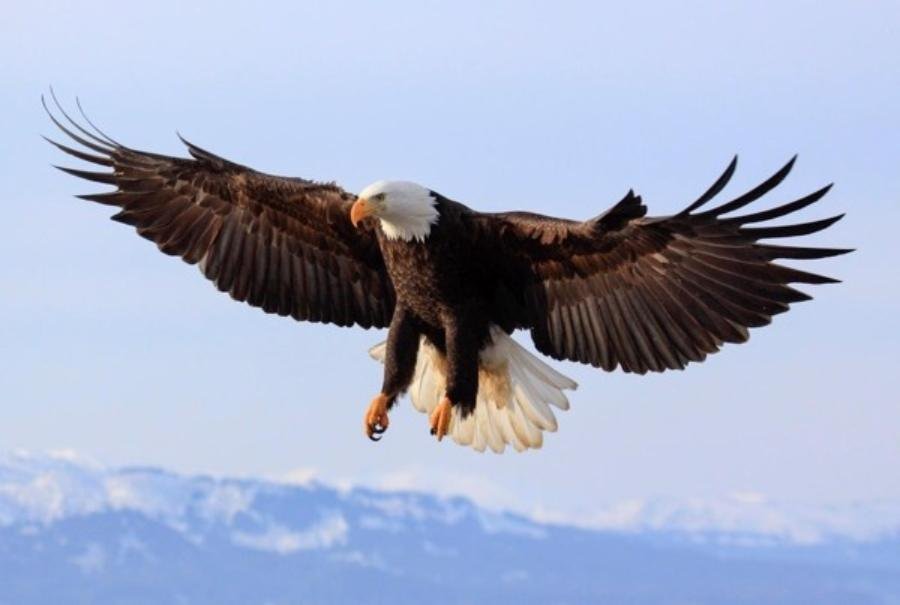
The spiritual meaning of an eagle centers on freedom, strength, courage, vision, higher perspective, spiritual awareness, and connection with the divine. Eagles fly at great heights, see across vast distances, and move through open skies with power and precision. These physical qualities have made the eagle a spiritual symbol of rising above limitations, seeing situations clearly, and acting with confidence across different belief systems and symbolic traditions.
Seeing an eagle can therefore carry a personal spiritual meaning based on the circumstances of the encounter. An eagle flying overhead may represent the need for a broader perspective or greater freedom, while an eagle circling above you may symbolize observation, patience, and heightened awareness. Repeated eagle sightings can encourage reflection on recurring themes such as independence, courage, leadership, or personal transformation.
The meaning also changes according to the type of encounter. Seeing two eagles, finding an eagle feather, dreaming about an eagle, or encountering a bald or golden eagle can each have a different symbolic interpretation. Understanding these meanings requires looking at the eagle’s behavior, the context of the encounter, and the spiritual symbolism associated with the bird rather than treating every sighting as a literal prediction or supernatural message.
What Does an Eagle Mean Spiritually?
An eagle spiritually represents freedom, strength, courage, higher perspective, vision, spiritual awareness, transformation, leadership, and connection with the divine. These meanings are closely tied to the eagle’s ability to fly high above the ground, navigate vast territories, and observe its surroundings from a distance. Spiritually, these characteristics translate into the ability to rise above immediate problems, recognize a larger purpose, and make decisions with greater clarity.
Freedom is one of the strongest spiritual meanings associated with an eagle. Its ability to move through open skies without being restricted to the ground makes it a natural symbol of independence and liberation. In a personal spiritual context, the eagle can represent breaking away from limiting beliefs, unhealthy attachments, or circumstances that prevent growth. Someone facing a major life decision, for example, may interpret an eagle encounter as a reminder to consider which choice provides greater independence and alignment with personal values.
Strength and courage are also central to eagle symbolism. Eagles rely on physical power, precision, and persistence to survive, so their symbolism extends naturally to resilience and decisive action. Spiritually, this meaning applies to situations that require a person to confront fear rather than avoid it. The eagle does not symbolize the absence of difficulty; it represents developing enough inner strength to move through difficulty without losing direction.
Vision and higher perspective form another important layer of eagle spiritual meaning. Because eagles observe their environment from great heights, they symbolize the ability to step beyond immediate details and recognize a wider pattern. This symbolism is particularly relevant during periods of uncertainty. Instead of reacting only to what is happening in the present moment, the eagle represents evaluating where a situation is leading and how individual events connect to a larger goal.
The eagle can also symbolize spiritual awareness and transformation. Its movement upward into the sky has historically encouraged associations between the earthly and the spiritual. Within modern spiritual interpretation, this symbolism can represent becoming more conscious of personal beliefs, intuition, values, or purpose. Transformation occurs when that increased awareness changes how a person thinks or acts rather than remaining only an abstract realization.
Leadership is another meaning associated with the eagle because its symbolism combines independence, confidence, vision, and decisive action. In this context, leadership does not simply mean authority over other people. It can represent taking responsibility for personal choices and maintaining direction when circumstances are uncertain. An eagle encounter may therefore resonate strongly during periods when a person needs to stop relying on external approval and make a deliberate decision.
What Does an Eagle Symbolize?
An eagle symbolizes freedom, power, courage, vision, independence, leadership, spiritual elevation, and a higher perspective. These meanings are interconnected rather than separate symbolic labels. The eagle’s physical characteristics provide the foundation, while spiritual traditions and personal interpretations give those characteristics additional meaning.
Freedom comes from the eagle’s relationship with the open sky. Power and courage are associated with its strength and hunting ability. Vision derives from its exceptional eyesight and ability to observe a large area from above. Together, these characteristics create a broader symbol of seeing clearly before taking decisive action. For example, someone considering a career change could relate eagle symbolism to both perspectives: seeing beyond short-term uncertainty and having the courage to pursue greater independence.
The eagle’s upward flight also explains its association with spiritual elevation. The sky has long served as a symbolic contrast to the physical ground, so an animal capable of ascending high above the earth can represent moving beyond immediate material concerns. In spiritual reflection, this does not necessarily mean rejecting everyday responsibilities. It means examining them from a wider perspective and asking how individual decisions relate to values, purpose, and long-term direction.
Eagle symbolism can therefore change emphasis without losing its central meaning. A person dealing with fear may connect most strongly with courage. Someone feeling restricted may focus on freedom. A person facing confusion may interpret the eagle primarily through vision and clarity. The symbolic attribute that becomes most relevant depends on the situation in which the eagle appears and the circumstances occupying the observer’s attention.
What Does It Mean Spiritually When You See an Eagle?
Seeing an eagle spiritually can symbolize a need for greater perspective, courage, freedom, awareness, or decisive action. The sighting does not have one fixed interpretation because the eagle’s behavior and the observer’s circumstances determine which part of its symbolism is most relevant. A single encounter can therefore carry a different personal meaning from repeated sightings or an eagle behaving in a particularly noticeable way.
The first factor to consider is what the eagle was doing. An eagle soaring high above the ground emphasizes freedom and perspective, while a perched eagle can place greater symbolic emphasis on observation and patience. An eagle appearing during an important transition may resonate with transformation or courage. The behavior provides context that helps narrow the broad symbolism of the eagle into a more specific interpretation.
The second factor is the observer’s current situation. Eagle symbolism becomes more useful when it relates to an identifiable question, conflict, or transition rather than being interpreted in isolation. For example, seeing an eagle while struggling with a difficult decision may encourage reflection on whether fear is narrowing your perspective. During a period of personal change, the same encounter may instead represent independence and movement toward a new direction.
Seeing an eagle should not automatically be treated as proof that a supernatural event will occur. Spiritual symbolism works more effectively as a framework for reflection than as a guaranteed prediction. The encounter can draw attention to themes such as courage, perspective, freedom, and transformation while leaving the observer responsible for determining which theme actually fits the circumstances.
What Does It Mean When an Eagle Flies Over You?
An eagle flying over you spiritually symbolizes higher perspective, freedom, awareness, and direction. The meaning comes primarily from the eagle’s position above the observer. Because the bird can see a much larger area from the air than a person can see from the ground, an overhead eagle naturally represents looking beyond an immediate problem and considering the wider situation.
Higher perspective is especially relevant when an eagle flies overhead during a period of uncertainty. A difficult situation can narrow attention toward immediate obstacles, while eagle symbolism encourages the opposite approach: examining the larger pattern before deciding what to do. For example, a person struggling with a career decision may focus on the short-term discomfort of changing jobs. The eagle’s symbolism shifts attention toward longer-term questions involving purpose, independence, development, and direction.
Freedom is another important interpretation because a flying eagle moves through open space rather than remaining confined to one location. Spiritually, this can represent releasing restrictions that no longer serve a useful purpose. These restrictions may include limiting beliefs, dependence on external approval, or commitments that conflict with personal values. The symbolism does not mean that every restriction should be abandoned; it emphasizes recognizing the difference between necessary responsibility and unnecessary limitation.
An eagle passing directly overhead can also symbolize heightened awareness. The encounter is visually prominent and naturally draws attention upward, which can function as a prompt to examine something that has been overlooked. In this context, the eagle represents awareness before action. The practical spiritual message is to see the situation more completely before choosing a direction rather than reacting only to what feels urgent.
What Does It Mean When an Eagle Circles Above You?
An eagle circling above you spiritually symbolizes observation, patience, perspective, and focused awareness. Circling differs from simply flying past because the eagle remains within the same general area for a period of time. Symbolically, this repeated movement places greater emphasis on watching and assessing before taking action.
Observation is the strongest interpretation of a circling eagle. Eagles use altitude and visual awareness to monitor the landscape below, so circling can represent the value of gathering information before making a decision. For someone facing uncertainty, this symbolism suggests examining the situation from several angles instead of committing immediately to the first available option. The spiritual lesson centers on deliberate awareness rather than hesitation.
Patience follows naturally from observation. A circling eagle does not need to represent inactivity; instead, it can symbolize waiting until conditions become clearer before acting decisively. For example, someone considering an important personal or professional commitment may interpret the encounter as a reminder to distinguish genuine opportunity from pressure to make a quick decision. Patience becomes useful when it improves clarity.
A circling eagle can also represent recurring attention. Because the bird repeatedly passes through the observer’s field of vision, the encounter may draw attention to a question or concern that has not been resolved. This interpretation becomes more meaningful when a specific issue is already occupying the observer’s thoughts. Rather than treating the eagle as a prediction, the encounter can serve as a symbolic prompt to identify what requires closer observation.
What Does It Mean When You Keep Seeing Eagles?
Repeatedly seeing eagles spiritually symbolizes a recurring need to examine freedom, courage, perspective, independence, or personal transformation. Repetition makes an encounter more noticeable, but it does not establish that the sightings are supernatural messages. Its spiritual value comes from using the repeated symbol to identify themes that are also recurring in your life.
The first step is to identify what remains consistent across the sightings. Seeing eagles repeatedly during the same life transition may make transformation the most relevant symbolic theme. Seeing them while repeatedly questioning a restrictive situation may place greater emphasis on freedom and independence. The surrounding circumstances therefore provide more interpretive value than the number of sightings alone.
The eagle’s behavior also matters. Repeated sightings of soaring eagles can emphasize perspective and freedom, while repeatedly noticing perched eagles can emphasize observation, patience, and readiness. If the behavior changes between encounters, the broader eagle symbolism may be more useful than trying to assign one fixed meaning to every sighting.
Recurring eagle encounters can also function as a reflection trigger. Ask what decision repeatedly requires courage, what situation needs a broader perspective, and where greater independence would improve your direction. For example, someone repeatedly postponing an important decision because of fear may connect eagle symbolism with courage and clarity. Someone pursuing too many competing goals may instead relate it to rising above details and identifying the larger priority.
What Does Seeing Two Eagles Mean Spiritually?
Seeing two eagles spiritually symbolizes partnership, balance, shared direction, mutual strength, and independence within connection. While a single eagle strongly emphasizes individual freedom and personal vision, two eagles can shift the symbolic focus toward how two independent individuals move in relation to each other.
Partnership is one of the clearest symbolic interpretations. Two eagles appearing together can represent a relationship in which both individuals retain personal strength while sharing a direction. This symbolism can apply to romantic relationships, friendships, family relationships, or professional partnerships. The emphasis is not dependence; it is cooperation between individuals who remain capable of acting independently.
Balance is another relevant meaning because two eagles introduce a relational element absent from a solitary sighting. Spiritually, this can represent balancing personal freedom with commitment, individual goals with shared goals, or leadership with cooperation. For example, someone entering a serious relationship may use the symbolism as a prompt to consider whether the partnership supports both connection and individual growth.
The behavior of the two eagles changes the emphasis of the interpretation. Eagles flying together can symbolize shared direction, while two eagles occupying the same area can place greater emphasis on coexistence and mutual presence. Personal context remains essential. Seeing two eagles during a relationship decision will naturally carry a different symbolic relevance from seeing them while considering a business partnership or family responsibility.
Two eagles should therefore not be treated as a guaranteed sign of romance, reunion, or a specific future event. Their stronger spiritual value lies in the relationship between two themes already central to eagle symbolism: independence and connection. The encounter can encourage reflection on whether an important relationship allows both people to maintain strength, direction, and freedom while moving toward something together.
What Does a Bald Eagle Mean Spiritually?
A bald eagle spiritually symbolizes freedom, independence, strength, resilience, vision, and personal authority. These meanings overlap with general eagle symbolism, but the bald eagle places particularly strong emphasis on freedom and self-determination. Its powerful flight, commanding presence, and ability to survey large areas make it a natural symbol of maintaining direction while remaining independent.
Freedom is one of the most recognizable meanings associated with the bald eagle. In spiritual interpretation, freedom is broader than physical independence. It can represent the ability to make decisions according to personal values rather than fear, social pressure, or the expectations of others. Seeing a bald eagle during a major transition may therefore prompt reflection on whether your current direction gives you enough autonomy to live according to those values.
The bald eagle also represents resilience and personal strength. Its symbolism can become relevant when progress requires persistence rather than immediate results. For example, someone rebuilding a career, ending an unhealthy pattern, or recovering from a major setback may connect the bald eagle with the strength required to continue moving toward a long-term objective despite temporary difficulties.
Vision adds another layer to the bald eagle’s spiritual meaning. Like other eagles, it is associated with observing circumstances from above and identifying what matters within a larger landscape. Spiritually, this represents separating important long-term priorities from temporary distractions. The combination of vision and independence makes the bald eagle particularly relevant to decisions involving personal direction, responsibility, and leadership.
What Does a Golden Eagle Mean Spiritually?
A golden eagle spiritually symbolizes power, confidence, vision, elevation, courage, and spiritual aspiration. Its symbolism emphasizes the combination of strength and the ability to rise above immediate circumstances. Rather than representing power as control over others, the golden eagle can symbolize the personal capacity to act decisively while maintaining a wider perspective.
Power is central to this interpretation because the golden eagle is a large and capable bird of prey. In spiritual symbolism, physical power becomes a metaphor for inner strength, determination, and the ability to confront demanding situations. Someone facing a difficult goal may interpret a golden eagle encounter as a reminder that progress requires both confidence and deliberate action.
Elevation connects the golden eagle with spiritual aspiration. An eagle rising high into the sky can symbolize moving beyond a limited viewpoint and directing attention toward larger goals, values, or purpose. This interpretation becomes especially relevant when a person has become absorbed in short-term problems. The symbolic message is not to ignore practical difficulties but to evaluate them in relation to the larger direction of life.
The golden eagle can also represent confidence guided by vision. Confidence without perspective can become impulsiveness, while vision without action can remain an intention. Golden eagle symbolism brings these qualities together: see clearly, identify the direction, and act with enough courage to pursue it. This makes the symbol particularly relevant during periods involving ambition, personal development, or a demanding transition.
What Does an Eagle Mean as a Spirit Animal?
An eagle as a spirit animal represents independence, vision, courage, self-trust, freedom, and the ability to view life from a higher perspective. People who identify strongly with eagle symbolism may use these qualities as a framework for reflecting on decisions, challenges, relationships, and personal growth.
Vision is a central quality of the eagle spirit animal because it represents seeing beyond what is immediately visible. In practical terms, this means considering the consequences of a decision rather than focusing only on its immediate effects. For example, when choosing between a comfortable option and one that better supports a long-term goal, eagle symbolism encourages evaluating the destination rather than judging the choice only by short-term difficulty.
Independence and self-trust form a second major theme. The eagle spirit animal can symbolize developing enough confidence to make deliberate choices without depending entirely on external validation. This does not mean rejecting advice or separating from other people. It means listening to useful perspectives while accepting responsibility for the final decision.
Courage complements this independence because personal freedom often requires difficult choices. Changing direction, setting boundaries, pursuing an ambitious goal, or leaving an unsuitable situation can create uncertainty. Eagle symbolism frames courage as moving forward with awareness of that uncertainty rather than waiting for all fear to disappear.
The eagle spirit animal can also represent the balance between action and perspective. Eagles do not symbolize constant movement; observation is equally important to their symbolic identity. In a spiritual context, this creates a simple principle: gain enough distance to see clearly, then act when the direction becomes apparent.
The term “spirit animal” should not be treated as interchangeable with every Indigenous or traditional spiritual belief involving eagles. Different cultures have distinct relationships, teachings, ceremonies, and meanings associated with the bird. General modern spiritual interpretation can use the eagle as a symbol of vision, courage, and freedom, while culture-specific meanings should be described within their own traditions rather than combined into a single universal belief system.
What Does an Eagle in a Dream Mean Spiritually?
An eagle in a dream spiritually symbolizes freedom, ambition, courage, higher perspective, personal power, or a desire to rise above current limitations. The specific meaning depends on what the eagle does, how you interact with it, and the emotions experienced during the dream. A peaceful eagle flying above you, for example, creates a different symbolic context from an eagle chasing or attacking you.
Eagle dreams often emphasize perspective because the bird can move between the ground and the sky. Symbolically, this movement can represent shifting from an immediate, limited viewpoint toward a broader understanding of a situation. A person who feels trapped by one problem may dream of an eagle during a period when they are beginning to recognize alternatives that were previously overlooked.
Freedom is another central interpretation. A freely flying eagle can reflect a desire for greater independence, fewer restrictions, or more control over personal direction. The relevant restriction does not have to be physical. It may involve a relationship, career, responsibility, belief, or fear that limits the dreamer’s choices. The eagle becomes a symbolic contrast between the current limitation and the freedom the dreamer wants to achieve.
The emotional tone of the dream provides additional context. Feeling calm or inspired around the eagle can strengthen interpretations involving confidence, aspiration, and freedom. Feeling threatened can shift the meaning toward conflict, fear, pressure, or difficulty handling personal power. Dream symbolism is therefore most useful when the eagle’s behavior and the dreamer’s emotional response are interpreted together rather than separately.
What Does a Flying Eagle Mean in a Dream?
A flying eagle in a dream symbolizes freedom, ambition, progress, and a higher perspective. Upward or unrestricted flight can reflect a desire to move beyond limitations and pursue a larger objective. The eagle’s direction and the dreamer’s emotional response help determine which meaning is most relevant.
Watching an eagle rise into the sky may represent aspiration or a growing ability to see beyond an immediate challenge. An eagle flying steadily toward a destination can instead emphasize direction and commitment. For example, someone preparing for a major career or lifestyle change may associate the dream with moving toward greater independence despite uncertainty about the transition.
What Does an Eagle Attacking You Mean in a Dream?
An attacking eagle in a dream can symbolize conflict with power, ambition, independence, responsibility, or a challenge that feels difficult to control. Because the eagle normally represents strength and freedom, aggression changes those positive attributes into a source of pressure or confrontation.
The source of that conflict depends on personal context. Someone pursuing an ambitious objective may feel overwhelmed by the responsibility that accompanies it. Another person may be struggling against an authority figure or resisting a difficult decision that requires greater independence. In each case, the attacking eagle can represent tension involving qualities normally associated with the bird rather than predicting that an external threat will occur.
Your response to the eagle also matters. Running from it can reflect avoidance, while confronting it may symbolize readiness to address a difficult issue. The useful question is therefore not simply why the eagle attacked, but what form of power, freedom, fear, or responsibility currently feels confrontational in waking life.
What Does an Eagle Landing Near You Mean in a Dream?
An eagle landing near you in a dream can symbolize awareness, opportunity, clarity, or a significant issue becoming difficult to ignore. The transition from distant flight to physical proximity changes the symbolism from observing something abstract to confronting something more immediate.
A calm eagle landing nearby can represent an idea, decision, or opportunity that deserves focused attention. For example, a person who has considered changing direction for months may associate the landing eagle with the moment when that possibility becomes concrete enough to evaluate seriously. The eagle’s proximity symbolizes attention rather than guaranteeing a particular outcome.
A peaceful emotional response strengthens meanings such as clarity, confidence, and readiness. Fear or discomfort can instead indicate hesitation about accepting greater independence, responsibility, or change. As with other eagle dreams, the dreamer’s circumstances provide the context needed to determine which interpretation fits.
What Does Finding an Eagle Feather Mean Spiritually?
Finding an eagle feather can spiritually symbolize strength, honor, courage, protection, freedom, and connection with something greater than oneself. The feather retains many meanings associated with the eagle itself while placing greater emphasis on a physical object that can remind the observer of those qualities.
Flight gives the feather its strongest symbolic connection. Because feathers enable birds to rise and move through the air, they can represent elevation, freedom, and moving beyond limitations. An eagle feather may therefore serve as a personal symbol during a period when courage or a broader perspective is needed. For example, someone beginning a difficult transition might associate the feather with remaining focused on long-term direction instead of allowing immediate uncertainty to determine the decision.
A feather can also represent connection. Unlike seeing an eagle at a distance, finding a feather creates a tangible encounter with something associated with the bird. In modern spiritual interpretation, this physical connection can become a reminder of strength, awareness, or personal values. Its meaning still depends on the observer’s circumstances rather than proving that a particular spiritual event has occurred.
Eagle feathers also have specific cultural and ceremonial significance within certain Indigenous traditions, so their meanings should not be reduced to generic claims about “Native American spirituality.” Different peoples maintain distinct beliefs and practices involving eagles and their feathers. These culture-specific meanings should be understood within their individual traditions rather than merged with modern spiritual symbolism.
Practical considerations matter as well. Finding a feather does not automatically mean it should be collected or kept. Laws can protect eagles and restrict the possession of their feathers in some countries. The symbolic value of an encounter does not require physically removing the feather; observing it where it was found can carry the same personal significance.
What Does the Eagle Symbolize in Different Spiritual Traditions?
The eagle symbolizes spiritual elevation, divine connection, power, courage, authority, and vision across different spiritual traditions, but its exact meaning is not universal. Each religious or cultural tradition interprets the eagle within its own beliefs, stories, symbols, and practices. Similarities between traditions can exist, but they should not be treated as evidence that every culture assigns the same spiritual meaning to the eagle.
In Christianity, eagle imagery is commonly associated with spiritual renewal, strength, and elevation toward God. The connection between eagles and renewal is reinforced by biblical imagery that describes renewed strength through the metaphor of rising on wings like eagles. From a symbolic perspective, upward flight also supports associations with faith, spiritual aspiration, and looking beyond immediate earthly difficulties.
Eagles also hold important meanings within numerous Indigenous cultures of North America, but there is no single “Native American eagle meaning” that accurately represents all Indigenous peoples. Different nations maintain their own teachings and relationships with eagles. In some traditions, eagles and eagle feathers have sacred or ceremonial importance and can be associated with concepts such as honor, prayer, strength, or connection with the spiritual world. These meanings need to be attributed to specific traditions when discussed in detail rather than presented as one universal Indigenous belief.
In ancient Greek and Roman contexts, the eagle was strongly connected with authority and the divine. The eagle became associated with Zeus in Greek tradition and Jupiter in Roman tradition, reinforcing symbolic relationships with sovereignty, power, and the heavens. This context adds another dimension to eagle symbolism: the bird represents not only physical strength but also elevated authority.
The similarities among these traditions help explain why modern spiritual interpretations frequently connect eagles with strength, elevation, vision, and spiritual connection. However, modern interpretations such as “seeing an eagle means the universe is sending you a message” should not automatically be attributed to ancient religions or Indigenous traditions. A modern spiritual belief and a historically documented cultural meaning are separate contexts and should be identified as such.
How Can You Interpret an Eagle Encounter in Your Own Life?
Interpret an eagle encounter by examining four factors: the eagle’s behavior, your current circumstances, the symbolism that matches those circumstances, and the difference between reflection and prediction. This method provides a more useful interpretation than assigning the same spiritual meaning to every eagle sighting.
First, observe what the eagle was doing. A soaring eagle emphasizes freedom and higher perspective, while a circling eagle places greater emphasis on observation and patience. A perched eagle can symbolize stillness, awareness, and readiness before action. Repeated sightings make recurrence itself part of the context. The behavior narrows the possible interpretation because different actions emphasize different attributes of eagle symbolism.
Second, identify what was happening in your life when you noticed the eagle. Consider specific circumstances rather than asking only what an eagle means in general. A person deciding whether to leave a restrictive situation may find freedom especially relevant. Someone struggling to choose between several options may connect more strongly with vision and perspective. A person approaching a difficult challenge may identify courage and strength as the most useful meanings.
Third, match the encounter with the symbolic attribute that fits the situation. Eagle symbolism includes several distinct qualities, so every sighting does not need to represent all of them simultaneously. For example, an eagle soaring overhead during a period of uncertainty may function as a reminder to look at the larger picture. The same sighting during a period of excessive dependence on other people’s approval may instead make independence the more relevant interpretation.
Finally, separate spiritual reflection from prediction. An eagle encounter can provide a meaningful symbol without guaranteeing that a specific future event will happen. Seeing an eagle does not establish that a relationship will begin, money will arrive, a decision will succeed, or another predetermined event will occur. Its practical spiritual value comes from directing attention toward qualities such as courage, freedom, vision, strength, and awareness.
The most useful interpretation is therefore the one that connects the encounter to a real circumstance and leads to clearer reflection or action. If freedom is the relevant theme, identify the restriction that needs examination. If courage is relevant, identify the decision fear is delaying. If perspective is relevant, determine which problem needs to be viewed within a larger context. In this way, eagle spiritual meaning becomes a framework for understanding your present direction rather than a fixed prediction about your future.