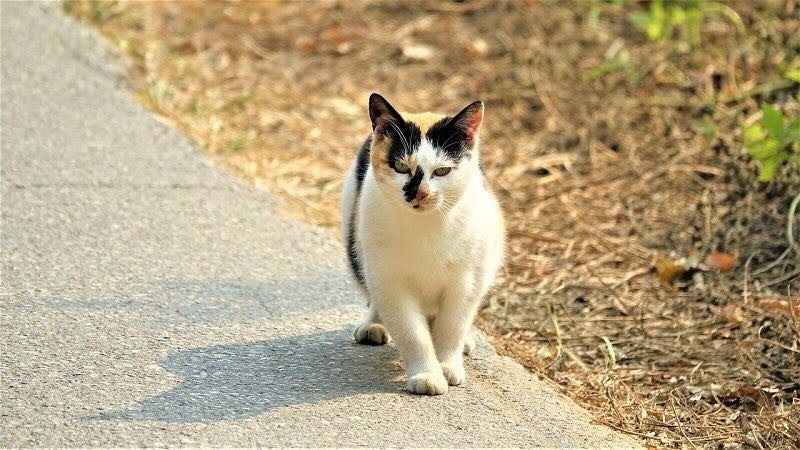
Cats hanging around your house are often interpreted in spiritual traditions as symbols of intuition, protection, independence, transformation, and heightened awareness. A cat that repeatedly visits your yard, waits near your door, or chooses to stay close to your home may therefore carry personal symbolic meaning, especially when its appearance coincides with a period of change or reflection. The interpretation is not universal, however. Different spiritual traditions and cultures assign different meanings to cats, and factors such as the cat’s behavior, color, and frequency of visits can change how the encounter is understood.
A cat appearing around your home is also not automatically a spiritual sign. Cats may approach a property because they find food, water, warmth, shelter, safety, or a comfortable place to rest. These practical explanations can exist alongside a personal spiritual interpretation without proving that the animal was sent as a supernatural message.
This article explains the main spiritual meanings associated with cats around your house, including repeated visits, stray cats, groups of cats, different cat colors, and specific behaviors. It also examines cultural symbolism and practical reasons cats may choose to spend time around your home.
What Does It Mean Spiritually When Cats Hang Around Your House?
Cats hanging around your house are commonly interpreted as symbols of intuition, protection, independence, transformation, and spiritual awareness. The exact meaning depends on the spiritual tradition, the cat’s behavior, and the circumstances surrounding its appearance. A single cat passing through a yard carries less symbolic significance than the same cat repeatedly returning, waiting at the door, or choosing the property as a regular resting place.
There are 5 main spiritual meanings associated with cats appearing around a home: intuition, protection, independence, transformation, and spiritual awareness. Intuition is one of the strongest associations because cats are frequently portrayed as observant, sensitive, and responsive to subtle changes in their surroundings. In a spiritual interpretation, a visiting cat can therefore serve as a reminder to pay closer attention to instincts, emotions, or circumstances that have been overlooked. This does not mean the cat has detected a supernatural presence; rather, its characteristics provide the symbolic basis for the interpretation.
Protection is another meaning attributed to cats around a house. The home represents security, privacy, family, and personal boundaries, while the cat can represent vigilance and guardianship in spiritual symbolism. A cat repeatedly sitting near a doorway, porch, or property boundary may consequently be interpreted as a symbol of protecting personal space. This association should be understood symbolically rather than as evidence that the cat is physically protecting the home from negative spiritual forces.
Independence is represented by the cat’s ability to move freely while choosing where it spends its time. A cat that visits a house but remains independent can symbolize the balance between connection and personal freedom. This interpretation becomes particularly relevant when a person is dealing with relationships, boundaries, or decisions that require greater self-reliance. The symbolic message is not necessarily to withdraw from others, but to maintain autonomy while deciding where and with whom to invest attention.
Transformation is associated with a visiting cat when its appearance coincides with a period of personal change. Moving home, beginning or ending a relationship, changing careers, or developing new priorities are examples of transitions that can make an unusual recurring encounter feel significant. In this context, the cat functions as a personal symbol through which the observer interprets change rather than as proof that the animal was deliberately sent to announce an upcoming event.
Spiritual awareness is the fifth major interpretation. Cats are associated in different belief systems with mystery, perception, and unseen aspects of experience, which has contributed to their spiritual symbolism. When cats repeatedly appear around a home, some people interpret the pattern as an invitation to become more attentive to their inner life, environment, or spiritual practices. The meaning remains dependent on personal and cultural beliefs because there is no universal spiritual interpretation that applies to every visiting cat.
The location also affects the symbolism. A house is more than a physical location in symbolic interpretation; it represents a person’s private life, security, relationships, and sense of belonging. For this reason, a cat appearing repeatedly around a home may feel more personally significant than encountering the same animal in a public place. A cat waiting at the front door, for example, places the encounter at the boundary between private and outside space, which can strengthen interpretations related to protection, boundaries, or transition.
A cat coming to your house can therefore be treated as a spiritual sign when that interpretation is meaningful within your belief system, but its presence alone does not establish a supernatural cause. Frequency, behavior, timing, and personal circumstances provide the context for symbolic interpretation. Practical factors such as food, water, warmth, shelter, and safety should also be considered because these directly influence where cats choose to spend their time.
Why Does a Cat Keep Coming to My House Spiritually?
A cat that keeps coming to your house can spiritually symbolize recurring intuition, personal boundaries, independence, or a period of transition. Repetition changes the way people interpret the encounter because the same event occurring regularly attracts more attention than a single visit. Within spiritual belief systems, this recurring pattern may be treated as a reason to examine what the cat represents personally rather than assuming every visit carries a separate message.
The same cat returning repeatedly is particularly associated with familiarity and trust. Cats tend to revisit environments where they have established a positive association, so the behavior has a clear practical explanation when the property provides safety or resources. From a symbolic perspective, however, repeated return can represent persistence. A person may use that pattern as a prompt to reconsider an unresolved decision, recurring emotion, neglected boundary, or intuitive impression that continues to demand attention.
Repeated visits can also symbolize independence combined with voluntary connection. Unlike an animal confined to the property, a roaming cat has the ability to leave and return. Spiritually, this pattern can represent maintaining personal autonomy while still forming meaningful connections. For someone reconsidering a relationship, friendship, career, or personal commitment, the symbolism may center on choosing connection freely rather than remaining attached through obligation.
Transition provides another interpretation when the visits begin during a noticeable period of change. A cat that suddenly starts appearing while someone is moving through a new relationship, career change, relocation, or personal shift may become associated with that transition. The timing can make the encounter personally meaningful, but correlation should not be treated as proof that the cat predicts or causes the change.
The most useful way to interpret a cat that keeps returning is therefore to consider what repeats alongside the cat’s visits. Notice whether the visits coincide with a particular concern, decision, emotional state, or life transition. Then consider the physical environment: accessible food, water, shade, warmth, hiding places, and freedom from threats can all encourage a cat to return. Spiritual symbolism can provide personal meaning to the pattern, while observable conditions explain why the animal may have chosen the house itself.
What Does It Mean Spiritually When a Stray Cat Comes to Your House?
A stray cat coming to your house can spiritually symbolize compassion, trust, vulnerability, hospitality, and an unexpected connection. These meanings come from the relationship created when an unfamiliar and relatively independent animal voluntarily approaches a person’s private space. The interpretation becomes more personally significant when the stray cat returns regularly, waits near the property, or begins interacting directly with someone in the household.
Compassion is one of the strongest symbolic meanings associated with a stray cat because the animal may appear to need food, shelter, safety, or care. In a spiritual context, encountering an animal in this situation can be interpreted as an opportunity to examine how you respond to vulnerability. Offering appropriate help can represent kindness and responsibility, while maintaining healthy boundaries remains equally important. The spiritual significance therefore comes partly from your response to the encounter rather than from assuming the cat was deliberately sent to you.
Trust is another important interpretation when a stray cat repeatedly chooses your property. An unfamiliar cat that initially keeps its distance but gradually approaches, rests nearby, or becomes comfortable in your presence can symbolize the gradual development of trust. Spiritually, this process may reflect patience, openness, and the idea that meaningful connections do not always develop immediately. The symbolism is especially relevant when trust and emotional boundaries are already important themes in a person’s life.
A stray cat choosing you can also symbolize an unexpected connection. The encounter was not planned, yet the cat voluntarily returns and establishes a relationship with you or your home. Some spiritual interpretations view this type of experience as a reminder to remain receptive to relationships, responsibilities, or opportunities that arrive in unexpected forms. The important distinction is that being chosen is a symbolic interpretation of the interaction, not evidence that a supernatural force directed the cat to a particular person.
The practical explanation should also remain part of the interpretation. Stray cats return to places that provide useful resources or feel safe. Food, fresh water, protection from weather, quiet resting areas, and the absence of aggressive animals can make one house more attractive than another. A stray cat may therefore have a clear behavioral reason for choosing your property while the encounter simultaneously holds personal spiritual meaning for you.
What Does It Mean When Multiple Cats Gather Around Your House?
Multiple cats gathering around your house can spiritually symbolize community, abundance, heightened attention, or a concentrated symbolic presence. The appearance of several cats can feel more significant than an encounter with one animal because repetition across multiple animals makes the event more noticeable. However, the number of cats does not establish that a supernatural event is occurring, and practical environmental factors become especially important when several cats consistently gather in the same location.
Community is a natural symbolic interpretation because several cats occupying the same area create an image of coexistence and shared space. For someone reflecting on family, friendship, belonging, or social relationships, a group of cats may represent the need to consider how independence operates within a community. Cats retain individual boundaries even when they share territory, making the group a useful symbol for balancing personal autonomy with connection to others.
Abundance is another interpretation associated with multiple cats. In spiritual symbolism, an increase in the number of animals appearing around a particular place can be viewed as an amplification of the qualities attributed to that animal. If cats represent intuition, independence, or awareness within a person’s belief system, seeing several cats may be interpreted as emphasizing those themes. This does not mean that three, five, or seven cats have a fixed universal spiritual meaning; numerical interpretations vary substantially between belief systems and should not be presented as universal rules.
Multiple cats can also function symbolically as a call for heightened attention. A single visiting cat may go unnoticed, while several cats repeatedly gathering near a yard, porch, or doorway create an obvious pattern. Spiritually inclined observers may use that pattern as a prompt to examine their environment, emotions, relationships, or current life changes more carefully. The significance comes from how the event relates to the observer’s circumstances rather than from the number of cats alone.
There are also strong practical reasons for several cats to gather around one house. Food, water, shelter, warmth, safety, territory, and opportunities for social interaction can attract multiple animals to the same property. A person who regularly leaves food outside, for example, may unintentionally establish a predictable feeding location. Covered porches, sheds, gardens, and other protected spaces can similarly provide resting or hiding areas. These explanations should be considered before treating a group of cats as evidence of a spiritual event.
The spiritual and practical interpretations do not have to cancel each other out. Multiple cats may gather because the property provides resources, while their presence can still become personally meaningful to someone who associates cats with intuition, independence, protection, or community. Keeping these two levels separate allows the experience to be interpreted spiritually without presenting symbolic meaning as a proven cause of the cats’ behavior.
Does the Color of a Cat Change Its Spiritual Meaning Around Your House?
A cat’s color can change its symbolic meaning in some spiritual traditions, but cat color does not have one universal spiritual interpretation. Black, white, and orange cats have acquired different associations through folklore, religion, superstition, and modern spiritual practices. The same color can even represent opposite ideas across cultures. For this reason, the cat’s color should be treated as one contextual element alongside its behavior, frequency of visits, location, and the observer’s belief system.
Color symbolism can make a visiting cat feel more personally significant because people already associate colors with particular qualities. Black may evoke mystery or the unknown, white may represent purity or peace, and orange may suggest warmth or vitality. When these associations are combined with the broader symbolism of cats, they create more specific interpretations. A black cat repeatedly appearing at a doorway, for example, may be interpreted differently from a white cat resting peacefully in the same location.
What Does a Black Cat Around Your House Mean Spiritually?
A black cat around your house can spiritually symbolize protection, intuition, mystery, and the unknown. Its meaning is strongly influenced by cultural context because black cats have accumulated both positive and negative associations. Treating every black cat as a sign of bad luck oversimplifies a much more varied symbolic history.
Mystery is closely associated with black cats because the color black commonly represents what is hidden, unknown, or difficult to perceive. Combined with the cat’s reputation for independence and alertness, this association can make a visiting black cat a personal symbol of intuition. Someone facing an uncertain decision, for example, might interpret repeated visits as a reminder to observe carefully and trust informed instincts rather than immediately viewing the animal as an omen.
Protection is another interpretation found in spiritual and folkloric associations with cats. When a black cat repeatedly sits near a house, yard, or entrance, a spiritually minded observer may connect its presence with boundaries and guardianship. This remains symbolic protection rather than evidence that the animal is absorbing negative energy or preventing supernatural forces from entering the home.
Black cats should therefore not automatically be interpreted as warnings or signs of misfortune. Their symbolic meaning varies by tradition, and negative superstition represents only one cultural interpretation. The circumstances of the encounter provide more useful context than the cat’s color alone.
What Does a White Cat Around Your House Mean Spiritually?
A white cat around your house can spiritually symbolize peace, clarity, purity, and heightened awareness. These interpretations largely develop from the broader symbolic associations attached to the color white rather than from a universal belief specifically concerning white cats.
Peace becomes particularly relevant when a white cat regularly rests or sleeps near the house. Because resting behavior suggests comfort and safety at an observable level, a spiritual interpretation may connect the encounter with calmness, emotional balance, or the desire to create a more peaceful personal environment. The cat does not cause that state; instead, its presence can function as a symbol through which the observer reflects on it.
Clarity is another possible interpretation. White is frequently associated symbolically with openness and illumination, while cats are associated with perception and intuition. Combining these attributes creates an interpretation centered on seeing a situation more clearly. A white cat appearing during a confusing period may consequently become a personal reminder to remove distractions and examine circumstances carefully.
Purity should not be interpreted as proof that a white cat carries inherently “positive energy.” Spiritual color meanings are culturally dependent, and physical coat color does not determine an animal’s spiritual qualities or behavior. Context remains more important than color alone.
What Does an Orange Cat Around Your House Mean Spiritually?
An orange cat around your house can spiritually symbolize vitality, warmth, confidence, and creative energy. These interpretations connect the warm orange color with qualities such as activity, enthusiasm, and expression while retaining the broader cat symbolism of independence and curiosity.
Vitality is a particularly relevant interpretation when an orange cat behaves actively around the property by exploring, approaching people, or repeatedly moving between different areas. A spiritual interpretation may use that energetic presence as a reminder of action and engagement. Someone who has been postponing a personal project, for example, might associate the encounter with renewed motivation, although the cat’s appearance itself does not predict the project’s outcome.
Warmth and connection can also shape the symbolism of an orange cat that repeatedly approaches the household. Warm colors are commonly associated with friendliness and emotional energy, so a recurring encounter may acquire personal meaning related to openness or social connection. The significance becomes stronger for the observer when these themes already correspond with events occurring in their life.
Creative energy is another possible symbolic association because orange combines qualities commonly attributed to warm, stimulating colors with the curiosity associated with cats. For a person focused on art, writing, problem-solving, or another creative pursuit, an orange cat may therefore become a personal symbol of curiosity and expression.
Black, white, and orange cats ultimately demonstrate why color modifies spiritual interpretation rather than determining it. The strongest interpretation considers the whole encounter: what the cat does, how often it appears, where it stays, what the color represents within the relevant tradition, and what circumstances are occurring in the observer’s life.
Does a Cat’s Behavior Change Its Spiritual Meaning Around Your House?
A cat’s behavior can change how its presence around your house is interpreted spiritually because sitting, staring, meowing, and sleeping represent different forms of interaction with the home. Behavior provides more context than presence alone. A cat that briefly crosses a yard, for example, creates a different symbolic situation from one that repeatedly waits at the front door or sleeps beside the house.
A cat sitting at your door can spiritually symbolize boundaries, transition, and the threshold between different stages of life. A door separates private space from the outside world, so its symbolic meaning centers on what is allowed to enter or leave. When a cat repeatedly chooses this location, someone experiencing a major decision or personal transition may interpret the encounter as a reminder to examine boundaries. Starting a relationship, leaving a job, moving home, or reconsidering a commitment are examples of circumstances that can make threshold symbolism personally relevant.
The practical behavior also matters. A doorway may provide shelter, warmth, shade, familiarity, or access to people who have previously given the cat attention. The physical location can therefore explain why the animal waits there, while the symbolic meaning of a threshold explains why the same behavior may feel spiritually significant to the observer.
A cat staring at your house can spiritually symbolize awareness, observation, and intuition. Cats naturally spend time watching their surroundings, and this characteristic provides the basis for symbolic interpretations involving perception. A person who repeatedly notices a cat watching from the yard may interpret the encounter as a prompt to become more observant of circumstances that have been ignored or underestimated.
Staring should not be treated as evidence that a cat sees spirits, detects supernatural energy, or senses an approaching event. Cats visually monitor environments for practical reasons, including movement, potential threats, food, other animals, and human activity. Spiritual symbolism uses the observable characteristic of attentiveness as a metaphor for greater personal awareness rather than establishing a supernatural ability.
A cat meowing outside your house can spiritually symbolize communication, attention, or a need that has not been acknowledged. Unlike silent observation, meowing creates a direct attempt to attract attention. Within a personal spiritual interpretation, this behavior may prompt someone to consider whether an issue, relationship, emotion, or responsibility requires more direct attention.
There is also a straightforward behavioral explanation for vocalization. A cat outside a house may meow because it wants food, access to shelter, social interaction, or attention from a person it recognizes. A previously fed cat may learn that vocalizing near a door produces a response. These observable explanations should be considered before interpreting repeated meowing exclusively as a spiritual message.
A cat sleeping near your house can spiritually symbolize trust, safety, peace, and belonging. Sleep makes an animal less responsive to immediate environmental changes, so choosing a regular resting location can indicate that the surroundings feel sufficiently secure. This observable behavior provides a natural basis for spiritual interpretations centered on safety and peaceful energy.
For someone experiencing conflict or instability, a cat peacefully sleeping near the home may become a personal symbol of creating security and calm. The significance comes from the relationship between the observed behavior and the person’s circumstances. It does not demonstrate that the house possesses a particular type of spiritual energy.
The most useful spiritual interpretation therefore considers behavior, repetition, location, and personal context together. Sitting at a door emphasizes boundaries and transition; staring emphasizes awareness; meowing emphasizes communication and attention; sleeping emphasizes trust and safety. These meanings provide symbolic frameworks for reflection while practical feline behavior explains why a cat may perform the same actions around a particular house.
What Do Cats Symbolize in Different Spiritual Traditions?
Cats symbolize protection, independence, mystery, good fortune, and connections with the unseen in different spiritual and cultural traditions. There is no single historical meaning of a cat that applies across every culture. Ancient Egyptian religious traditions, Celtic folklore, and Japanese folk beliefs developed different associations with cats, so these traditions provide cultural context rather than a universal explanation for why a cat appears around a particular house.
In ancient Egypt, cats became strongly associated with domestic life and protection. One of the best-known connections is Bastet, an Egyptian goddess who was represented first with leonine characteristics and later commonly depicted as a cat or cat-headed woman. Bastet became associated with the home, women, children, fertility, and protection. This historical connection helps explain why modern spiritual interpretations sometimes associate a cat appearing near a home with guardianship and household protection. However, an ancient Egyptian association with cats does not establish that a modern cat visiting someone’s property carries a message from Bastet or another deity.
Celtic folklore presents a different symbolic context. Cats, particularly mysterious or supernatural cats appearing in traditional stories, could be associated with the Otherworld, secrecy, and forces existing beyond ordinary human experience. The Cat Sìth of Scottish and Irish folklore is one example of a supernatural feline figure. These traditions contributed to the broader association between cats, mystery, and unseen realms, although folkloric supernatural cats should not be treated as equivalent to ordinary domestic or stray cats encountered around a modern home.
Japanese folklore adds another major symbolic association: luck and prosperity. The maneki-neko, or beckoning cat, became a recognizable symbol associated with attracting good fortune and customers. It is commonly displayed at businesses and other entrances, strengthening the symbolic relationship between cats, thresholds, welcome, and prosperity. For someone familiar with this tradition, a cat appearing near an entrance may therefore evoke positive meanings rather than danger or misfortune.
These examples also demonstrate why the same encounter can produce different spiritual interpretations. A person influenced by household-protection symbolism may view a visiting cat as a guardian figure, while someone familiar with Japanese symbolism may associate it with fortune. Another person may focus on independence, intuition, or mystery. Cultural background changes the interpretation because spiritual symbolism is learned through traditions, stories, religious concepts, and personal beliefs.
The cultural context is particularly important when interpreting black cats. Modern superstition sometimes treats a black cat as a bad omen, but this meaning should not be generalized to all cultures or historical periods. Cats have accumulated both favorable and unfavorable associations, making claims such as “a black cat at your house means bad luck” too absolute to represent the range of traditions surrounding them.
For this reason, historical symbolism works best as context rather than as a fixed decoding system. Ancient Egyptian associations with protection, folkloric associations with mystery, and Japanese associations with good fortune help explain why cats carry rich spiritual meanings today. They do not provide a universal rule stating what will happen when a particular cat visits a particular home.
Are Cats Around Your House Always a Spiritual Sign?
No, cats around your house are not always a spiritual sign. Cats may repeatedly visit a property because it provides food, water, shelter, warmth, safety, territory, or opportunities for social interaction. These physical factors offer observable explanations for why a cat chooses one house over another. Spiritual meaning belongs to the interpretation of the encounter rather than proving why the cat physically arrived.
Food is one of the clearest reasons a cat may keep returning. A cat that receives food at a particular property can learn that the location provides a predictable resource. Even unintended food sources, such as unsecured garbage, pet food left outdoors, or prey attracted to a garden, can encourage repeated visits. If several cats gather around the same house, a reliable food source becomes an especially relevant explanation.
Water can have a similar effect. Outdoor bowls, dripping taps, fountains, ponds, and other accessible water sources can make a property attractive to roaming cats. This explanation becomes more relevant during hot or dry conditions when convenient water sources are limited. A cat returning to drink from the same location is demonstrating a practical preference even when the encounter also carries personal symbolic meaning for the observer.
Shelter and warmth provide another reason cats remain close to houses. Porches, sheds, garages, decks, bushes, and covered entrances can protect an animal from rain, wind, direct sunlight, or cold temperatures. Warm surfaces and protected corners may become regular resting places. A cat sleeping beside a house can therefore indicate that it considers the location comfortable and relatively secure rather than demonstrating that the property has a particular spiritual energy.
Safety also influences where a cat spends its time. Cats may return to environments where they encounter fewer threats from dogs, traffic, aggressive animals, or people. A quiet yard can become part of a cat’s familiar territory, particularly when it has previously rested there without being disturbed. This practical explanation overlaps naturally with the symbolic interpretation of trust and protection because both arise from the cat choosing a place where it appears comfortable.
Territory can explain repeated appearances even when no one in the household feeds the cat. Cats regularly move through familiar areas to rest, explore, hunt, or monitor their surroundings. A house may simply fall within an outdoor cat’s established range. Seeing the same animal at similar times can therefore reflect a repeated movement pattern rather than a recurring supernatural message.
Social interaction provides another explanation, particularly when a cat has received positive attention from someone in the household. A friendly cat may return because it associates a person with petting, play, food, or safety. Multiple cats can also occupy overlapping areas, making a property a recurring meeting or resting location without requiring a spiritual cause.
A practical explanation does not prevent an encounter from having personal spiritual meaning. The two answer different questions. Animal behavior addresses why a cat may physically visit a house, while spiritual symbolism addresses what that encounter represents to a person within a particular belief system. A cat may return because your porch provides shelter while simultaneously becoming a personal symbol of trust, independence, or transition.
The distinction is important when interpreting repeated encounters. Treating every visiting cat as a supernatural omen can lead to meanings that ignore obvious environmental causes. A more grounded spiritual interpretation first observes what is happening: which cat appears, how frequently it returns, what it does, and what resources the property provides. Personal symbolism can then be considered without presenting it as a proven explanation for the animal’s behavior.
How Should You Interpret a Cat That Keeps Coming to Your House?
Interpret a cat that keeps coming to your house by considering 5 factors: frequency, identity, behavior, environment, and personal symbolism. These factors separate what the cat is physically doing from the meaning you personally attach to the encounter. A recurring visit can hold spiritual significance within your belief system without requiring the assumption that every appearance is a supernatural message.
Frequency is the first factor because a single encounter provides less context than a repeated pattern. A cat passing through your yard once may simply be exploring its surroundings. The same cat appearing every evening, sleeping near your porch, or waiting outside your door creates a recognizable pattern. Spiritually, repetition may encourage greater attention to themes associated with cats, such as intuition, independence, protection, boundaries, or transition. Practically, repetition also suggests that the animal has found something valuable or comfortable at the property.
Identity is the second factor. Determine whether you are seeing the same cat repeatedly or several different cats. One cat consistently returning can indicate familiarity with the location and may symbolically emphasize trust, persistence, or connection. Several cats gathering around the house creates a different context and may be interpreted through themes such as community or abundance. Multiple cats also increase the likelihood that the property provides a shared resource, such as food, water, shelter, or a safe resting area.
Behavior is the third factor because what the cat does provides more context than its presence alone. A cat sitting at the door can be associated symbolically with boundaries and transition. A cat staring toward the house may evoke awareness and observation. Repeated meowing can represent communication or a need for attention, while sleeping near the property can symbolize trust, security, and peace. Each behavior also has ordinary feline explanations, so symbolic meaning should complement rather than replace observation.
Environment is the fourth factor. Examine whether the property provides food, water, warmth, shelter, quiet spaces, or protection from other animals. A covered porch may provide a dry sleeping area, while pet food left outside can create a predictable feeding location. Identifying these environmental attractions helps explain why the cat returns. This step is particularly important before interpreting repeated visits as evidence that the animal has been spiritually drawn to the house.
Personal symbolism is the fifth factor and determines how relevant the encounter is to your own spiritual beliefs. Consider what cats already represent to you and whether their appearance coincides with a meaningful situation. Someone dealing with personal boundaries may connect a visiting cat with independence. Someone moving through a major life transition may focus on transformation, while another person may associate the same encounter with protection, intuition, or trust. The same cat can therefore carry different symbolic meanings for different observers.
Context becomes especially important when the timing feels meaningful. If a cat begins appearing during a relocation, relationship change, career decision, loss, or period of spiritual reflection, the encounter may become connected with that experience in your personal interpretation. The connection can provide a useful framework for reflection without establishing that the cat predicts an outcome or was deliberately sent because of the event.
Avoid relying on one detail to determine the entire meaning. Color alone, the number of cats alone, or a single unusual behavior does not provide a universal spiritual message. A black cat is not automatically a warning, a white cat does not automatically guarantee positive energy, and several cats appearing together do not automatically predict abundance. Spiritual symbolism varies between cultures, traditions, and individuals.
The most balanced interpretation combines observation with reflection. First, identify the cat, its behavior, the frequency of its visits, and anything around your property that attracts it. Then consider whether the encounter connects meaningfully with your beliefs or current circumstances. Cats repeatedly visiting your house can become personal symbols of intuition, protection, independence, trust, or transformation, while their actual visits remain explainable through their needs, behavior, and environment.