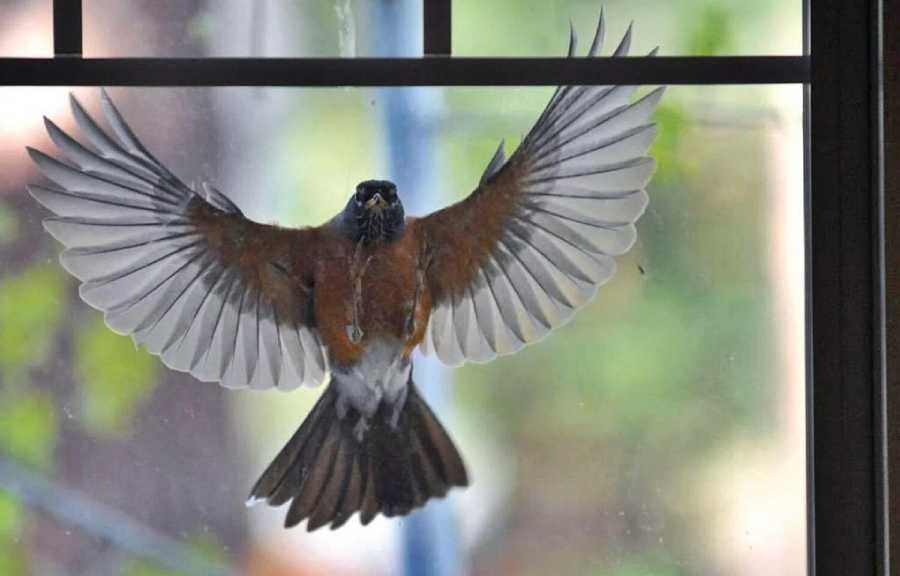
A bird hitting your window is often interpreted spiritually as a sign of change, transition, heightened awareness, or a message that calls for your attention. The event does not have one universal meaning. Its interpretation depends on what happens to the bird, whether the collision occurs once or repeatedly, the bird’s species or color, and the spiritual or religious tradition used to interpret it.
In spiritual symbolism, birds are frequently associated with freedom, transformation, messages, and the connection between physical and spiritual realms. A window represents a boundary between two spaces and can symbolize perception or the way you see a situation. When a bird suddenly strikes that boundary, the event may therefore be interpreted as an interruption that encourages you to notice a change, unresolved issue, or transition in your life.
A bird hitting a window is not scientific evidence of a supernatural message or a prediction of a future event. Birds also collide with windows for physical reasons, particularly reflections and transparent glass. This distinction matters when interpreting the experience. The sections below explain the major spiritual meanings, whether the event is considered a good or bad omen, and how its symbolism changes when the bird flies away, dies, returns repeatedly, or belongs to a particular species or color.
What Does a Bird Hitting Your Window Mean Spiritually?
A bird hitting your window spiritually represents four main themes: change or transition, a call for awareness, a meaningful message, and an ending that creates space for renewal. These interpretations come from the symbolic relationship between the bird, the window, and the sudden collision. However, spiritual traditions do not assign one universal meaning to the event, so its significance depends on the context and the beliefs of the person experiencing it.
Change or transition is one of the strongest interpretations because birds symbolize movement and the ability to travel from one place to another. A sudden collision interrupts that movement. Spiritually, this interruption can mirror a transition in which your current direction, routine, relationship, or perspective needs attention. For example, someone approaching a major career or relationship decision may interpret the event as a reminder to examine where that decision is leading rather than continuing automatically.
A bird hitting a window can also symbolize a call for awareness. A window allows you to see what lies beyond it while still creating a physical boundary between two spaces. In symbolic terms, it can represent perception, limitations, or something visible but not yet accessible. The impact of the bird draws attention to that boundary. This interpretation is especially relevant when you have been ignoring a decision, repeating an unproductive pattern, or avoiding an issue that requires action.
The event is also interpreted by some people as a spiritual message or reminder. Birds have long carried symbolic associations with freedom, the soul, and communication between different realms. Under this interpretation, the collision does not necessarily predict a specific future event. Instead, its unexpected nature prompts reflection on what was happening in your life when it occurred. The meaningful element is the attention the experience creates rather than proof that an external spiritual force deliberately caused the collision.
An ending followed by renewal is the fourth major interpretation. A collision represents an abrupt interruption, while the bird’s ability to recover and continue moving can represent adaptation after disruption. This symbolism becomes particularly relevant when one phase of life is ending and another is beginning. The event may therefore be interpreted as a reminder to release an outdated situation, belief, or attachment so that a new direction can emerge.
Is a Bird Hitting Your Window a Good or Bad Omen?
A bird hitting your window is not universally a good or bad omen. Its spiritual interpretation can be positive when associated with awakening, renewal, and new beginnings, or negative when associated with warning, disruption, and endings. The circumstances surrounding the collision matter more than treating every bird-window encounter as having the same meaning.
As a positive omen, the event can represent a transition that creates an opportunity for growth. An unexpected impact interrupts normal movement, which symbolically fits moments when an established pattern must change before progress becomes possible. A person beginning a new phase of life, for example, may view the encounter as encouragement to accept change rather than resist it. In this interpretation, the collision represents a turning point rather than impending misfortune.
As a negative omen, a bird hitting a window can represent a warning to pay closer attention to something being overlooked. The symbolism does not establish that a harmful event will occur. Instead, the sudden interruption can be interpreted as a prompt to reconsider a decision, unresolved conflict, or direction that no longer serves its purpose. The “warning” therefore functions as an invitation to awareness rather than a literal prediction of danger.
The outcome of the collision can also influence how people interpret the omen. A bird that recovers and flies away lends itself to themes of resilience, recovery, and moving forward, while a bird that dies is more commonly associated with endings, closure, and transformation. Neither outcome reliably predicts what will happen in a person’s life. Spiritual meaning remains symbolic, and the same encounter can carry different significance depending on personal beliefs, cultural traditions, and the circumstances in which it occurs.
What Does It Mean Spiritually If a Bird Hits Your Window and Flies Away?
A bird hitting your window and then flying away is commonly interpreted as a symbol of temporary disruption, resilience, transition, and the ability to move forward. The bird experiences an abrupt obstacle but continues its journey, making this outcome more closely associated with recovery than with finality.
Temporary disruption is the most direct interpretation. The window interrupts the bird’s movement without permanently stopping it. Symbolically, this can represent an unexpected problem that changes your immediate direction without determining your final outcome. A delayed plan, difficult conversation, rejected opportunity, or sudden change may interrupt progress while still leaving another path available.
The bird flying away also creates a strong symbolism of resilience. Its movement after the collision represents continuation after a setback. Spiritually, someone experiencing uncertainty may interpret the encounter as a reminder that disruption does not necessarily mean failure. The obstacle can require adjustment before movement resumes.
Transition provides another interpretation because the event contains three distinct stages: movement, interruption, and movement again. This pattern can mirror a period in which an established situation is disrupted before a new direction becomes clear. The emphasis is therefore on adapting and continuing rather than interpreting the collision as a prediction of misfortune.
The bird’s survival does not prove that a positive event is about to occur. A physical bird-window collision can happen because the bird sees reflected sky, vegetation, or another misleading visual cue in the glass. The spiritual meaning comes from how the event is interpreted symbolically, while the collision itself can still have a natural cause.
What Does It Mean Spiritually If a Bird Hits Your Window and Dies?
A bird hitting your window and dying is spiritually associated with endings, closure, transition, letting go, and transformation rather than reliable prediction of physical death. Because death creates a definitive ending to the bird’s movement, this version of the encounter carries different symbolism from a bird that recovers and flies away.
An ending is the most immediate symbolic interpretation. Death marks the completion of a life cycle, so the encounter may prompt reflection on something in your own life that has reached its end. This could involve a relationship, habit, role, belief, goal, or phase of life that no longer has the same place it once did. The symbolism concerns closure and transition rather than assuming that another death will follow.
Letting go is closely connected with this interpretation. Holding onto a situation after it has reached its natural conclusion can prevent movement into a new phase. A person who encounters a dead bird at a window may therefore give the experience personal meaning by considering what they need to release. For example, the symbolism may resonate with someone who has already recognized that a job, relationship, or long-held expectation needs to end.
Death can also symbolize transformation because an ending changes what becomes possible afterward. Many spiritual systems use cycles of death and renewal metaphorically to describe personal change. Under this interpretation, the dead bird represents the closing of one stage rather than a literal forecast of tragedy. The distinction is important because symbolic death and physical death are not equivalent claims.
A bird dying after hitting your window does not provide reliable evidence that you or someone close to you will die. Death-omen interpretations belong to superstition, folklore, or particular belief traditions rather than established predictions of future events. Finding a dead bird can be emotionally unsettling, but the event should not be treated as proof that another death is imminent.
What Does It Mean When a Bird Keeps Hitting Your Window?
A bird repeatedly hitting your window can spiritually symbolize a repeated reminder, an unresolved issue, or a call to pay closer attention to a recurring pattern in your life. Repetition can make an encounter feel more significant because the same event continues to demand attention, but it does not establish that a supernatural force is causing the behavior.
As a repeated reminder, the bird can symbolically draw attention to something that has not yet been addressed. The relevant issue may involve a decision being postponed, a recurring conflict, or a behavior that repeatedly produces the same result. In this interpretation, the value of the encounter lies in prompting a specific question: what keeps returning in your life because it has not been resolved?
The window adds another layer to this symbolism because it represents a boundary that appears passable but is physically closed. A bird repeatedly encountering the same invisible barrier can therefore serve as a metaphor for repeatedly approaching a problem in the same way. For example, someone experiencing the same difficulty across several relationships or jobs may interpret the repeated collision as encouragement to examine the pattern rather than focusing only on each individual outcome.
There is also a direct natural explanation for repeated window hitting. Birds can respond to their own reflections in glass as though another bird has entered their territory. A bird may consequently return to the same window and strike or peck it repeatedly. Reflections of vegetation and open sky can create additional collision risks. Repetition therefore makes the behavior more noticeable, but it does not automatically make a spiritual interpretation more certain.
The physical and spiritual explanations answer different questions. The physical explanation addresses why the bird behaves this way, while the spiritual interpretation addresses what personal meaning someone chooses to draw from witnessing the event. Keeping these two contexts separate allows the encounter to have personal symbolic value without presenting that symbolism as a proven cause of the bird’s behavior.
Does the Type of Bird Change the Spiritual Meaning of Hitting a Window?
The type of bird can change the spiritual interpretation of a window collision because different bird species carry different symbolic associations. A cardinal, robin, dove, sparrow, or blue jay does not have one universally accepted meaning, but the symbolism traditionally associated with each bird can shape how someone interprets the encounter.
A cardinal hitting your window is often interpreted through themes of vitality, remembrance, and personal connection. The cardinal’s striking red appearance makes it visually distinctive, while modern spiritual traditions frequently associate cardinals with remembering someone who has died. In that context, the collision may be interpreted as a reminder of a deceased loved one or an invitation to reflect on an important emotional connection. This is a symbolic interpretation rather than evidence that the bird carries a literal message from the dead.
A robin hitting your window is more closely associated with renewal, transition, and new beginnings. Robins are strongly connected with spring in places where their seasonal appearance coincides with the transition out of winter. Spiritually, a robin encounter can therefore represent the beginning of a new phase after a stagnant or difficult period. The collision adds the idea of an obstacle, suggesting that renewal may require confronting something that currently blocks progress.
A dove hitting your window can be interpreted through symbolism associated with peace, hope, and spiritual connection. Doves have religious and cultural associations that extend beyond modern spirituality, which makes the context of the interpretation especially important. Someone experiencing conflict, grief, or uncertainty may interpret the encounter as a personal reminder to seek peace or reconciliation rather than as a prediction of a specific future event.
A sparrow hitting your window can symbolize perseverance, community, and the significance of ordinary life. Sparrows are small, familiar birds that live successfully near human communities, which contributes to symbolic associations with persistence and adaptability. An encounter may therefore resonate with someone facing an obstacle that requires steady effort rather than a dramatic change of direction.
A blue jay hitting your window can be interpreted through themes of communication, confidence, and persistence. Blue jays are conspicuous birds with strong vocal behavior, so symbolic interpretations frequently emphasize expression and assertiveness. In a personal spiritual context, the encounter may serve as a reminder to communicate clearly, establish boundaries, or persist with an issue that requires attention.
Species should therefore be treated as an additional layer of meaning rather than a fixed spiritual code. The same bird can carry different associations across cultures, religions, and personal belief systems. The most coherent interpretation considers both the symbolism of the species and the circumstances surrounding the window collision.
Does the Color of a Bird Change Its Spiritual Meaning?
The color of a bird can influence its spiritual interpretation because colors carry symbolic associations with emotions, transitions, and spiritual concepts. Black, white, red, and blue birds are consequently interpreted differently in many symbolic systems, although color alone cannot establish a universal meaning for a bird hitting a window.
A black bird hitting your window can symbolize mystery, the unknown, transition, or an ending. Black is frequently connected with what is hidden or not yet understood, so the encounter may resonate during periods of uncertainty or significant change. It should not automatically be interpreted as a death omen. Equating every black bird encounter with death reduces several different symbolic traditions to a single fear-based interpretation.
A white bird hitting your window can be associated with peace, purity, hope, or spiritual transition. White commonly carries symbolism connected with clarity and peace, making the encounter potentially meaningful during periods of emotional conflict or change. If the event occurs during grief, a person may interpret it as a symbol of peace or remembrance, but that personal meaning does not establish communication with the deceased as a fact.
A red bird hitting your window can symbolize energy, vitality, passion, or the need for immediate attention. Red is visually intense and commonly associated with life, energy, and strong emotion. When the red bird is specifically a cardinal, species symbolism and color symbolism overlap, strengthening themes such as vitality and remembrance within traditions that associate cardinals with those ideas.
A blue bird hitting your window can be interpreted through themes of peace, communication, hope, or emotional clarity. Blue symbolism often emphasizes calmness and expression, while individual blue-colored species may carry additional associations of their own. The interpretation can therefore shift depending on whether the bird is a bluebird, blue jay, or another species.
Color provides context rather than a definitive answer. Species, the outcome of the collision, repetition, personal circumstances, and the belief system being used all provide additional information for interpreting the encounter. A black bird that flies away, for example, creates a different symbolic combination from a white bird that dies after the collision. Considering these attributes together produces a more coherent spiritual interpretation than assigning meaning from color alone.
What Does a Bird Hitting Your Window Mean in Christianity?
A bird hitting your window does not have a specific meaning established by the Bible. Scripture uses birds in several symbolic and illustrative contexts, but it does not teach that a bird striking a window predicts death, announces misfortune, or delivers a specific divine message. Claims that every window collision is a biblical omen therefore go beyond what the Bible directly states.
Birds nevertheless carry important symbolism within Christianity. Biblical passages use birds in contexts involving God’s care, provision, peace, and the work of the Holy Spirit. In Matthew 10:29–31, for example, Jesus refers to sparrows while teaching about God’s awareness and care. The dove has another prominent association: the Gospels describe the Spirit of God descending like a dove at the baptism of Jesus. These examples establish bird symbolism within biblical texts, but neither creates a biblical rule for interpreting a bird hitting a window.
A Christian may still give the encounter personal spiritual significance. An unexpected bird collision might prompt someone to pray, reflect on a difficult decision, consider a neglected responsibility, or remember the importance of faith during a period of change. In this case, the event functions as a catalyst for reflection rather than a coded message whose meaning can be determined from Scripture.
This distinction separates biblical teaching from later folklore and modern spiritual interpretation. A belief that a bird hitting a window foretells death, for example, should not be described as biblical simply because birds have symbolic roles in Christianity. The Bible does not provide that prediction. Someone approaching the event from a Christian perspective can therefore acknowledge its personal significance without assuming that the collision reveals a predetermined future event.
Can a Bird Hitting Your Window Be a Sign From a Deceased Loved One?
Some people interpret a bird hitting a window as a symbolic reminder of a deceased loved one, but the encounter does not provide verifiable evidence that the deceased person is communicating through the bird. The association belongs primarily to personal spirituality, grief symbolism, and modern beliefs about signs from loved ones rather than to a universally established spiritual rule.
Birds lend themselves to this interpretation because their symbolism frequently involves freedom, transition, and movement beyond ordinary physical boundaries. For a grieving person, these themes can resemble ideas about the soul continuing after death or moving from one state of existence to another. A sudden bird encounter can therefore become emotionally connected with someone who has died, particularly when it occurs during remembrance, an anniversary, or another personally significant moment.
Cardinals are a prominent example of this type of modern symbolism. Some people regard the appearance of a cardinal as a reminder that a deceased loved one remains emotionally or spiritually close. If a cardinal suddenly hits a window, the unexpected nature of the encounter may make that association feel especially meaningful. The experience can function as a source of remembrance or comfort without proving that the deceased person intentionally sent the bird.
Personal context is important when interpreting such an encounter. Someone who was already thinking about a deceased parent when a bird appeared may attach a different meaning to the event than someone who experienced the same collision during an unrelated daily activity. The first experience can hold genuine personal significance because it activates memories, emotions, and existing spiritual beliefs, even though those factors cannot establish supernatural causation.
A useful distinction is therefore between personal meaning and factual prediction. You can regard the encounter as a meaningful reminder of someone you loved without concluding that every bird hitting a window is a message from the dead. This approach preserves the symbolic and emotional value of the experience while avoiding a claim that the event can objectively confirm communication with a deceased person.
Why Do Birds Actually Hit Windows?
Birds hit windows primarily because they do not recognize glass as a solid barrier. Reflections, transparent glass, and territorial behavior can make a window appear to be open space or part of the surrounding environment. These physical explanations can exist alongside a personal spiritual interpretation of the event, but they explain the bird’s behavior rather than its symbolic meaning.
Reflections are a major cause of bird-window collisions. Glass can reflect trees, vegetation, clouds, and open sky, creating what appears to a flying bird to be a continuation of its environment. The bird responds to the reflected scene rather than recognizing the window as an obstacle. This explains why a collision can occur suddenly even when the bird appears to be flying normally immediately beforehand.
Transparent glass creates a similar problem. A bird may see vegetation, daylight, or open space through two facing windows and attempt to fly directly toward what appears to be a clear route. The glass remains difficult for the bird to perceive because visual cues that humans recognize as a window are not necessarily meaningful to a bird moving at flight speed.
Territorial behavior can explain why the same bird repeatedly approaches or strikes one particular window. A bird may see its reflection and perceive it as another bird occupying its territory. Instead of attempting to fly through the glass, it may approach, peck, or strike the reflected “competitor.” This behavior helps explain repeated encounters that might otherwise appear unusually deliberate.
The natural explanation does not determine what the experience must mean to you personally. Physical cause and spiritual meaning answer two different questions. Window reflection can explain why the collision occurred, while spiritual symbolism concerns the meaning a person draws from witnessing it. Keeping those questions separate prevents a symbolic interpretation from being presented as the physical cause of the bird’s behavior.
What Should You Do After a Bird Hits Your Window?
After a bird hits your window, first assess the bird from a safe distance, protect it from immediate threats, and seek professional wildlife assistance if it appears injured or does not recover. The bird’s welfare should take priority over interpreting the spiritual meaning of the encounter.
Check whether the bird is conscious and able to move without immediately handling it. A collision can leave a bird stunned or cause injuries that are not obvious from its external appearance. Keep children and pets away from the area so the bird is not exposed to additional stress or injury while you determine its condition.
Contact a licensed wildlife rehabilitator or appropriate local wildlife service when the bird is visibly injured, cannot fly, remains unresponsive, or shows other signs of serious distress. Professional guidance is preferable to attempting to treat an injured wild bird yourself. Local regulations concerning the handling of wild birds can also differ, making qualified wildlife assistance the safest source of instructions for a specific situation.
Preventing another collision is important when birds repeatedly strike the same window. Making the glass more visible to birds can reduce the illusion of open space or reflected habitat. Effective approaches focus on altering the exterior appearance of the glass so birds can recognize that a physical barrier is present rather than continuing to respond to reflected sky or vegetation.
If the encounter feels spiritually significant, reflection can come after the bird’s immediate needs have been addressed. Consider what the event brought to your attention, such as a transition, unresolved concern, relationship, decision, or memory. A bird hitting your window can hold personal symbolic meaning without requiring you to treat it as a prediction of what will happen next. This distinction allows spiritual reflection to remain meaningful while recognizing the natural reasons birds collide with windows.